We may earn a commission from links on this page.
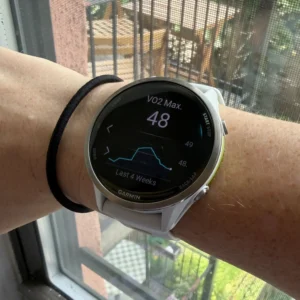
I always feel tougher after running in the summer heat—until I look at my Garmin Forerunner and see it thinks my fitness has suddenly gotten worse. If you, too, watch your Garmin VO2max number slide down as the temperatures climb, you’re not imagining it, and you’re definitely not alone. Every summer, comment sections and Reddit threads fill up with people convinced their fitness is falling apart, or their expensive watch is broken, or generally panicking about a stat that’s supposed to reflect their aerobic capacity. But there’s no need to panic. Your fitness almost certainly isn’t going anywhere. What’s actually happening is that your body is adapting to heat, and Garmin’s algorithm is struggling to separate “hot weather effort” from “declining fitness.”
Why it looks like your VO2max drops during the summer
VO2max estimates are built from your pace, heart rate, and effort during a run. In hot weather, your heart rate rises faster and stays higher for the same pace, because your body is diverting blood flow to your skin to help you cool down, and you’re likely sweating more and dealing with some degree of dehydration. To Garmin’s algorithm, a higher heart rate at a given pace looks like reduced efficiency, which it interprets as lower fitness. In reality, you’re doing the same physical work; your cardiovascular system is just working harder to keep you cool at the same time.
This is why every year, so many runners see their VO2max estimate creep down every summer, only to bounce back once the weather cools off in the fall.
Some Garmin watches account for the heat
Newer Garmin models, including the Forerunner 970, do attempt to factor heat (and humidity) into the VO2max calculation, adjusting the estimate to account for the extra cardiovascular strain. Of the Forerunners, the 745, 945, 955, and 965 all have heat acclimation, along with the 245 and 255 with software updates. And if Garmin’s numbering system confuses you, my colleague Beth Skwarecki has got you covered.
If you have one of these newer devices, you may notice the swings are less dramatic than what older models produce. Older Garmins generally don’t make this adjustment, which is a big part of why the phenomenon is so widely discussed among long-time Garmin users.

How to fix your VO2max trend
If you understand what’s happening and you’re fine ignoring the number for a few months, that’s my recommendation. Your training is still working, whatever Garmin’s algorithm seems to suggest. But if you’d rather stop the swings altogether, you do have a few practical options.
The most direct fix is to change your activity profile settings so that specific activities don’t contribute to VO2 max at all. In the Garmin Connect app, you can go into an activity profile and turn off VO2max calculation for it entirely. A popular approach here is to let your road running profile keep contributing to VO2max, since road paces tend to be more consistent and comparable, while turning it off for trail running, where elevation, terrain, and effort variability already make VO2 max less reliable.
You can even take this a step further by creating a dedicated “hot run” activity profile. Simply copy your existing Run profile, rename it something like “Hot Run,” and disable VO2max calculation on that copy. Then, on brutally hot or humid days, switch to that profile before you head out. Your run still gets logged normally with pace, heart rate, and all your usual data, but now it won’t skew your overall VO2max trend.
Finally, if you really want to keep your VO2 max estimate clean and consistent year-round, you might have to stick to a treadmill in an air-conditioned gym. Controlled temperature and humidity mean your heart rate response will better reflect your actual fitness rather than heat strain, giving you a more stable number to track over time. However, in pursuit of a perfect number, you’ll be sacrificing all the mental and physical gains that come from training in the heat. Don’t let your VO2max cause you to lose the plot here.
The bottom line
A dropping VO2 max number in the summer is one of the most common false alarms in the running world. It’s always troubling to see a fitness score drop, especially for Garmin fanatics like myself. But during the summer, your body is spending energy adapting to the heat, which is its own form of fitness. Whether you decide to ignore the dip, tweak your activity settings, or move your key efforts indoors, the most important thing is not to let a single algorithm-generated number convince you that months of hard training have suddenly vanished.