The redesign tested well. Users hate it anyway. Welcome to the paradox that costs companies millions and leaves everyone baffled.
When Sonos released its redesigned app in May 2024, the backlash was immediate and brutal. Users couldn’t access basic features like volume control and alarms. Systems became unusable. The company’s stock plummeted 25%. Eventually, the CEO was replaced, and lawsuits claimed over $5 million in damages from customers who’d lost functionality they’d paid for.
But here’s the part that makes this story particularly fascinating: Sonos hadn’t just thrown darts at a wall and hoped for the best. The redesign came after extensive testing and development. They genuinely believed it was an improvement. And they’re far from alone in discovering that what looks good on paper can feel terrible in practice.
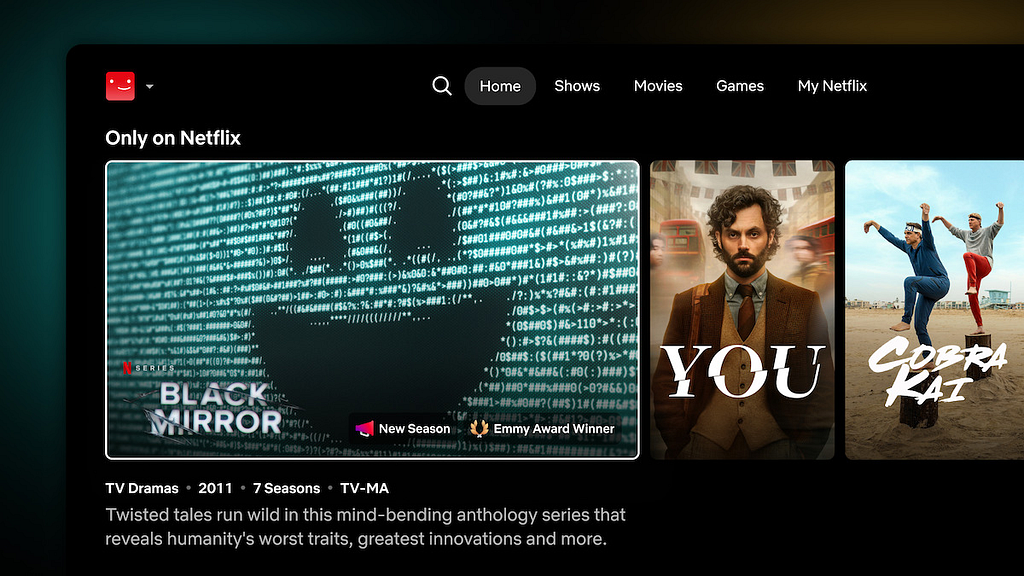
Even something as small as Google Photos changing its crop tool from square corners to rounded ones in July 2025 triggered enough complaints that Google eventually reversed the change. Netflix faced similar fury when it rolled out its TV app redesign later that year. They claimed months of testing showed improved user satisfaction. Yet Reddit threads exploded with users reporting the new layout as a bug, convinced something had gone catastrophically wrong. Then in October, Instagram reorganised its bottom navigation bar, and users immediately started accidentally swiping between sections when they meant to browse photos.
The pattern repeats itself with almost mathematical precision: the company announces a redesign, users revolt, comment sections fill with rage, and everyone involved feels misunderstood. So what’s actually happening here?
Your brain on autopilot
Every time you open an app you use regularly, your brain isn’t really thinking about what you’re doing. You’ve developed what cognitive psychologists call automaticity: the ability to perform tasks without conscious attention. Your thumb knows exactly where that button sits. Your eyes scan the screen following a pattern you’ve rehearsed thousands of times. You’re operating almost entirely on muscle memory.
This isn’t laziness. It’s efficiency. Our brains are designed to convert frequently repeated actions into automatic processes, freeing up mental resources for more demanding tasks. When you can navigate your favourite app without thinking, that’s your brain working exactly as intended.
Then comes the redesign.
Suddenly, that button you could tap with your eyes closed has moved. The menu you accessed with a quick gesture now requires three taps through nested options. Everything that was once automatic now demands active focus. You’re forced back into deliberate, effortful thinking… and it feels exhausting.
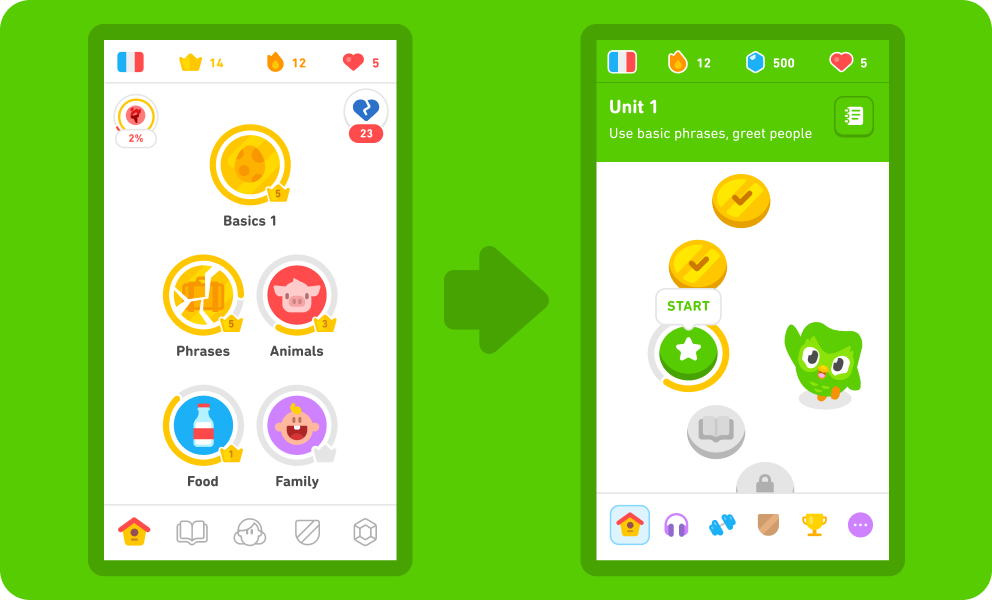
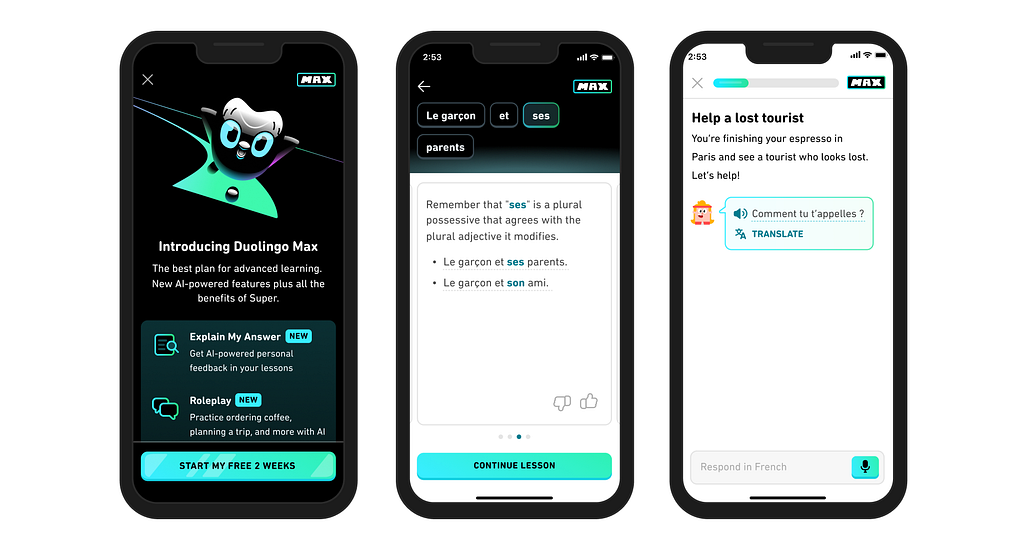
When Duolingo redesigned its app in 2022, switching from a branching tree structure to a single linear path, longtime users were livid. The company’s CEO, Luis von Ahn, acknowledged the backlash but stood firm: “People are change averse,” he said, refusing to offer users a way to revert. What he framed as resistance to change was actually something more specific. Users had built sophisticated mental models of how to navigate the app, and those models had just become obsolete overnight.
The cognitive load of relearning isn’t trivial. Research into cognitive fluency shows that when information feels difficult to process, we experience it as unpleasant, regardless of whether the end result is objectively better. Your brain genuinely registers the increased effort, and it doesn’t particularly care that the new design tested well with fresh users who never had to unlearn anything.
Loss aversion and the endowment effect
Even if a redesign objectively offers improvements, we fixate on what’s been taken away. This isn’t just psychological stubbornness. It’s a well-documented cognitive bias called loss aversion. We feel losses roughly twice as intensely as equivalent gains.
The Sonos disaster illustrates this perfectly. Yes, the new app had a sleeker interface. But users couldn’t adjust their volume or set alarms — functions they’d relied on daily. No amount of visual polish could compensate for losing tools that had become part of their routines. One user’s complaint, shared thousands of times across social media, captured the sentiment: “I’ve spent over £10,000 on a complete home Sonos system. Even if you fix this app, the damage is done.”
There’s another psychological force at play here: the endowment effect. We overvalue things we already possess. That old interface isn’t just a collection of buttons and menus–it’s ours. We’ve invested time learning it, built workflows around it, developed preferences and shortcuts. The new design might be objectively superior in controlled testing, but it requires us to surrender something we’ve claimed as our own.

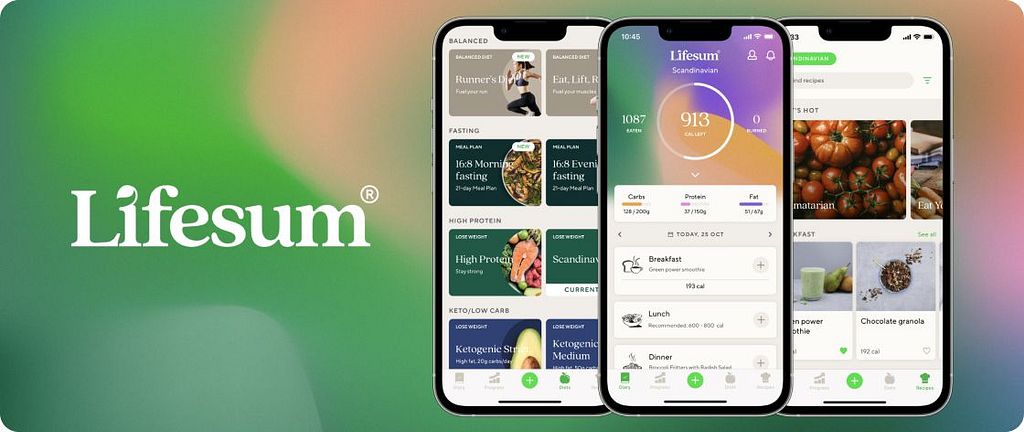
When Lifesum forced users into their December 2024 update, removing their colourful, cartoonish icons in favour of minimal black and white lineart, the complaints weren’t just about aesthetics. Users described spending hours trying to figure out how to get their old views back. The app hadn’t just changed. It had taken something from them without permission.
The familiarity principle
Here’s where things get interesting: the design you hate today might be the design you prefer in three months.
The mere exposure effect is one of psychology’s most robust findings. We develop preferences simply through repeated exposure. The old design wasn’t necessarily better, it was just familiar. And familiarity feels good. It feels safe. It feels right.
This creates a paradox for designers. The Netflix redesign that users called “horrible” and “confusing” when it launched? Netflix’s own data suggested that user satisfaction actually improved over time as people adjusted. Von Ahn made the same claim about Duolingo’s controversial path update, pointing to positive engagement metrics even as the Reddit community devoted to the app erupted in fury.
The question becomes: how long do users need before familiarity catches up? And how much short-term pain is acceptable for long-term gain?
Instagram’s October 2025 navigation changes demonstrate the friction period. The same swipe gesture now switches between sections and browses multi-photo posts, a decision that likely made sense in design reviews but feels confusing in practice. Will users eventually develop new muscle memory? Almost certainly. But in the meantime, each accidental section switch reinforces the feeling that something is broken.
When good design feels wrong
This is perhaps the most frustrating part for designers: even genuine improvements can feel worse during the transition.
Change blindness (our difficulty noticing even significant alterations when we’re not specifically looking for them) means users often can’t articulate what’s different. They just know something feels off. The cognitive load of adjusting creates a general sense of friction that colours the entire experience negatively.
Google Photos’ removal of the perspective correction tool in July 2025 showcases another dimension. Google buried manual editing tools deeper to highlight their new AI features, transforming what used to be a two-tap process into a three-tap journey through nested menus. From Google’s perspective, this made sense: guide users toward powerful AI assistance. From the users’ perspective: “where did my tools go?”
The backlash was significant enough that Google eventually reversed course, restoring both the perspective tool and those familiar square-cornered crop brackets that they’d changed to rounded ones. Sometimes the smallest visual details matter most, especially when they affect the tools people use daily.
The AI complication
Duolingo’s story adds another layer that’s increasingly relevant: what happens when redesigns coincide with fundamental shifts in how work gets done?
The 2022 interface redesign was contentious enough. But then in late 2023, Duolingo laid off 10% of its contractors: translators whose work was being handed to AI. Another round of cuts followed in October 2024, this time affecting writers. Then in April 2025, von Ahn sent an internal memo (which he also shared publicly on LinkedIn) declaring Duolingo would become “AI-first.” The company would “gradually stop using contractors to do work that AI can handle.”
For users, this created a toxic combination. The redesign had already disrupted their experience and removed choice. Now they were watching human expertise being replaced by AI-generated content, with remaining contractors reduced to reviewing machine output for basic acceptability. The redesign wasn’t just annoying. It felt like evidence of a company prioritising cost-cutting over quality.
This matters because trust is fragile. When users are already frustrated with interface changes that make their experience worse, discovering that those changes might be driven by a desire to reduce reliance on human workers compounds the sense of betrayal. You’re not just fighting with unfamiliar buttons. You’re questioning whether the company still cares about delivering the experience that made you loyal in the first place.
What designers can (and can’t) control
So what’s a designer to do? The paradox is real: you can’t improve products without changing them, but users will resist change even when it’s beneficial.
First, accept that the initial backlash isn’t necessarily a sign you’ve failed. Almost every major redesign faces resistance, even ones that ultimately succeed. The Snapchat redesign of 2018 was so unpopular that over a million users signed a petition demanding they undo it. Kylie Jenner’s tweet criticising it temporarily tanked the company’s stock. Yet Snapchat didn’t revert, and the platform survived.
There is a transitioning problem at play, too. During that adjustment period, even improvements create cognitive load. This doesn’t mean your metrics are lying or your users don’t know what they want. It means change has an inherent cost that takes time to recoup.
Second, how you roll out changes matters enormously. Sonos’ biggest mistake wasn’t just removing features; it was forcing every user into the new app without offering a beta period or a graceful transition. Users reported that the app was “obviously unfinished” and full of critical bugs. When people asked why it was released in that state during a community forum, there was no good answer.
Gradual rollouts give you time to catch issues before they become disasters. Duolingo rolled their path update to new users first, getting early feedback before exposing longtime users. Netflix tested their redesign extensively. But even sophisticated rollout strategies can’t eliminate the fundamental challenge: people who’ve built workflows around your old interface need time and support to adjust.
Third, communication can help, but only if it’s honest. Telling users “we tested this, and it’s better” when they’re actively experiencing it as worse creates a disconnect. Acknowledging that change is difficult, explaining what you’re trying to achieve, and being responsive to legitimate concerns about lost functionality builds more goodwill than insisting everything is fine when it clearly isn’t.
Google’s decision to eventually restore the perspective correction tool after months of complaints shows that sometimes listening to users means admitting you got it wrong. Duolingo’s refusal to maintain two versions because “it’s difficult” prioritises engineering convenience over user experience.
Finally, consider whether you’re inadvertently training users to distrust you. When redesigns coincide with AI integration, workforce reductions, or other changes that suggest cost-cutting over quality, users notice. They’re not just reacting to the interface. They’re reacting to what the interface represents.
Making sense of the mess
Your brain’s resistance to redesigns isn’t a bug; it’s a feature. The automatic processes that make change feel painful are the same ones that make daily tasks effortless. We evolved to build efficient mental models and resist disruptions to them, because in most contexts, that stability serves us well.
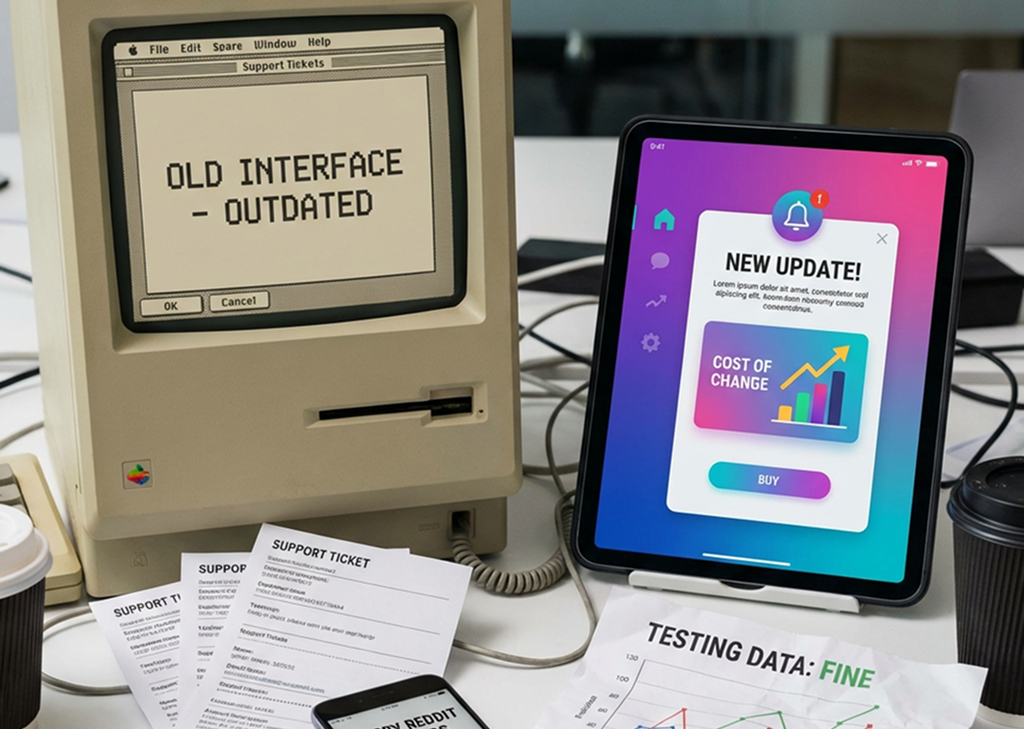
For designers, this creates a genuine dilemma. Products need to evolve. Interfaces that never change become outdated and lose competitive ground. But every change carries a cost that shows up in user frustration, support tickets, and angry Reddit threads, no matter how good your testing data looks.
The gap between objective improvement and subjective experience cannot be ignored. Metrics can show increased engagement while users are simultaneously threatening to cancel their subscriptions. Both things can be true at once.
Perhaps the real insight is that redesigns aren’t just about interface improvements. They’re about relationship management. Users who feel heard, who understand why changes are happening, and who trust that the company has their interests at heart are far more likely to weather the transition period. Users who feel forced into changes they didn’t ask for, who lose functionality they depended on, and who suspect the redesign is really about cutting costs will revolt — no matter how good your testing data looks.
Not all that changes, improves. But that which does improve often needs to change. The trick is knowing the difference and having the humility to admit when you’ve got it wrong. Sometimes, the most important feature you can build is an undo button.
Thanks for reading! 📖
If you liked this post, follow me on Medium for more!
References & Credits:
- Sonos App Redesign Backlash: CMSWire coverage of customer outrage and falling stock prices
- Sonos App Arbitration: ClassAction.org lawsuit details
- Netflix 2025 TV App UI Redesign: WebProNews analysis of user backlash
- Instagram Update: Profile News coverage of interface redesign
- Google Photos Tool Restoration: Android Gadget Hacks on perspective tool reversal
- Duolingo Redesign: NBC News interview with CEO Luis von Ahn
- Lifesum User Reviews: Trustpilot customer feedback
- Loss Aversion: Behavioral Economics explanation
- Endowment Effect: The Decision Lab overview
- Mere Exposure Effect: Verywell Mind definition
- Duolingo Layoffs: TechCrunch coverage of contractor cuts
- Duolingo AI-First Strategy: Tech Republic on replacing contractors
Why your brain rebels against redesigns — even good ones was originally published in UX Collective on Medium, where people are continuing the conversation by highlighting and responding to this story.