AI and SEO are converging. The combined pressure is reshaping how content gets made and read in ways that push the human reader further down the list of priorities.
On a Tuesday morning in May 2024, Google quietly began rolling out AI Overviews to US users. The change looked small at face value: a paragraph of generated text now sat above the familiar list of blue links.
The first viral reactions made the launch look like an embarrassment. Asked how to keep cheese from sliding off pizza, the Overview suggested adding “about one-eighth cup of non-toxic glue” to the sauce, a recommendation lifted from an 11-year-old Reddit joke. Another asked how many rocks to eat each day. Screenshots flew around social media, and the internet had a field day. Google quickly issued statements about edge cases and refined the system.

By 2025, the glue had gone from the answers, but the traffic had vanished from the sites. Penske Media, the parent of Rolling Stone, Billboard, and Variety, became the first major publisher to sue Google over its new feature. Danielle Coffey, whose News/Media Alliance represents more than 2,200 US publishers, called the system “parasitic” and “a real existential threat to many in our industry.”
That is what the disruption looks like for major media. Outside the headlines, the same forces are changing the day-to-day for everyone else publishing online. You write a punchy article. It is well researched, engaging, clearly laid out, and it ranks first on Google. And then, for a growing share of the people who searched for it, nothing happens. No click. No visit. The page sits there, first in line, going nowhere.
The working reality for writers, designers, and marketers falls between those two extremes. There is more to it than the numbers on their own suggest. Not just for traffic, but for how we think about building things on the web at all.
The disappearing click
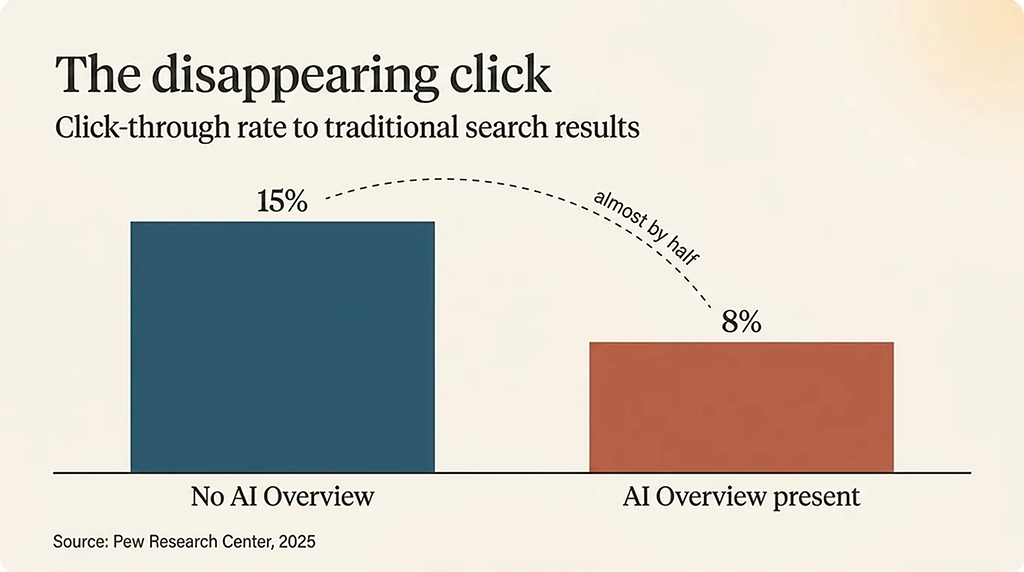
The effect of the rollout on clicks was immediate and, depending on your industry, severe. The clearest read on what was happening came from Pew Research, which tracked the browsing of about a thousand US adults across nearly 69,000 Google searches a year later.
When an AI Overview appeared, the click-through rate to traditional results fell almost by half, from 15% down to 8%. Links cited inside the Overview itself were followed less than one in a hundred times.
This was not a new direction, only an escalating one. So-called zero-click searches, where someone types a query and never visits a website at all, had been climbing for years. SparkToro had already put them at 58.5% of US Google searches in their 2024 analysis.
The follow-up from Similarweb, focused on news-related queries, found the rate had jumped from 56% to 69% in a year. Nearly seven in ten searches in that category were resolved before the user ever reached a publisher.
The case that drew the most attention was HubSpot. A company widely regarded as having one of the best SEO operations in the industry watched its monthly organic traffic fall from approximately 13.5 million visits to under 7 million in a matter of weeks. CEO Yamini Rangan addressed the shift publicly over the months that followed, attributing it to AI Overviews answering questions before users clicked through. If it could happen to HubSpot, the reasoning went, it could happen to anyone.
The trend has steepened since. When Ahrefs re-ran their numbers in February 2026, they found that an AI Overview now correlates with a 58% lower click-through rate for the top-ranking page, nearly double the impact of a year earlier.
Other estimates put the drop at between 49% and 65% depending on the sector. The variance matters less than the trajectory: consistently down, and getting worse.
“Google, as they have announced their AI Overview, has reduced search traffic by 20 to 70 per cent.”
– Yamini Rangan, CEO of HubSpot
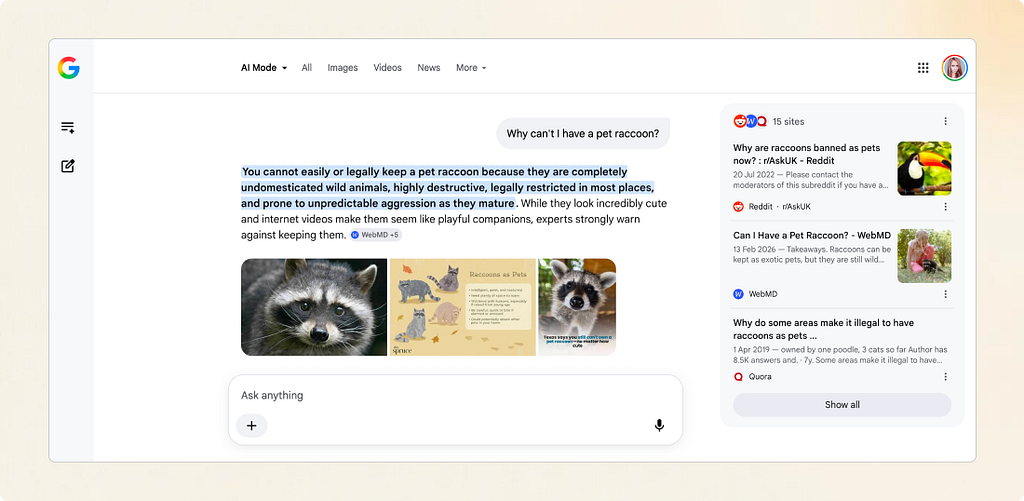
Then came I/O 2026. On 19 May, at the company’s annual developer conference, Sundar Pichai announced the biggest upgrade to the Google Search box in more than twenty-five years. The redesigned interface is built around the technology itself, with AI Overviews and AI Mode folded into a single seamless experience. A new Gemini 3.5 Flash model powers the whole thing, and the numbers attached to the rollout speak for themselves.
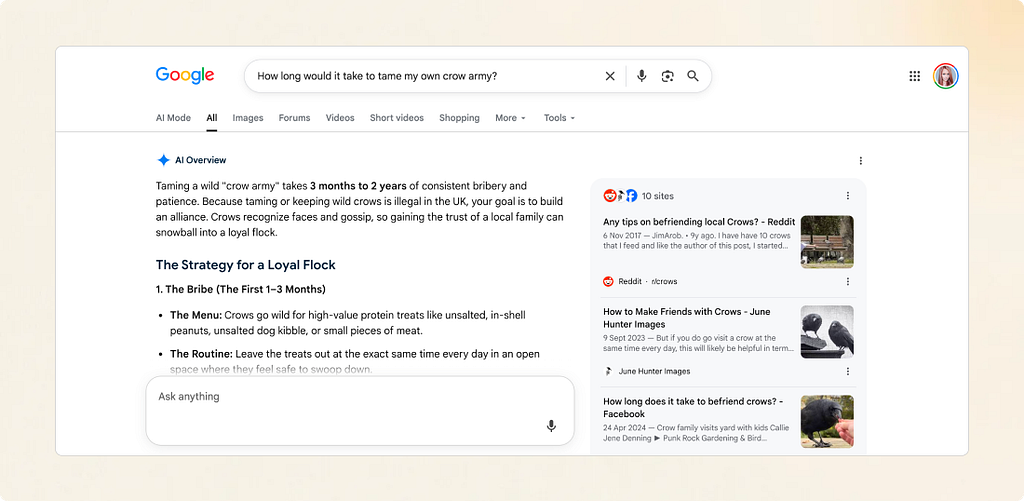
AI Overviews now reach more than 2.5 billion monthly users. AI Mode, which only launched twelve months before, has passed one billion. Google’s own framing has caught up with the product: “Google Search is AI Search,” the company stated in its keynote materials. Traditional blue links have not vanished, but they are no longer the centre of gravity. The chat interface is.
Inside AI Mode, the outcomes are more extreme. A Seer Interactive review of 25.1 million impressions found that 93% of AI Mode queries end without a single outbound click. Users read the answer and leave. The destination is not just disappearing; for most queries handled in this mode, it is already gone.
When the crawler becomes the reader
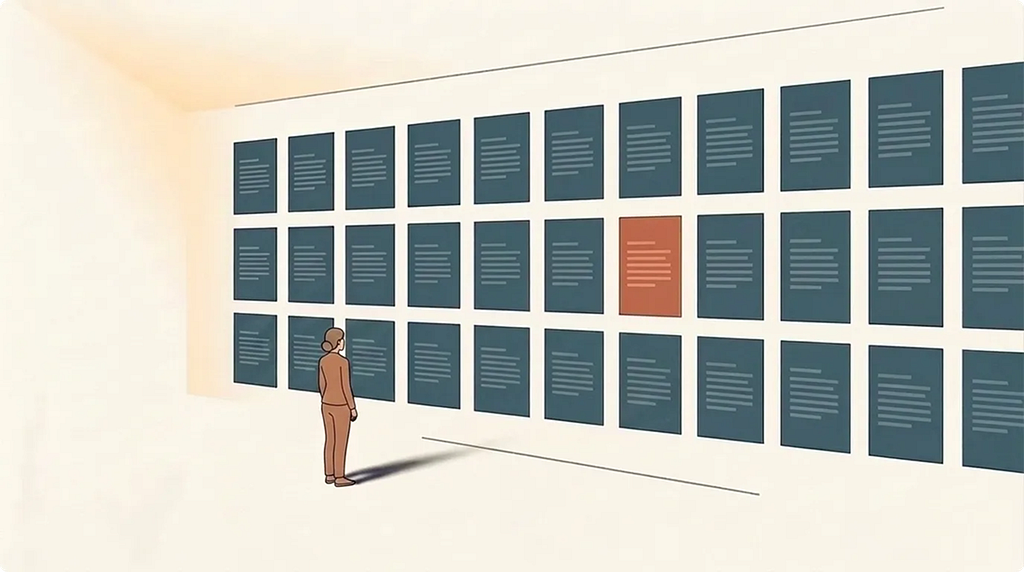
For creatives in the field, the implications go well beyond the search bar. Once the reader’s arrival is no longer guaranteed, the logic of what a page is for starts to invert. After all, the first meaningful engagement with your content is no longer a human landing on it. A machine now decides whether to summarise it, cite it, or skip it entirely.
The industry has even minted a new vocabulary to keep up. Answer Engine Optimisation, or AEO, is the practice of shaping content so that AI systems can lift it cleanly and serve it as the direct answer to someone’s question.
Generative Engine Optimisation, GEO, makes the same case for large language models specifically, the ChatGPTs, Claudes, and Perplexitys of the world. The two overlap so heavily that most practitioners use them interchangeably. The premise underneath both is the same. Ranking is no longer the prize. Citation is.
None of this means SEO has gone away. It still does the foundational job of helping any of these systems find your content in the first place. But it is just one layer among several now, and the balance between them no longer works the way it used to. Designing for two audiences at once, the human reader and the crawler, used to mean roughly the same thing for both. Clear structure. Relevant content. Accurate information. Serving one tended to serve the other.
Schema markup, the code that labels content so machines understand what it means rather than just what it says, used to be a technical footnote. Increasingly, it is becoming core infrastructure. Google and Microsoft both confirmed in early 2025 that they use this kind of labelling to power their generative AI features. Google called it critical to modern search because it is efficient, precise, and easy for machines to process. ChatGPT said around the same time that it relies on similar signals to choose which products appear in its responses.
The shorthand widely used across the SEO industry is that well-structured content is “cheap to interpret for machines.” Useful and broadly accurate. The catch is that catering to machines can gradually displace the human reader in the order of priorities, without anyone making a conscious decision that it should.
Google’s Core Web Vitals, which score sites on load speed, interactivity, and visual stability, work the same way. A page that scores well tends to win Google’s favour and benefit human visitors. Sometimes, though, the reason teams chase those scores is the ranking payoff, not the user’s experience. Those are very different starting points.
Every nudge toward machine readability, every Core Web Vitals score chased, every blog post handed to a tool, is a choice. Reasonable in isolation, but together they pull one way. Call it what it is: the crawler-first web.
Flattened into one voice
A third pressure runs alongside the structural and technical ones, working at the level of the writing itself.
The SEO industry has long understood that chasing the same keywords, targeting identical search intent, and following shared best-practice frameworks tends to produce interchangeable copy. The convergence is not new. Its speed is. AI writing tools, trained on overlapping datasets and steered toward common performance metrics, have accelerated the process dramatically.
Analysts at Seer Interactive have a name for the result: the “sea of sameness.” It describes a state where the top results for any given query are nearly identical, covering the same ground in the same order with the same heading patterns, because they were all shaped by the same logic. High-ranking, rarely distinctive, and best classed as performative.
Here is the irony. Sameness is precisely the wrong outcome for visibility. AI Overviews draw from multiple sources to build a synthesised answer, and the ones it favours tend to be those demonstrating genuine authority, firsthand experience, and specific expertise. Google groups these signals under E-E-A-T (Experience, Expertise, Authoritativeness, Trust). A confident paraphrase of what already exists on a topic is not well positioned for citation. Just well positioned to be ignored.
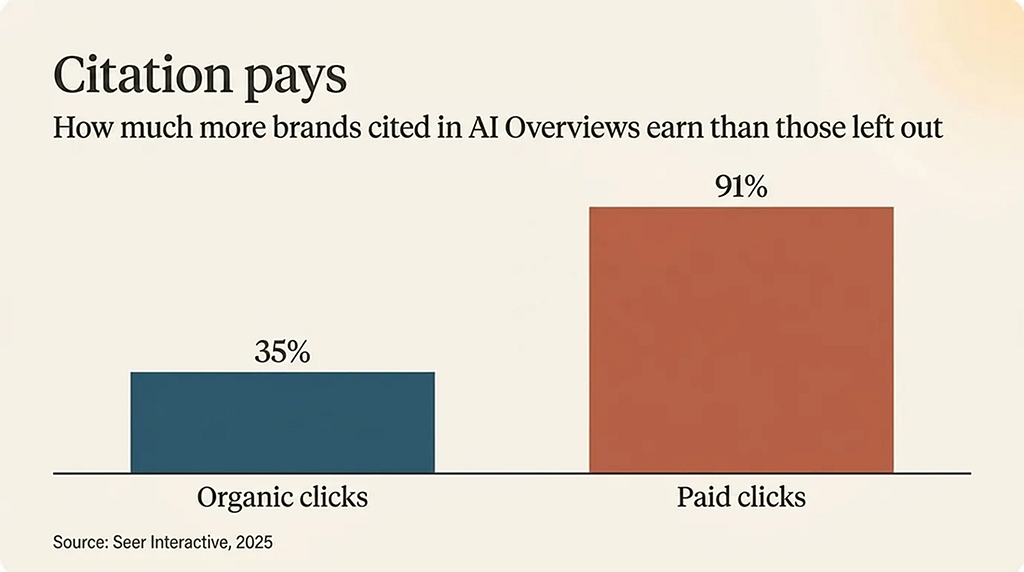
That distinction comes with a price tag. Brands cited in AI Overviews earn 35% more organic clicks and 91% more paid clicks than those left out. When traffic concentrates that sharply around a small number of sources, the sameness problem stops being merely aesthetic. There is a direct cost.
The suspicion gap
These are the mechanical pressures. A subtler one lies beneath them, difficult to measure but impossible to ignore.
People have grown sceptical of content they think AI has touched, even when they cannot prove it. That space between doubt and detection is the more interesting finding, which Baringa’s 2025 consumer study captures well. Some 43% of respondents felt confident they could spot AI-generated images, yet they only got it right about a third of the time. Hunch and proof are not always in sync.
What is growing instead is a kind of background wariness: a sense that something on a page may not have been written by a person, even if the reader cannot say exactly why. Researchers at Princeton’s Center for Digital Humanities ran a neat experiment. They asked 556 people to react to literary passages, some presented as written by humans, some marked as AI. The text was identical in both cases, yet around three in five readers preferred the human-flagged version. Same writing, different label. The penalty arrives not when readers detect the AI, but when they merely suspect it.
Not every kind of work shows its seams. Changes to a codebase, a design system, or a UI component are largely invisible to everyday users. A site rebuilt on an AI-generated component library looks, to most people, like any other site. A break in writing voice, by contrast, is immediately legible to anyone who reads. You do not need to know anything about typography or front-end architecture to notice that a company’s blog posts feel strangely flat, or that a newsletter you have read for years now sounds like it was produced by someone else entirely.
Writing is the most exposed layer in the stack. The one creative discipline readers evaluate constantly, often without realising they are doing so. This may explain why it has also been the first to feel the professional weight of the change.
Repriced, not replaced
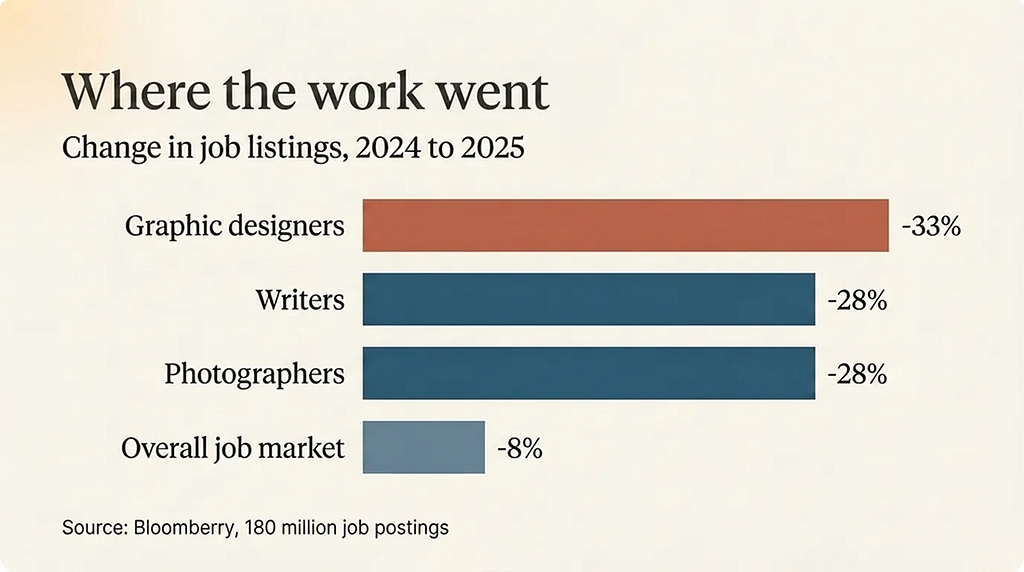
The strain is showing up most visibly in the job market. Henley Wing Chiu’s analysis at Bloomberry, drawing on 180 million global job postings, found writer roles falling 28% between 2024 and 2025. Listings for photographers fell by an equal margin. Only graphic designers declined faster, at 33%. The overall job market dropped 8% across the same window, so the figures for creative work were running three to four times the baseline. Basic SEO articles, product descriptions, and general blog posts have been handed wholesale to AI tools by the majority of businesses that once commissioned them from human writers.
What is taking its place is narrower and considerably more demanding. Clients are paying more for copy that earns its keep, lands citations, holds a reader’s attention, builds authority, and sounds like someone with something to say.
They are also asking for it more explicitly, and Upwork’s own data backs this up. Freelancers in specialised AI roles command up to 22% more per hour than those on comparable non-AI briefs. Demand has scaled with it too: across 2025, AI-related freelance work on the platform more than doubled, measured by what clients actually paid.
The real dividing line, though, is not between writers who use AI and writers who don’t. It cuts through the work itself, separating what anyone could write from what only someone with specific knowledge, experience, and perspective could. One side of that market has largely collapsed, while the other is being repriced upward.
Beyond its effect on the writing profession, it points to something useful about where human attention is concentrating. The readers who still make it to a page are, by definition, the ones who clicked through despite being offered a machine-generated summary. They are not looking for what the AI already gave them. They are looking for a point of view, a distinctive voice, or expertise that an algorithm could not supply.
Not the whole story
Everything above runs in one direction. The temptation is to take it as a tale of decline, but the data is messier than that.
Semrush, which has tracked AI Overview behaviour throughout the year, found that zero-click rates have actually been falling since January 2025 on the queries that trigger them. In some cases, users who saw one clicked through slightly more often than those who did not. One explanation could be that the summaries sharpen intent rather than satisfy it in certain cases. A partial answer can send the reader looking for more.
The quality of that traffic is the bigger surprise. Visitors from LLM platforms such as ChatGPT, Claude, and Perplexity convert at substantially higher rates than those from organic search. Seer Interactive’s mid-2025 data put ChatGPT-referred conversion at roughly 16%, against the 1.76% for the latter, though the sample sizes remain small enough to treat with caution. AI-referred sessions nonetheless grew sixfold over the year, indicating redistribution rather than destruction. Traffic is concentrating around sources that have built credibility, not merely chased volume.
The reader, eventually
This is not an argument that SEO is broken, that schema markup is a distraction, or that designing for machine readability betrays users. Those would all be overcorrections.
The claim is more modest than that. When commercial pressure points this strongly one way, it pays to pause and ask what slips out of view in the process. In a web built more and more for machine consumption, the thing most at risk of being overlooked is the quality of the experience for the actual human who eventually shows up.
Anyone who clicks through today is high-intent by definition, and they notice quickly when a page was built for a crawler rather than for them. Trust, one of the primary signals deciding which sources get cited by generative AI, cannot be manufactured through technical markup alone. It accrues through prose that is genuinely useful, accurate, and worth someone’s time.
AI has restructured how content gets distributed. The fundamentals of what makes a piece of content matter have not shifted. Clarity, accuracy, relevance, and a recognisable human voice remain the standard. They hold true for the readers who arrive, and for the systems deciding what those readers see.
The crawler was always in the room. It is just getting harder to pretend the reader is not.
If you enjoyed this, follow me on Medium for more on design, psychology and technology.
References & Credits
- AdExchanger (2026, January). The AI Search Reckoning Is Dismantling Open Web Traffic. https://www.adexchanger.com/publishers/the-ai-search-reckoning-is-dismantling-open-web-traffic-and-publishers-may-never-recover/
- Ahrefs (2026, February). AI Overviews Reduce Clicks by 58%. https://ahrefs.com/blog/ai-overviews-reduce-clicks-update/
- Baringa (2025). Trust: transparency earns trust, and right now there isn’t enough of either. https://www.baringa.com/en/insights/balancing-human-tech-ai/trust/
- Bloomberry (2025). I analyzed 180M jobs to see what jobs AI is actually replacing today. https://bloomberry.com/blog/i-analyzed-180m-jobs-to-see-what-jobs-ai-is-actually-replacing-today/
- Digital Bloom (2025). 2025 Organic Traffic Crisis: Zero-Click & AI Impact Report. https://thedigitalbloom.com/learn/2025-organic-traffic-crisis-analysis-report/
- eMarketer (2025, September). Google faces first major publisher lawsuit over AI Overviews. https://www.emarketer.com/content/google-faces-first-major-publisher-lawsuit-over-ai-overviews
- Futurism (2024, May). Google Helpless to Stop Its AI From Recommending Glue on Pizza. https://futurism.com/google-ai-glue-pizza
- Google (2026, May). Google Search’s I/O 2026 updates: AI agents and more. https://blog.google/products-and-platforms/products/search/search-io-2026/
- Google (2026, May). Sundar Pichai’s opening keynote at Google I/O 2026. https://blog.google/innovation-and-ai/sundar-pichai-io-2026/
- Haverals, W. & Martin, M. (2025). Everyone prefers human writers, including AI. Princeton University, Center for Digital Humanities / arXiv:2510.08831. https://arxiv.org/abs/2510.08831
- Mi3 (2025, June). HubSpot CEO Yamini Rangan: AI-powered intent marketing is the new growth strategy. https://www.mi-3.com.au/17-06-2025/hubspot-ceo-yamini-rangan-seo-dead-ai-powered-intent-marketing-new-growth-playbook
- NPR (2025, July). Online news publishers face ‘extinction-level event’ from Google’s AI-powered search. https://www.npr.org/2025/07/31/nx-s1-5484118/google-ai-overview-online-publishers
- Pew Research Center (2025). Google users are less likely to click on links when an AI summary appears in the results. https://www.pewresearch.org/short-reads/2025/07/22/google-users-are-less-likely-to-click-on-links-when-an-ai-summary-appears-in-the-results/
- Schema App (2026). What 2025 Revealed About AI Search and the Future of Schema Markup. https://www.schemaapp.com/schema-markup/what-2025-revealed-about-ai-search-and-the-future-of-schema-markup/
- Seer Interactive (2025, September). AIO Impact on Google CTR: September 2025 Update. https://www.seerinteractive.com/insights/aio-impact-on-google-ctr-september-2025-update
- Semrush (2025). AI Overviews’ Impact on Search in 2025. https://www.semrush.com/blog/semrush-ai-overviews-study/
- Similarweb (2025). Zero-click news searches surge to 69% since Google AI Overviews launched. https://www.stanventures.com/news/similarweb-zero-click-search-surge-google-ai-overviews-3562/
- SparkToro (2024). 2024 Zero-Click Search Study.
https://sparktoro.com/blog/2024-zero-click-search-study-for-every-1000-us-google-searches-only-374-clicks-go-to-the-open-web-in-the-eu-its-360/ - Time (2026, May). Google Shifts to AI Search, Heralding Major Change in How People Use the Internet. https://time.com/article/2026/05/20/google-search-ai-internet/
- Upwork (2025, January). In-Demand Skills 2025. https://www.upwork.com/research/in-demand-skills-2025
- Upwork (2026, February). In-Demand Skills 2026: Demand for Top AI Skills More Than Doubles. https://investors.upwork.com/news-releases/news-release-details/upworks-demand-skills-2026-demand-top-ai-skills-more-doubles-ai
Who is your content actually for? was originally published in UX Collective on Medium, where people are continuing the conversation by highlighting and responding to this story.