
No one is going to save your career from AI. That’s the most useful thing anyone can tell you about your job, and the sooner you believe it, the sooner you start building a version of yourself the next economy will actually need.
Every day there’s another story about how, even though AI is taking our work away, new and better jobs will appear, eventually landing us in some golden age of abundance.
The reality is, nobody is coming to retrain you. Not your company, not the government, not the billionaires building the intelligence to replace us.
That’s the truth about AI and your job, but it’s not the whole story.
The fear that’s running through UX, design, product, and engineering about when AI is going to come for our jobs is real and it is not stupid. We keep telling ourselves “it’s not there yet, but….” and that “but” is doing a lot of work. It’s the sound of a whole industry watching the thing get closer and trying to decide how worried to be.
Everyone wants the answer to the question, if AI takes the work, where do the jobs go? Jon Stewart asked exactly that on The Daily Show, lining up the most powerful men in the industry and playing their answers back one after another. They all basically said the same thing, that there will not only be new jobs, but better ones.
“Great,” he said, “like what?” That’s where the smartest, richest, most confident people in technology went vague. Jensen Huang, whose company is worth more than most countries, managed one concrete example, “wellness centers and spas,” an industry that dates to 2000 BC. Elon Musk didn’t bother naming jobs at all. He just said we wouldn’t need them.
Between them, you have one man reaching back four thousand years for an example, the other telling you not to worry about it. These are people who can describe curing every disease and colonizing Mars in granular detail, and asked to name a single job that doesn’t already exist, they’ve got a spa and a shrug.
Stewart’s point was that if the people building the future can’t name a single job this will create, then the whole “new jobs are coming” story is a con, and their vagueness is the proof.
I love Jon Stewart, but he’s wrong here.
He’s wrong that “name the new jobs” is the question that catches them. It would be irresponsible to predict that.
Nobody can name the new jobs. Nobody ever could.
Put a factory worker in 1940 in front of a camera and ask him to list the jobs his grandchildren will have, and he is not going to say “podcast producer” or “UX researcher.” David Autor and his colleagues at MIT found that roughly 60 percent of the jobs Americans work today are in occupations that did not exist in 1940. The majority of what we do for a living was unimaginable to the people who lived through the last great rewiring of work.
Asking Sam Altman to sketch the 2050 org chart isn’t a gotcha. No human in any era has ever been able to do that, and that’s not where the lie is in all this.
The lie is in the next move, the one where they rush to fill the silence with comfort. Jensen Huang calls the jobs panic “complete nonsense.” Elon Musk promises an “age of abundance” and “universal high income,” and says work will be optional in ten to twenty years, so optional that he suggested you stop bothering to save money.
The message under the warmth is always the same. Don’t worry about it. Something better is coming. You’ll be fine.
The people who study this for a living are a lot less sure.
Daron Acemoglu, who won the Nobel in economics in 2024, looked at the same technology and estimated it will add somewhere around one percent to GDP over a decade, “nontrivial, but modest,” and found “no evidence that AI will reduce” inequality. Some workers, he projects, will see their real wages fall.
Molly Kinder, who spent three years studying AI and work at the Brookings Institution, calls the reassuring version “soothing” and false, and warns we’re heading into a long “messy middle” of concentrated, destabilizing job loss that “government and industry have no credible plan” for. These are not doomers. These are the most serious people in the room, and none of them are promising you a golden age.
On a long enough timeline, the abundance might even show up, which is what makes the pitch so slippery.
On a long enough timeline, the abundance might even show up, which is what makes the pitch so slippery. But the timeline is the entire problem. The IMF warns that generative AI can spread “much faster than previous disruptive technologies,” while the thing that’s supposed to catch displaced workers, retraining, new industries, people changing careers, moves at the same slow human speed it always has.
Acemoglu’s point from earlier is the gap between those two speeds: the change hits fast, the adjustment crawls, and the people caught in the difference are the ones who pay.
The new jobs will come, the way they always have. The real question is who gets you from the job you have now to the one that doesn’t exist yet. When the work changes under your feet, and it will, who is actually on the hook for carrying you across the gap?
History actually teaches us a lot about that. We have stood at the edge of it before, more than once. It’s worth understanding what happened to the people caught in it, again and again.

The new jobs have always been invisible
A loom operator in 1810 could not have described a single job that his trade would eventually turn into. He could not have pictured a web developer, a logistics coordinator, a CT technician, or a UX researcher, because the words didn’t exist and neither did the world that needed them.
The jobs that replaced his were not hidden somewhere waiting to be found. They did not exist yet, in any form, in anyone’s imagination. They had to be invented, slowly, by people reacting to a world the machines had already changed.
Some of those jobs don’t even last a career. “Desktop publisher” was a real, skilled profession that Apple and PageMaker invented in 1985, putting layout and typesetting power on an ordinary desk. It was a good job for about a decade. Then the software got easy enough that the specialized skill folded into tools anyone could use, and the job quietly dissolved back into “everyone’s problem.” The same technology created the role and erased it, inside a single working life.
This is the part the “name the new jobs” demand gets wrong. It treats the future jobs as if they’re sitting in a locked drawer and the founders are just refusing to open it. David Autor and his MIT colleagues found that roughly 60 percent of the work Americans do today is in job titles that didn’t exist in 1940. To be clear, that is not jobs that were rare in 1940, jobs that did not exist.
The majority of how we earn a living now was, to the people living through the last great shift, literally unimaginable. The new work is discovered, after the fact, by the people living in the wreckage and the opportunity of whatever just happened.
When Jensen Huang references “spas,” he isn’t being evasive. Well not exactly. He’s being honest in the most unflattering way possible. He genuinely cannot name the jobs, because the jobs are not nameable. Referencing a multiple millennia old industry didn’t help his cause, but nobody’s ever been able to predict the exact next wave of roles.
The useful information is in the fact that the question has never once, in the entire history of technological change, had a good answer, and we somehow keep demanding one anyway.
The most misunderstood workers in the history of the subject, by the way, are The Luddites.
In our current usage, a “Luddite” is someone who’s scared of technology, who can’t set up a printer, who refuses to learn the new tool. That is a near-total inversion of who they actually were. The Luddites were skilled textile craftsmen, many of them expert operators of the machines of their day, who were being replaced by cheaper work, often by unskilled laborers and children running the new frames. It’s not that they were against the machines, but rather, as Brian Merchant lays out in his history of the movement, they were against being discarded by the people who owned them.
For a decade, the Luddites petitioned Parliament, specifically, for things we still refuse to grant. A reasonable minimum wage, a phased, gradual introduction of the machinery so people could adjust, and, in Merchant’s telling, a tax on machine-made cloth that would fund “alternative employment for displaced men,” along with placement and retraining programs.
Two hundred years ago, skilled workers staring down automation drew up an actual plan to get people across the gap, and brought it to their government.
The answer they got was soldiers. Parliament made breaking a machine a crime punishable by death, sent troops into the textile towns, executed and deported people, and then let history recast them as idiots afraid of progress, which is a much more convenient story if you’re the one who sent the troops.
The word “Luddite” is what the winners named the losers. It’s worth remembering that the next time someone uses it on you for asking who, exactly, is planning to retrain anyone. We are having the exact same fight today, and the answer is still no, as we are about to see.
That’s the real lesson hiding under the “what are the new jobs” argument. We’re asking the wrong side of it. “What will the jobs be” is unanswerable and always has been. The question that has an answer, a long, ugly, well-documented answer, is what happens to the people caught in between the old jobs and the new ones.
We’ve run that experiment several times. It’s time to look at the results.

The long run is a place you don’t get to live
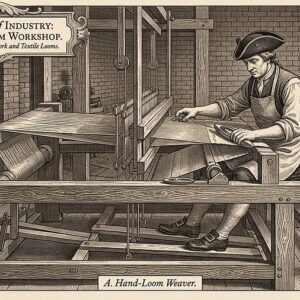
A handloom weaver in the north of England around 1815 had a skill that took years to build and a wage that took care of a household. Then the power loom showed up, and his pay totally collapsed.
Robert Allen reminds us that handloom weavers’ weekly pay fell from around 240 pence to under 100 in about a decade. Cut in half, then cut again, inside one working life. The weaver’s job wasn’t transferred to the power loom, because the power loom did not require his skill. All it needed was a cheaper, lower-skilled person, often a child, to feed it. So the weaver got poorer, then got old, and the better jobs the Industrial Revolution eventually produced went to people who hadn’t been born yet.
The machines did make everyone richer. The people who got rich were just two generations downstream. So yes, things got better, eventually. And “eventually” is doing an enormous amount of work in that sentence.
Economists call this “Engels’ pause.” Between 1780 and 1840, output per British worker rose about 46 percent while real wages rose about 12 percent. For sixty years, the country got radically more productive and the people doing the producing saw almost none of it. Wages didn’t climb back in line with output until around 1860, roughly eighty years after the whole thing started.
The prosperity was real. It just showed up two or three generations late, payable to the grandchildren of the people who footed the bill.
Eighty years.
If you were a working adult when the disruption hit, “it all works out” was a promise to people who wouldn’t be born until you were dead. You got the disruption. Your great-grandkids got the abundance.
If that sounds like ancient history, look at who’s eating the cost of the current one. Erik Brynjolfsson and his team at Stanford found that workers aged 22 to 25 in the jobs most exposed to AI, software development, customer service, marketing, have seen their employment drop by 13 percent, and in the updated numbers closer to 19, relative to everyone else.
Older workers in the exact same fields are fine. Their employment went up. The economist J. Scott Davis, at the Dallas Fed, found the same split. AI is thinning out entry-level hiring while pushing pay higher for the experienced people it can’t replace. Productivity is climbing. The gains are pooling at the top. The people getting squeezed out are the ones trying to get in. That is Engels’ pause 2.0, supercharged.
Charles Dickens built a whole novel out of this. In Hard Times, the factory town of Coketown runs on workers the owners call “the Hands,” because that’s all a worker was to the system, the part of a body it still had a use for, priced like coal, kept exactly as long as it stayed cheaper than the machine.
The handloom weaver was merely a cost the economy was working to cut. A twenty-three-year-old shut out of a junior dev job is learning the same lesson.
We even turned the American version into a song. John Henry, the steel-driving man, races a steam drill to prove a human can still beat the machine, and he wins, and the winning kills him, hammer in his hand. We remember it as a triumph, but it plays better as a warning.
You can be the best there’s ever been at the old job and still lose. Ask the senior engineer who is genuinely the best on the team and still can’t out-produce the model on the rote work. The contest itself is the trap.
The honest version of “new and better jobs are coming” is yes, they are, and they’ll be good, but they’ll mostly belong to someone else. The arc bends toward abundance across a stretch of decades no actual worker gets to stand inside. Even the people who believe in that better future are nervous about the gap.
Gina Raimondo, who ran the U.S. Commerce Department and fully believes AI will create new jobs in the long run, says the thing that keeps her up is that “we don’t have a plan to make sure that every American can have a good job in the age of AI,” and warns that without a planned transition we should expect “tens of millions of job losses and a long, deep recession.”
The question shouldn’t ask whether the new jobs arrive, but rather, when your pay is falling and your skill is worthless and the payoff is decades out, who’s going to help you transition to the next thing?
Historically, nobody. Worse than nobody, because every single time, somebody promised they would. The Luddites were promised Parliament would hear them. The freed slaves were promised forty acres. The laid-off factory towns were promised retraining. The promise is always part of the package, and it is always the first thing to go.

We have built the bridge exactly once, and then we burned it
There is one time in American history when the government looked at a mass of people whose entire way of earning a living had just been destroyed and said, “we will build you a way across.”
After the Civil War, four million newly freed people had no land, no capital, no wages, and a set of skills the postwar economy was not organized to pay for. In 1865, Congress created the Freedmen’s Bureau, and on paper it was extraordinary, offering food, medical care, schools, legal help, and a promise of land.
Eric Foner calls it the largest social welfare effort the federal government had ever attempted.
It was also designed to fail, in the specific way these things always get designed to fail. Congress gave it almost no money of its own. It gave it, at its peak, roughly 900 agents to serve those four million people across the entire South. The land, the “forty acres” that was supposed to turn freedpeople into independent farmers, mostly got taken back and handed to the men who had owned them.
Funding cuts gutted the operation by 1869, and in 1872 Congress let the whole thing die.
Eric Chyn, Kareem Haggag, and Bryan Stuart, who went back and studied the Bureau with modern tools, put the cause plainly: the federal government never provided the sustained resources the job actually required. The one serious attempt to carry a displaced population into a new economy was starved, undercut, and then quietly switched off, and the people it was meant to carry were left where they stood, to be absorbed into sharecropping and, soon after, Jim Crow.
This is not to equate UX layoffs with slavery, which would be obscene. It is, however, the clearest possible demonstration of a pattern that runs through every one of these transitions.
When the bridge gets built at all, it gets built cheap, run on a skeleton crew, and shut down the moment it becomes politically inconvenient.
We are set up to do it again, except this time we are not even pretending to build the bridge.
The research on retraining is brutal. A recent National Bureau of Economic Research study looking specifically at AI-exposed workers found that only something like 40 to 45 percent of occupations are cleanly “retrainable” into AI-complementary work at all. More than half don’t have an obvious safe harbor to be retrained toward. Of the workers who want to adapt, 43 percent said the single biggest thing stopping them was simply the lack of available training.
Meanwhile, the main federal workforce-training law has been stuck in reauthorization limbo for years, and the public programs meant to catch displaced workers are being cut at the exact moment the need is spiking. As Caroline Treschitta and her colleagues at the National Skills Coalition have documented, the budget proposals on the table would cut federal workforce funding by roughly a quarter and fold eleven separate programs into one shrunken block grant, eliminating, among other things, the Dislocated Worker program, which is the one whose entire job is retraining people thrown out of work by economic change.
We are defunding the bridge while standing at the edge of the canyon.
Molly Kinder put it even more plainly, saying that the most recent time we faced a major economic disruption and told everyone retraining was the answer, “it went terribly.” Her comparison is deindustrialization, the hollowing out of American manufacturing, where we waved at the displaced, said the word “retraining,” and then mostly watched communities fall apart for forty years.
She argues AI could do to a generation of college-educated women what deindustrialization did to a generation of working-class men. The track record of “we’ll retrain them” is not a hopeful one. If we’re being completely honest, it is a graveyard.
There is a number that should end the argument altogether. The World Economic Forum, the Davos optimists themselves, put out a Future of Jobs report projecting that by 2030, 59 of every 100 workers will need retraining or upskilling, and that 11 of those 100 are unlikely to get it. Scaled up, that is more than 120 million people worldwide who, by the cheerleaders’ own math, will need to be carried across the gap and will be left standing on the near side of it.
The scary part of this, in their own words, is that the commitment from employers and governments won’t be there.
When Sam Altman or Elon Musk tells you the transition will be fine, understand what is actually being promised, which is nothing. There is no plan. There is no funded program. There is no agency staffing up to walk you from the job AI takes to the job it hasn’t invented yet.
History is clear, the present is clear, and the people with the rosiest possible spreadsheets are telling you, in the fine print, that a hundred and twenty million of us are on our own.
If you can get past how bleak that sounds, it is the most useful thing anyone can tell you. Once you stop waiting for the bridge, you can start doing the only thing that has ever actually worked.

So do the only thing that has ever worked
If you’ve made it this far, you might reasonably want to throw your laptop into the sea, maybe followed by yourself, weighed down by the O’Reilly books you spent years reading to get good at your job.
Before you do that, know that there is a part that is actually good news, even though it does not sound like it at first.
The people who make it through these transitions are not the ones who guessed the new jobs correctly, and not the ones who got rescued, because almost nobody gets rescued. They are the ones who kept changing what they were while everyone around them waited to be saved. That is the entire pattern.In every rupture, a chunk of people treat their own skills as a living thing they are responsible for feeding, and those people tend to land on the other side.
Mar Carpanelli, Jedrzej Duszynski, and Fabian Stephany studied the skill profiles of 2.4 million workers and found that the people with broad, adaptable skill sets are the ones who pick up new skills fastest, get promoted, and move into roles that are harder for AI to touch. The ones who stood still, waiting for the retraining program or the government or the company to come get them, mostly did not.
“Just adapt” is the laziest advice in the world. It’s the thing executives say right before they lay you off. That said, the people who are good at this are not winging it.
Sarah Doody, who has spent more than two decades in UX and now coaches people through exactly this kind of career whiplash, frames it as “treat your career as a product,” a product you are actively developing, versioning, and repositioning as the market moves, instead of a static thing you finish once and defend forever.
The people who do this do not panic when a tool eats part of their job, because they were already asking what the next version of themselves needs to do. The people who treat their career as a fixed object, a job title to be protected, are the ones who get blindsided.
This isn’t just about learning “the new tool,” exactly, though you do have to learn the new tool. Patrick Neeman argues that the real value is splitting in two. Juniors are showing up fluent in the AI, and seniors hold the judgment to know when the AI is confidently wrong. The career that survives is the one that keeps both muscles working, the fluency and the judgment, and refuses to let either one atrophy.
I said something to Patrick once that he quoted back to me, and I’ll stand by it here. I don’t care about the tools. We can teach you the tools. What I can’t teach, at least not in a week, is taste, judgment, and the ability to tell when something is quietly broken.
The quiet corollary to all of this is aimed at the people who have decided the principled move is to refuse AI entirely. It’s an understandable impulse, but opting out is the same as waiting for a retraining program. It is still a wager that someone or something will preserve the job you have exactly as it is, and nothing in this entire history suggests that bet pays off.
Ethan Mollick, who studies how people actually work with these systems, frames the danger from the other direction. His take is that every time we hand a task to the machine without staying engaged, we lose a chance to build our own expertise.
Both errors, over-relying on it and refusing to touch it, end in the same place, a person whose skills quietly stopped growing while the ground kept moving. The move is to use the thing hard and stay sharper than it.
What we are being offered instead, is seductive and a trap. The pitch from the top is abundance, don’t worry about the work, the machines will handle it, and you will be free. Kurt Vonnegut wrote that exact world in 1952, in his first novel, Player Piano. The machines run everything, a tiny class of engineers keeps the system humming, and everyone else is kept comfortable, provided for, and utterly without purpose, handed make-work and a monthly check and a quiet, grinding sense of uselessness.
It was written as a warning.
Elon Musk is reselling it to you as the goal. Even he seems to half-know it, admitting in the same breath as his “universal high income” pitch that it is “less clear how we will find meaning in a world where work is” optional.
Vonnegut answered that question seventy years ago. You don’t. That’s the whole problem with the plan.
This is not the pep talk anyone wants. The pep talk is that it’ll be fine, new jobs are coming, somebody’s got it handled, but that’s a lie. The reality is, nobody is coming to retrain you, but that is not the end of the story.
Once you stop waiting for the bridge, you stop losing years standing at the edge of it, and you start building the only thing you actually control, which is a version of yourself the next economy still has a use for.
Jonathan Westover puts the uncomfortable part plainly, saying that thriving through what’s coming now depends on self-directed learning, and it happens, in his words, “often without organizational scaffolding.”
There is no scaffold. There is just you, and you need to decide to keep building before you have to. The machines are not the thing to be afraid of. The waiting is.
References and further reading
The arguments about the jobs
- World Economic Forum, Why there will be plenty of jobs in the future, even with AI. One corner of the optimism chorus: the work transforms, net jobs grow.
- IBM, What AI means for the future of work. The vendor’s version of the same promise, more opportunities than it destroys.
- Forbes Tech Council, The Future of Work: Embracing AI’s Job Creation Potential. Augmentation, not replacement, the purest distillation of the comforting pitch.
- Jon Stewart, The Daily Show (AI episode). The segment where the industry’s most powerful people get asked the jobs question and go vague.
- Jensen Huang (CNBC): on why he calls the AI jobs panic “complete nonsense,” and the task-versus-job distinction.
- Elon Musk (Fox Business): the “age of abundance” and “universal high income” pitch, and why saving money won’t be necessary.
- David Autor, Caroline Chin, Anna Salomons, and Bryan Seegmiller, New Frontiers: The Origins and Content of New Work, 1940–2018. Roughly 60 percent of today’s jobs are in occupations that did not exist in 1940.
- Daron Acemoglu (MIT Technology Review): the Nobel economist’s case that AI’s economic gains will be modest and uneven, with no reduction in inequality.
- Molly Kinder (Platformer): the Brookings researcher on the “messy middle” and why the reassuring story is false.
- IMF, Gen-AI: Artificial Intelligence and the Future of Work. On how generative AI can spread “much faster than previous disruptive technologies,” outpacing the economy’s ability to adjust.
The Luddites and the Industrial Revolution
- Richard Conniff, What the Luddites Really Fought Against (Smithsonian). The reclamation: they were skilled workers, not technophobes.
- Brian Merchant, Blood in the Machine. The definitive history, including the retraining and relief the Luddites actually asked Parliament for.
- Frame-Breaking Act 1812. The law that made machine-breaking a capital crime.
- Robert Allen, Engels’ Pause: Technical Change, Capital Accumulation, and Inequality in the British Industrial Revolution. The source of “Engels’ pause” and the 46-percent-versus-12-percent wage gap.
- Charles Dickens, Hard Times. The novel of Coketown and “the Hands.”
- John Henry (Library of Congress). The ballad of the man who beat the machine and died doing it.
Who pays, and who never gets caught
- Erik Brynjolfsson and the Stanford Digital Economy Lab, Canaries in the Coal Mine. The 13-to-19-percent drop in employment for entry-level workers in AI-exposed jobs.
- J. Scott Davis, Dallas Fed research on AI and the labor market: entry-level hiring thins (down roughly 16 percent) while experienced workers’ pay rises (up 8.5 percent).
- Gina Raimondo (CNBC): the former Commerce Secretary on the missing plan and the risk of a long, deep recession.
- Eric Foner (New York Review of Books): on the Freedmen’s Bureau as the largest federal social-welfare effort ever attempted.
- Freedmen’s Bureau (History.com): the 900 agents, the “forty acres” promise, and the collapse.
- Eric Chyn, Kareem Haggag, and Bryan Stuart, Inequality and Racial Backlash: Evidence from the Reconstruction Era and the Freedmen’s Bureau. The modern empirical study: the government never provided the sustained resources.
- How Retrainable Are AI-Exposed Workers? (NBER). Only 40 to 45 percent of occupations are cleanly retrainable; 43 percent of workers cite the lack of available training.
- Caroline Treschitta, Katie Spiker, Megan Evans, and Amanda Bergson-Shilcock, Cuts Disguised as Reform (National Skills Coalition). The current defunding, including the elimination of the Dislocated Worker program.
- Molly Kinder, We Can’t Retrain Our Way Out of AI’s Economic Disruption. On how retraining “went terribly” the last time, and the deindustrialization parallel.
- World Economic Forum, Future of Jobs Report 2025. The 120-million-worker gap: by 2030, 59 of every 100 workers will need reskilling, and 11 are unlikely to get it.
What actually works
- Mar Carpanelli, Jedrzej Duszynski, and Fabian Stephany, Navigating the Skill Diversity Frontier. A study of 2.4 million workers: adaptable skill portfolios predict who gets through.
- Sarah Doody, Career Strategy Lab. The practitioner behind “treat your career as a product.”
- Patrick Neeman, In the Age of AI, the UX Field Survives on Leaders Who Cultivate Juniors. On the split between junior fluency and senior judgment.
- Ethan Mollick, One Useful Thing. On how handing work to the machine without staying engaged costs you your own expertise.
- Kurt Vonnegut, Player Piano. The 1952 novel that already imagined the “abundance” being sold as utopia.
- Jonathan Westover, Reskilling for Resilience. On self-directed learning that happens “often without organizational scaffolding.”
What the AI era owes you was originally published in UX Collective on Medium, where people are continuing the conversation by highlighting and responding to this story.