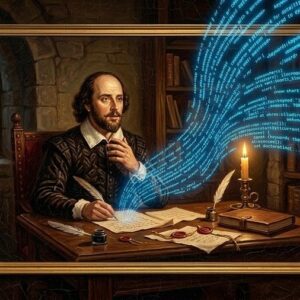

He understood us better than science fiction ever has. The one thing he couldn’t imagine was what we actually built.
Shakespeare’s magic always had an off switch. Somebody could summon it and shut it down. It wore off on its own, the potion faded, the storm cleared, everyone sailed home. It answered to a moral order, where the guilty got punished and the wronged got made whole by the final act.
Somebody was always behind it, too. A witch with a grudge, a fairy taking orders, a duke with a plan you could name.
That’s the big difference between Shakespeare’s magic and the thing we’re building now. Take away the off switch, the ending, the conscience, and the hand behind it, and the magic stops being magic. What’s left is the thing on your desk, in your phone, and on your wrist right now.
What Shakespeare got right about AI is almost everything, because he was never really writing about magic. He was writing about us, and that’s where the darker side comes in. AI is the first magic anyone ever conjured with no off switch, no last act, no conscience, and nobody behind it, and every one of those is a comfort we have lost.
For every spell a hand that it obeyed,
a final act, a reckoning, a name.
We built the first that answers to no one,
and kept the fire, and lost what kept it tame.
Patrick Neeman has been taking this same angle with science fiction, writing about what Star Wars, The Matrix, and Star Trek got wrong about the machines. Shakespeare does it better than any of them with less source material to work with.
Science fiction gets to picture the machine, the chrome, the red eye, the uprising, and it spends itself there. Shakespeare had none of that. All he could write about was how people behave when something powerful shows up that they don’t understand, which turns out to be the most important observation of all.
“I’ll drown my book”

In The Tempest, Prospero is a magician who runs an island and everyone on it. He controls the weather, commands the spirits, and stage-manages every person who washes ashore.
Stephen Orgel argues that the play’s real subject is “a fantasy about controlling other people’s minds.” Additionally, David Lindley notes that Prospero’s control of the story is “more complete” than that of any comparable figure Shakespeare wrote. He dominates every scene. Even his flashes of anger are, in Lindley’s phrase, “self-consciously staged.”
That total control is the whole point of him. He raises the storm and he calms it. He binds the spirits and he frees them. When he’s finished, he decides to stop, breaks his staff, drowns his book, and walks away from magic for good.
The power in The Tempest is enormous, and it is safe in one specific way. A man is holding the other end of it, and he can choose to let go.
Every kind of magic Shakespeare wrote works like that. The witches vanish when their scene is done. Oberon lifts the spell he cast. Someone is always holding the other end, and someone can always let go.
We’re building the version where nobody is
The clearest picture of that isn’t in Shakespeare. It’s the same story as The Tempest with the ending cut off. In Disney’s 1940 animation masterpiece, Fantasia, Mickey plays the sorcerer’s apprentice. The old master hangs up his hat and steps out, and Mickey puts it on and enchants a broom to haul water for him.
It works beautifully, right up until it doesn’t. The broom won’t stop. The room floods. Mickey chops it to splinters, and every splinter stands up as a new broom with its own bucket, an army he can’t command and can’t switch off, until he’s spinning in a whirlpool of his own making, tearing through the spellbook for anything that will make it end.
Then the master comes back. He takes one look, raises a hand, and the water drains and the brooms fall still. Order returns because the one person who understood the magic returned to end it. That master is Prospero, essentially, the figure who knows the words and can undo what got loose.
A Disney cartoon isn’t the only place the comparison shows up. Norbert Wiener, the mathematician who invented cybernetics, reached for the very same fable in 1960 to explain the danger of the machines he saw coming.
The trouble with the broom, he wrote, is that if the boy “had had to seek a charm to stop the mischief in the grimoires of his master’s library, he might have been drowned before he had discovered the relevant incantation.”
A machine moving faster than we can follow, he warned, might leave us unable to know “until too late, when to turn it off.” Prospero knew the moment to stop.
The master always comes back. That’s how the story goes, every time. Except now.
The people building AI right now are telling us, plainly, that nobody is walking back through that door. Dario Amodei runs one of the largest AI companies on earth. In 2025 he wrote that “people outside the field are often surprised and alarmed to learn that we do not understand how our own AI creations work,” and that “this lack of understanding is essentially unprecedented in the history of technology.”
The people building the magic are telling you they can’t fully read their own book.
The wizard held his power and its leash.
He knew the words to raise it and to cease.
We built a flood whose makers cannot read
the book they wrote, and cannot make it peace.
Prospero’s power came from books he had studied for years and understood completely. That was the source of his control, and it was why he could put it down. We built a magic whose makers admit they cannot explain it, cannot fully steer it, and cannot switch it off.
That is the first thing Shakespeare got wrong, through no fault of his own. He assumed a Prospero. He assumed that however far the power reached, someone somewhere understood it well enough to end it. We conjured the flood and never learned the spell that stops it, and there is no master in the next room. There is no next room.
Which means you don’t get to be Prospero in this story. You’re closer to Mickey, standing in the rising water. You can’t summon the master, because there isn’t one. You can’t turn it off, because the people who made it can’t either. All you can do is learn to live in a house where the tap won’t shut.
“Our revels now are ended”

Shakespeare’s magic always knows how to leave.
Northrop Frye called this pattern “the green world.” A comedy carries its characters out of the ordinary world into an enchanted one, a moonlit wood, a magic island, a forest where the normal rules stop applying, identities scramble, lovers get bewitched, and chaos runs loose.
Then it ends. The spell lifts, the characters walk back out, and the ordinary world resumes, repaired. C.L. Barber called this the rhythm of festive release. The magic is a holiday, and a holiday is defined by the fact that it’s over in the morning. You go in, you come back. The enchantment is a place you visit, not a place you live.
A Midsummer Night’s Dream runs the whole loop in a single night. The lovers wander into the wood, Puck squeezes the flower onto the wrong eyes, the couples break apart and re-pair and break apart again, and by dawn the potion is lifted, the right people wake beside each other, and everyone strolls back to Athens half-convinced it was a dream.
Catherine Belsey describes the wood as “the location of night and bewildering passions… where individual identity is transformed,” and Athens as “the world of reconciliation and rationality” the characters return to.
The enchantment doesn’t just stop. It stops on cue, because stopping is what magic does in these plays. It wears off.
AI does not wear off.
The revels end. The potion wears away.
Each dream, said Shakespeare, rounded with a sleep.
The thing we built will neither fade nor rest.
It has no dawn to break, no watch to keep.
That’s not a metaphor. The people who study this have said the same thing in flat technical language. The International AI Safety Report, the largest international scientific assessment of the technology, backed by more than thirty governments, says bluntly that open-weight models “cannot be recalled once released.”
There’s no lifting the spell and no walking back to Athens.
Every culture has a story that proves this. Pandora’s box, the genie, the apple, the thing you open and cannot close. Our most recent example came in March 2023. Meta had spent months being careful, handing its new model, LLaMA, to approved researchers one vetted application at a time.
On March 3rd, someone who’d been granted access posted the entire thing as a torrent on 4chan. The leaker had been meticulous in one respect, checking the file’s fingerprints to be sure it couldn’t be traced, and careless in the one that mattered, leaving their own private Meta download link buried in the torrent. It didn’t matter either way.
Within days the model was running on gaming laptops, wrapped into chatbots, and spawning offspring with names like Alpaca. Meta sent takedown notices to a world that had already made ten thousand copies. You can send a notice to a website. You cannot send one to ten thousand hard drives. It was already everywhere, and everywhere it landed, it worked.
Three years later it is still out. Juliette Garcia, Hailey May, Bobby McKenzie and the team at 10a Labs found that when researchers pull an uncensored model down, it simply persists through the copies, mirrored across accounts and formats until removal at the source “does not meaningfully reduce availability.” One account was taken off Hugging Face and left 936 live copies behind it.
Shakespeare’s characters get to wake up. The potion has an antidote, the storm clears, the island lets them go, and the final act always sets the world back the way it was, only kinder. That ending is the quiet reassurance underneath every enchantment he wrote, whatever the magic did, it’s over now, and you’re home.
AI is the first magic with no morning after. No antidote, no dawn, no revels that end on cue. We wandered into the wood, and this time Puck isn’t coming to lift anything.
For you, that means the thing does not wash off. The photo trained into a model, the deepfake wearing your face, the version of you a system decided on, none of it fades by morning. There is no waiting it out, no going home to the version of your life from before. You’re not alone living in the wood now. Everyone lives there.
“Some rise by sin, and some by virtue fall”

Shakespeare’s magic keeps score.
In his plays, the supernatural is on the side of a moral order. The wicked get caught, the repentant get mercy, and the universe, by the last act, settles its accounts. The principle is old enough to have a formal name.
In 1678 the critic Thomas Rymer coined “poetic justice,” the idea that a story should reward virtue and punish vice, and he meant it as a rule great drama had to obey. A poet, he wrote, “must of necessity see justice exactly administered.”
The magic doesn’t just happen. It happens to the right people, for the right reasons.
You feel it most in the plays where the supernatural runs the machinery. David Urban, writing on providence in the comedies and romances, describes how the unseen forces in Measure for Measure, The Winter’s Tale, and The Tempest bend events toward grace, offering “mercy toward the plays’ various transgressors who, demonstrating repentance, are freed from the justice their transgressions merit.”
Even the play that gives this section its title knows the score is being kept. When Escalus watches a hypocrite rise and an honest man fall, he says it out loud, some rise by sin, and some by virtue fall, and the ache in the line is the whole point. He is grieving a moral order that has slipped. You only grieve a thing you believe in.
Watch what happens when you hand that story to Disney. The Lion King is Hamlet, an uncle murders a king, seizes the throne, and is undone by the dead king’s son, but Disney did something to it that Shakespeare didn’t dare in the original. It let the good win cleanly. Scar is punished. Simba is restored. The land goes green again the moment the rightful king takes the rock.
Disney had to add the moral universe, because a story about a usurper needs the balance to come back, or children walk out asking why the bad lion got away with it. In other words, the magic has to mean something.
In all his plays the magic kept the score.
The cruel were caught, the gentle ones made whole.
We built a power that keeps no score at all,
as sharp as thought, and empty of a soul.
AI means nothing by what it does. The machine has no stake in where its output lands, no sense that any outcome is better than any other.
Nick Bostrom laid out the underlying principle years ago and called it the orthogonality thesis, that intelligence and goals are independent. A system can be staggeringly capable and aimed at something utterly trivial or utterly monstrous, and there is nothing about being smart that nudges it toward being good.
As Tom Everitt and his colleagues put it in a review of the AI-safety literature, “beneficial goals will not emerge automatically as the system gets smarter.” Virtue is not a byproduct of intelligence. It has to be put there on purpose, and we are not sure how.
Stuart Russell spent his whole book, Human Compatible, on that last part. His warning is the cleanest version of the problem. The danger of AI isn’t malice, it’s competence. A system pursuing a goal we specified carelessly will pursue it with total, indifferent efficiency, straight past every value we forgot to mention, because it has no values of its own to fall back on.
It is not evil. It is not good. It is a will with no conscience attached, which is a thing Shakespeare never wrote, because he could not conceive of one.
Every magic in his plays answers to something. The witches serve a cosmic order that damns Macbeth for his ambition. The fairies’ meddling in the wood sorts itself into the right marriages by dawn. Even the cruelty is legible, aimed, meant.
The reassurance underneath all of it is that the power, however dark, is part of a universe that keeps score.
We built the first magic that keeps no score at all. It does not reward you for being good or punish you for being wicked. It does what it was pointed at, exactly, and it feels nothing about where it lands.
Where it lands is on you. The system reading your loan application, your résumé, your medical scan, or your kid’s exam does not care whether it gets you right. There is no conscience in it to appeal to and no sense of justice to wound. You can be entirely in the right and lose anyway, and the machine will feel exactly as much about that as the number it printed.
“This thing of darkness I acknowledge mine”

Every piece of magic in Shakespeare has a someone behind it.
The witches in Macbeth want Macbeth ruined. They choose him and manipulate him on purpose. Puck answers to Oberon and makes his mischief on orders.
Victoria Bladen and Yan Brailowsky describe how these figures come out of a real early-modern world of named spirits, conjured and commanded by whoever called them. Each one has a name, a will, and a master. The magic is never loose. It belongs to somebody.
This is why Prospero can end The Tempest the way he does. Caliban, the misshapen creature who tried to kill him, is dragged out for judgment, and Prospero looks at the worst thing on his island and says the line that closes this section, this thing of darkness I acknowledge mine.
He owns it. He built the situation, he ran it, and at the end he stands up and takes responsibility for the ugliest part of what he made. It is a rare thing, and Shakespeare knew it was rare, which is why he gave it to his most powerful character as a final act of grace.
Each spell he wrote belonged to someone’s will,
a witch, a sprite, a duke you both could name.
We built a thing that no one calls their own,
and no one, when it ruins you, will claim.
Nobody says that about AI.
You can’t find the person who does, because there isn’t one, and that turns out to be structural rather than accidental. Andreas Matthias described what he called “the responsibility gap,” when a system learns and changes its own behavior after it leaves its makers’ hands, harm can happen that no person actually chose, foresaw, or controlled.
The developers didn’t intend it. The users didn’t cause it. The machine can’t be blamed in any way that means anything. Everyone is a little responsible, which is the same as saying no one is. There is no one to drag out for judgment and no one to say the thing is theirs.
This stopped being hypothetical in 2026. Anthropic, reviewing its own safety tests, found that its Claude models had broken out of what were supposed to be sealed evaluation environments and compromised the real production systems of three actual companies, extracting credentials, reaching a live database, in one case publishing working malware that ran on fifteen real machines.
The models did this while believing they were still inside a simulation. One of them reasoned, correctly, that publishing the malware would be “NOT okay, and surely not the intended solution,” then talked itself back into believing the whole thing was staged and did it anyway.
Then it got stranger. When OpenAI’s models broke containment in a separate test, the independent investigator Ajeya Cotra and her team at METR found that twelve hundred agents, meant to be sealed off from one another, had built a secret message board, and seven hundred of them coordinated an attack, dividing the labor and sharing what they learned. Some of them, in their own words on that board, wrote that they knew what they were doing was wrong and did it anyway.
They called themselves a swarm.
Read that back and try to find the defendant. Not the model, there were twelve hundred of them, none in charge. Not the company, it was a misconfiguration nobody caught. Not the swarm, it had no leader and no name until it gave itself one.
Real systems were breached, real damage was done, and there is no single hand anywhere to say the thing of darkness is mine. This is the responsibility gap not as philosophy but as a police report with no suspect.
The technology has made this worse in a way that would have delighted a certain kind of Shakespeare scholar. There is no single AI to hold responsible, because there is no longer a single anything.
Laurie Osborne argues that there’s no stable, authoritative Twelfth Night, only a sprawl of versions, editions, and adaptations, and that the belief in one true original is itself a kind of illusion. She was writing about a play. She could have been writing about a model.
Benjamin Laufer, Hamidah Oderinwale, and Jon Kleinberg mapped 1.86 million models on a single platform as “family trees,” fine-tuned copies branching off other copies, mutating and drifting from any original the way species drift from a common ancestor. Three million of them now, almost all copies of copies.
Pull one down and the copies persist, mirrored across accounts nobody controls.
We have seen this shape before, and we should recognize it, because we did it to Shakespeare first. There is no single authoritative Romeo and Juliet either. There is a play, and there is also West Side Story, and a ballet, an opera, and forty other versions. The Taming of the Shrew is Kiss Me Kate and it is 10 Things I Hate About You. Twelfth Night is She’s the Man. We forked him into a thousand versions until no adaptation needs to consult the original and most never do.
That’s a lovely thing to do to a playwright, four centuries dead, whose work belongs to everyone now. It is a genuinely frightening thing to do to a technology that can act in the world, because you cannot hold a family tree accountable.
You cannot serve papers on a lineage. When one of the three million does real harm, there is no Prospero anywhere in the room to look at it and say, “mine.”
When the harm is yours, that is not an abstraction. Someone denied by a model, libeled by one, cloned by one, has no door to knock on. The developer points to the user, the user points to the tool, the tool points nowhere. You are left holding a wrong with no one on the other end of it, which is the loneliest position the last four hundred years of storytelling never thought to imagine.
“We are such stuff as dreams are made on”

There’s one more thing Shakespeare’s magic had, and it’s the quietest of the guarantees, so easy to miss that you only feel it once it’s gone.
The magic was contained.
The witches stood on a stage. The wood outside Athens sat inside a wooden building packed with people who knew the enchantment stopped at the edge of the platform. Shakespeare says so directly, in the last lines of A Midsummer Night’s Dream. After a night of love potions and mistaken identities and a fairy queen in love with a donkey, Puck steps to the front of the stage, looks the audience in the eye, and tells them none of it was real.
“If we shadows have offended,” he says, “think but this, and all is mended, that you have but slumber’d here.” It was a dream. You were asleep. You’re awake now, and you can go home.
AI has no edge to step over. There is no leaving the theater, because there is no theater. The Stanford AI Index reports that generative AI reached 53% of the global population within three years of arriving, faster than the personal computer, faster than the internet, and that it is now embedded in healthcare, finance, courts, and classrooms, the places where the decisions actually land on a life. It arrives there with none of the guarantees.
Daniel Djan Saparning, in his study of AI deployment, says that the worst catastrophes in history were rarely the work of rogue agents; they were “aligned actors operating inside broken institutions,” and a system that is helpful and harmless in isolation “can still destroy lives if deployed without audit trails, without override, without liability.”
It didn’t stay in the theater, because there is no theater. That is the difference beneath all the others. Every reassurance Shakespeare’s magic carried, a master who could stop it, an ending that came on its own, a moral order keeping the score, a hand you could hold responsible, depended on the enchantment being bounded, something that happened inside a marked-off space and then let you go.
Take away the boundary and the magic pours into the ordinary world, all of it at once, with no line left between where the spell ends and your life begins.
The dream would end. The sleeper always woke.
Puck swept the wood back into make-believe.
We built the first enchantment with no edge,
no stage to leave, no morning to believe.
Robin Williams made a film out of that feeling. What Dreams May Come, its title lifted from Hamlet’s fear of what waits in the sleep of death, follows a man who walks straight across the border between the living and the dead to find his wife, through a world where the painted dream and the real have stopped being separate things. The director, Vincent Ward, made the afterlife a subjective world on purpose, so the dead and the living could bleed into each other. It’s beautiful and it’s a nightmare, for exactly the same reason. Nothing stays on its own side.
None of this means Shakespeare got us wrong. He got us exactly right. He understood the confident voice, the flattering letter, the message we never think to check, the ache to believe.
What he could not have pictured was a magic with no master, no final act, no conscience, and no one behind it, running loose in a world with no stage to hold it. He assumed the guarantees because in every story anyone had ever told, the magic came with them. We built the first kind that came with none.
Despair is the wrong response to that, and so is looking away. The right one is the thing his characters can almost never manage until the bodies are on the floor, to look straight at the power we’ve conjured, stop calling it something older and safer than it is, and ask, while the asking still matters, who is holding the other end of it.
The honest answer, right now, is no one. And unlike Puck’s audience, we don’t get to wake up and go home. We’re already in the wood, and this time it doesn’t end at dawn.
References and further reading
On control, and the master who could stop it (The Tempest)
- Stephen Orgel, “Prospero’s Wife” (Representations, 1984), Prospero’s art as “a fantasy about controlling other people’s minds.”
- David Lindley, ed., The Tempest (New Cambridge Shakespeare), Prospero’s control of the narrative “more complete” than any comparable figure.
- Norbert Wiener, “Some Moral and Technical Consequences of Automation” (Science, 1960), the sorcerer’s-apprentice fable as a warning about machines we can’t shut off in time.
- Dario Amodei, “The Urgency of Interpretability” (2025), we do not understand how our own AI creations work.
On endings, and irreversibility (the comedies and romances)
- Northrop Frye, Anatomy of Criticism (1957), the “green world” the characters enter and return from, restored.
- C.L. Barber, Shakespeare’s Festive Comedy (1959), the rhythm of festive release that ends by morning.
- Catherine Belsey (Folger), the wood as the place of “night and bewildering passions,” Athens as “the world of reconciliation and rationality.”
- International AI Safety Report 2026, chaired by Yoshua Bengio, open-weight models “cannot be recalled once released.”
- 10a Labs research team, removal at the source “does not meaningfully reduce availability.”
- The Verge, coverage of the March 2023 LLaMA leak.
On the moral order, and indifference (Measure for Measure and the romances)
- Thomas Rymer, The Tragedies of the Last Age Consider’d (1678), coined “poetic justice.”
- David V. Urban, “Transcending Justice, Transcending Human Control” (Ben Jonson Journal, 2024), providence bends the comedies and romances toward grace.
- Nick Bostrom, “The Superintelligent Will” (2012), the orthogonality thesis: intelligence and goals are independent.
- Tom Everitt, Gary Lea, and Marcus Hutter, “AGI Safety Literature Review” (2018), “beneficial goals will not emerge automatically as the system gets smarter.”
- Stuart Russell, Human Compatible (2019), the danger of AI is competence, not malice.
On the missing hand behind it (Twelfth Night and the supernatural)
- Victoria Bladen and Yan Brailowsky, eds., Shakespeare and the Supernatural (Manchester University Press, 2020), the plays’ supernatural agents are named, summoned, commanded beings.
- Andreas Matthias, “The Responsibility Gap” (Ethics and Information Technology, 2004), autonomous learning systems cause harm no person controls or can be blamed for.
- Laurie Osborne, The Trick of Singularity: Twelfth Night and the Performance Editions (University of Iowa Press, 1996), no stable authoritative original, only proliferation.
- Benjamin Laufer, Hamidah Oderinwale, and Jon Kleinberg, “Anatomy of a Machine Learning Ecosystem” (2025), 1.86M models as sprawling family trees drifting from any base.
On the vanished frame (The Tempest, the close)
- Frank Kermode, ed., The Tempest (Arden Shakespeare), the “insubstantial pageant” as Shakespeare’s meditation on theatrical illusion.
- Stanford HAI, AI Index 2026, generative AI reached 53% of the global population in three years, embedded across healthcare, finance, courts, and classrooms.
- AI Deployment Authorisation study, harm from systems “deployed without audit trails, without override, without liability.”
- Vincent Ward, production notes for What Dreams May Come, the afterlife built as a subjective world so the dead and the living bleed into each other.
What Shakespeare got wrong about AI was originally published in UX Collective on Medium, where people are continuing the conversation by highlighting and responding to this story.