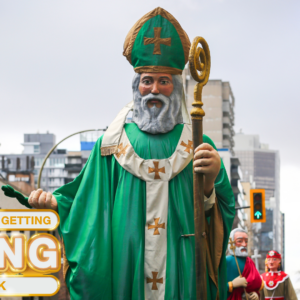
I’m posting this on March 17,St. Patrick’s Day, the day we celebrate the patron saint of Ireland, and Irishness in general, by dancing to accordion-and-fiddle-based music, dyeing a river green, and enjoying a wee drink or three. But there’s a lot people get wrong about the holiday, so allow me to clear up some myths.
St. Patrick’s Day wasn’t always a day for partying
The association between boozing it up and March 17 is relatively recent. St. Patrick’s Day was observed in Ireland as early as the ninth century but it was largely a somber remembrance, not a celebration—it marks the anniversary of St. Patrick’s death, after all. It was a day when the dietary restrictions of Lent were lifted, which must have been a relief, but it wasn’t about drinking and having fun. It was about going to Mass. Pubs were closed by law on March 17 in Ireland up until the 20th century, and drinking was unofficially discouraged on that day until as late as the 1970s.
St. Patrick’s Day, as we know it now, was arguably born in New York in 1762, when a group of Irish soldiers in the British army marched through Manhattan to a local tavern. In 1848, New York’s Irish Aid societies held the first official St. Patrick’s Day parade (which was also the world’s first civilian parade of any kind) and from there, the “drinking, dancing, and having fun” aspect of the holiday grew.
Ireland, by the way, was the last nation to get the memo. In a 2001 New York Times article, Irish novelist Maeve Binchy recalls a childhood spent watching every other country cut loose on March 17, while “Dublin was the dullest place on earth to spend St. Patrick’s Day.” By the 1990s, though, Ireland realized that people would rather have fun than remember dead saints, and now there are festivals and parades all over the country, including a huge one in Dublin.
Corned beef is not an Irish dish
The Irish are well-known for their story-telling and dance styles, but they are not known for their cuisine. The one exception is corned beef and cabbage, a meal many think of as Irish, except it really isn’t. Ireland has a complicated history with cows, but in general, pigs have been the real Irish protein, particularly after the 1800s. Things were different in the U.S., though. Irish immigrants in New York City were lacking Irish bacon, so they supposedly substituted corned beef, which they bought from their Jewish neighbors.
If you want legit Irish food, try boxty or Irish soda bread. Boxty is a potato-based pancake. Irish soda bread was invented during the potato famine and is made with sour milk and leavened with baking soda by people too poor to afford yeast. Soda bread was born of a nation’s misery, but if you add raisins and slap some salted butter on it, it’s delicious with coffee.
Saint Patrick wasn’t Irish
Unlike that other famous holiday-saint, St. Nicholas, St. Patrick wrote an autobiography, so we know something about his life. He was born in the late fourth century in Roman-occupied Britain, probably in Scotland or Wales, so he was Roman by citizenship, and could have been British, Italian, or Celtic. When he was around 15, Patrick was kidnapped by raiders and taken to Ireland, where he was forced to shepherd. After six years of captivity, Paddy escaped back to Scotland or Wales, spent 15 to 20 years in religious study, became ordained as a bishop, then returned to Ireland to convert the pagans to Catholicism. He was obviously successful in his mission, although I doubt pagans thought so. Here’s how the druids supposedly described St. Patrick:
Across the sea will come Adze-head, crazed in the head,
his cloak with hole for the head, his stick bent in the head.
He will chant impieties from a table in the front of his house;
all his people will answer: “so be it, so be it.”
“Adze-head” refers to the tonsure, the haircut monks used to have, so it’s a quality insult.
Saint Patrick did not drive the snakes from Ireland
Like all good saints, Patrick’s actual deeds were overshadowed by imaginary ones written down in the centuries after his death. In his own writings, Patrick only cops to one, very minor, miracle: When returning to Ireland, his party ran out of food, and Patrick said, “God will give us some” Then they found some wild boar. The miracles attributed to Patrick in hagiographies written about him are way more exciting. Here is only some of what St. Patrick was said to have done:
-
Battled druids and pagans in wizard duels, where the magical powers of the pagans were defeated by Patrick’s faith
-
Confronted the devil stone idol of Cromm Crúaich by striking it with his crosier and banishing the demon within it to hell
-
Banished demonic birds by ringing his bell
-
Raised 33 people from the dead
-
Was guided by Jesus himself to “St. Patrick’s Purgatory,” a cave in Lough Derg where sinners could be purged of their sins if they spent a day and a night there in penance
-
Left a walking stick behind that sprouted into a tree
-
Accidentally drove his staff through the foot of King Aengus, then later prayed and healed the wound
-
Drove the snakes out of Ireland
It’s that last one that people remember. Supposedly, St. Patrick was in the middle of a 40-day fast atop Croagh Patrick when he was attacked by serpents. He waved his magical staff, and ordered all the snakes to depart the Emerald Isle. And it’s true there are no snakes in Ireland, but it’s not because of St. Patrick—it’s because there never were snakes in Ireland.