
The path to designing for AI is in questioning the fundamentals of what design stands for

I admire artists and industrial designers who challenge assumptions. Ross Lovegrove is one of them. If you’ve never heard of him, he is one of the most visionary creators in the world, and designs all sorts of devices, including door handles, computers, fragrance bottles, and concept cars.
In an article in the popular design magazine Wallpaper, he claims that the potential of working with AI is utopian. That says a lot coming from someone considered by many as a futurist.
Lovegrove admits that most people in his generation, including design leaders, are skeptical of AI’s use in design. He doesn’t belong to that group, as he says that “AI is complementary, like having a conversation with a very intelligent friend.” He even built a Carrara marble sculpture in collaboration with a robot!
After reading Lovegrove’s take on AI, I asked myself: Are design leaders prepared for this new AI era? Or, more precisely, what do they need to unlearn to stay relevant and lead their teams in a world where AI is reshaping how we create?
Here’s what I’m unlearning, and what I think other design leaders should consider letting go of too.
#1. “AI enablement is (just) a tooling decision”

This might be a hard pill to swallow for some design leaders and any business leaders in general.
Before we entered what we now call an AI-first world, AI felt like a frontier that was approaching slowly. Leaders could afford to experiment, pilot a few tools, let teams test them out, see what stuck… It was like a free buffet where everyone could try the new shiny thing without much risk.
The problem now is how your team uses it, because the consequences of this free-for-all approach can be the opposite of what you expect: AI tools expose the talent gap in your team.
A 2025 study titled Not Everyone Wins with LLMs: Behavioral Patterns and Pedagogical Implications in AI-assisted Data Analysis, sheds some light on this. In it, researchers tracked 36 students as they used an LLM to complete programming and data analysis tasks. Everyone had equal access to the same AI tools.
The study found that students with strong data & coding foundations used AI to extend their thinking, explore alternatives, and debug more quickly. Those with weaker fundamentals often copy pasted outputs, misread results, or got overwhelmed by verbose explanations.
Now extrapolate this to your design team. If you just democratize the use of AI without paying attention to core fundamentals like systems thinking, experimentation, and evaluating AI output, your best performers will become even better at their craft, but junior designers may fall behind and become too dependent on AI.
Choosing the right tools is still and will remain relevant for years to come, but it’s equally important to build capability from the ground up so your team can use AI to extend their thinking. Today, AI enablement is a talent strategy decision.
#2. “Designers (only) design interfaces, researchers (only) provide insights”
There was a time when a designer had a very specific role, and so did researchers. And it was easy to assign them tasks, goals, and projects because everything worked like a well-oiled machine.
AI has changed the way we box these positions in. Can we already say we are on the verge of seeing more hybrid roles in design teams? J.M. Downey, Director of Design Strategy & Research at AT&T, thinks so.
Downey is one of the design leadership voices interviewed in the 2025 report The AI Shift: Transforming How We Discover, Imagine, and Design, conducted by the Design Executive Council (DXC). He sees his team as design strategists as much as he sees them as researchers. “That’s the future of this discipline,” he claims.
Most leaders interviewed for DXC’s report agreed that the old boundaries between design and research no longer work. For example, Dave Brown, who leads design for AI services at Amazon Web Services, says, “Design and research now need to look across the whole stack.” He’s talking about understanding how data flows, how models make decisions, and how those decisions show up in the user experience.
My perspective aligns with what they all say. Design leaders must adapt to what’s coming and upskill their teams for new challenges. Your designer needs to understand what the AI is optimizing for, why it’s making certain recommendations, and how to design friction when users need transparency or control. Your researcher can’t just deliver insights and walk away. They need to shape how those insights get embedded into product decisions, AI training, and business strategy.
An AI-first world demands strategic builders. Your team needs them, starting with yourself.
#3. “Polish, craft, and aesthetics are what make design good”
When you read this headline, it might sound like an oversimplification. I’m not arguing that design leaders have ever cared only about how a product looks, but I do include myself among those who have, at times, over-indexed on polished prototypes, pixel-perfect interfaces, and visual refinement as proxies for quality.
In AI-powered products, that definition of quality isn’t enough. Designing with AI introduces additional layers of responsibility and complexity. Beyond aesthetics and usability, which remain essential, quality now also includes:
- Trust: Can users rely on the system’s outputs over time?
- Transparency: Do users understand why the system made a recommendation or took an action?
- Graceful degradation: Does the product communicate uncertainty and fail safely when it doesn’t know something, rather than confidently producing wrong results?
In this context, a visually polished interface can mask deeper issues: unreliable outputs, opaque decision-making, brittle behavior at the edges… Design leaders must therefore stop measuring quality just by surface-level polish and instead treat trust, clarity, and reliability as first-class design outcomes.
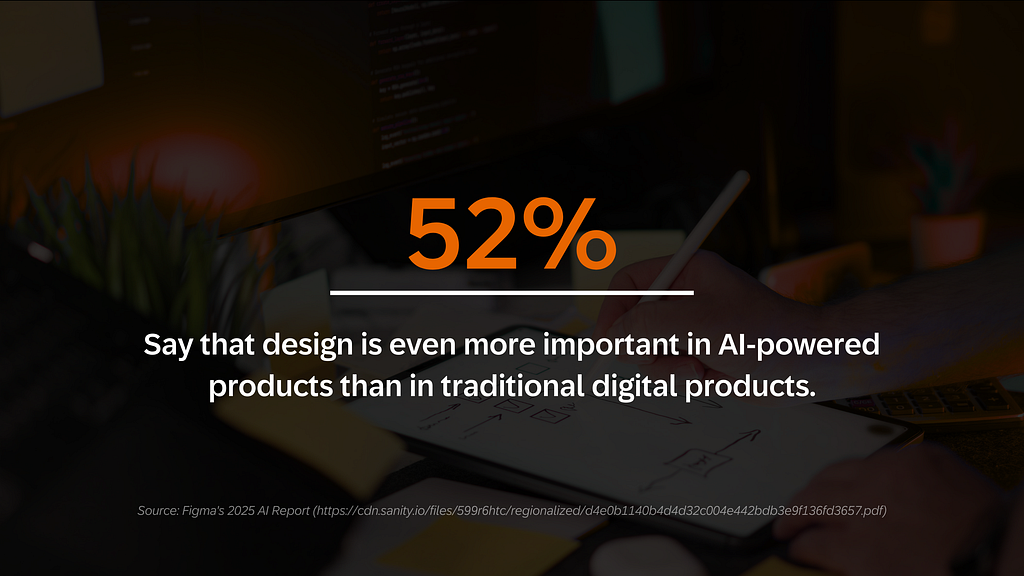
According to Figma’s 2025 AI Report, more than half of designers and AI builders believe design has become more important for AI-powered products, precisely because users now depend on design to interpret, evaluate, and trust intelligent systems.
For the design leaders of the future, great design will be defined by how confidently users can understand a system and rely on it in real-world conditions.
#4. “Speed equals progress”
I’ve heard many times in my career things like “moving faster is always the right move” or “if we ship faster, we win.” Well, these assumptions may be wrong today. Although I agree that for certain companies, especially startups, speed is a virtue, for the most part, we should stay vigilant when hearing such claims.
There’s one thing we all love about AI: it makes us faster. It can accelerate good work, there’s no doubt about it, but it can also accelerate mistakes. I recently read an article in CIO magazine on why AI initiatives fail, and one of the reasons mentioned was, indeed, ‘rushed pilots.’
Often, when pressured by stakeholders, business leaders may feel the need to deploy products without clear goals or proper processes, just to release them as quickly as possible. And design teams fall into the trap, mistaking speed and novelty for progress.
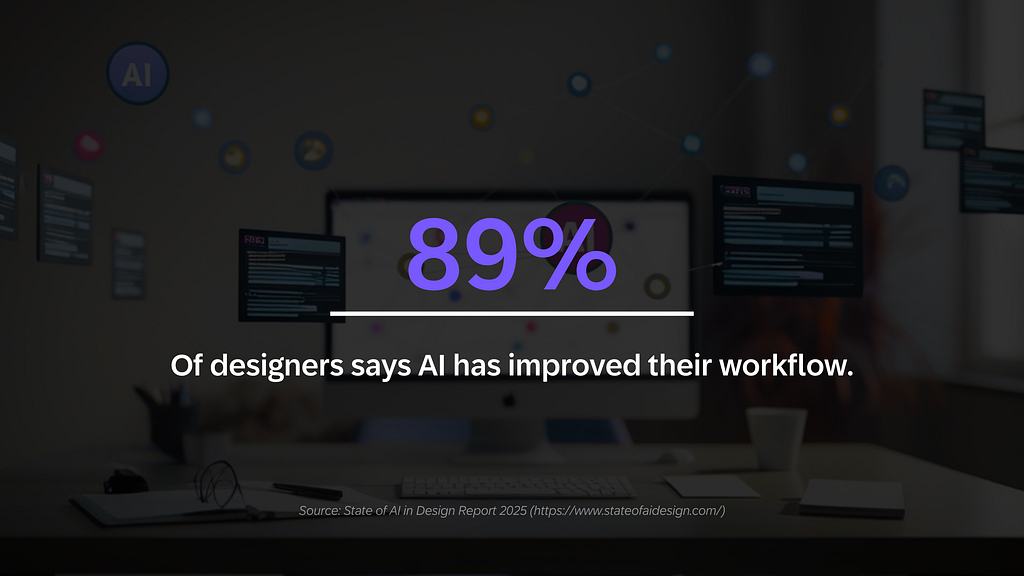
As per the State of AI in Design Report 2025, 89% of designers say AI has improved their workflow in some way. Your team may already be benefiting from this. They are more productive, and you get tangible results. Everything works faster, and everyone’s celebrating that. But is the work truly better?
The best design leaders know when to slow down, validate, and ensure that what they’re building is worth shipping.
Closing thoughts
One day, not too far away, we won’t talk about an “AI-first world”, just our world, much like we no longer say we’re in an “Internet-driven world”. AI will be embedded in everything, just as the internet is now.
Until then, design leaders have time to build and, apologies for the redundancy, ‘design’ this new reality. That means unlearning some of the universal truths we all took as sacred, as set in stone.
Want to see how we’re putting these principles into practice? Explore SAP’s approach to human-centered design at www.sap.com/design.
Arin Bhowmick (@arinbhowmick) is Chief Design Officer at SAP, based in San Francisco, California. The above article is personal and does not necessarily represent SAP’s positions, strategies or opinions.
What design leaders must unlearn to lead in an AI-first world was originally published in UX Collective on Medium, where people are continuing the conversation by highlighting and responding to this story.