
Kierkegaard on how fa*th becomes a bad word.
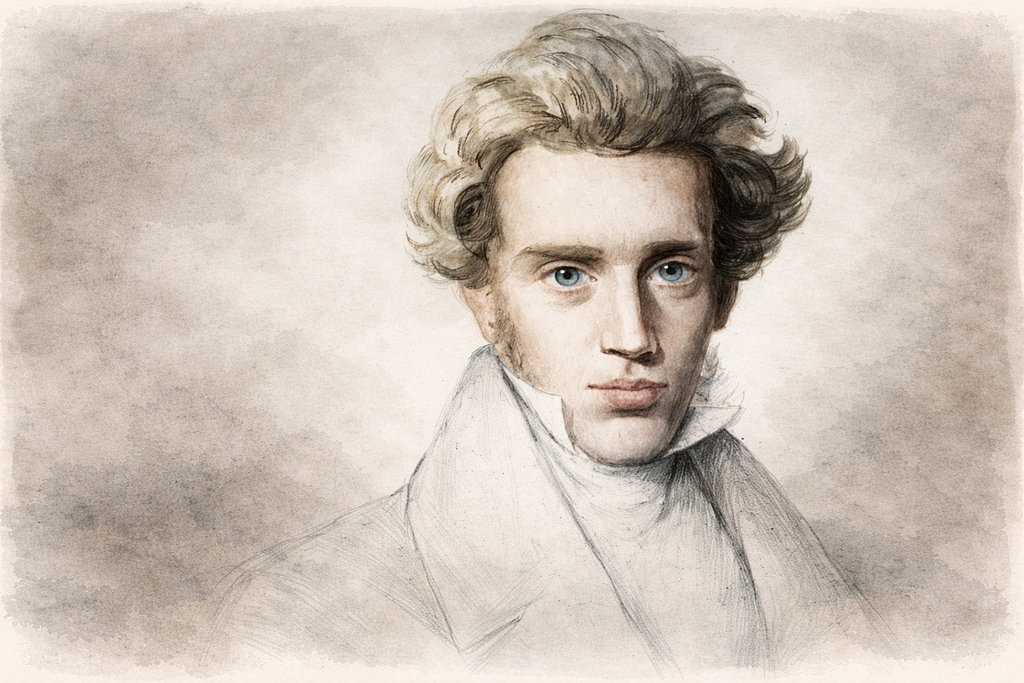
You can tell something isn’t true the moment its certainty becomes mandatory.
I’m Nate Sowder, and this is unquoted, installment 15. Kierkegaard.
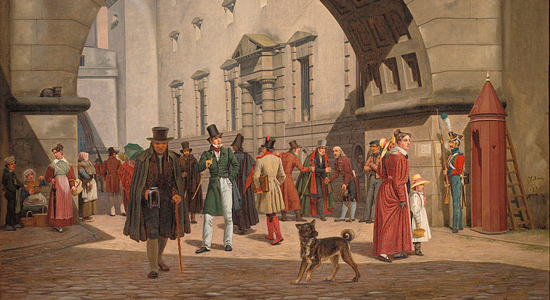
Designed certainty
For Kierkegaard, Christianity wasn’t a choice so much as the background noise of Copenhagen. In the early 1800s, belief didn’t require conviction, it required attendance. You inherited your faith the same way you inherited your surname, and no one seemed particularly bothered by the gap between saying the right words and understanding what they meant.
People were comfortable with answers being given to them before questions were even asked. Faith was spoken about constantly, often with confidence, but this confidence felt rehearsed. Kierkegaard couldn’t tell if people ever wrestled with or questioned their beliefs.
Eventually, he realized there was nothing to question. The system had already done the hard part. The role of the individual was to nod in agreement. This created a kind of harmony, but a shallow one… a collective certainty that never had to prove itself against anything real.
As he grew older, Kierkegaard saw how quickly certainty had replaced belief. Whenever a group becomes too sure of itself, it stops producing individuals capable of doing the inward work that faith requires. People learn to perform conviction rather than develop it. Say something often enough and you can skip the part where you understand (or question) it.
He noticed another pattern: People spoke confidently about truths they had never encountered firsthand, truths they had never risked anything to understand. And inherited certainty revealed an uncomfortable vulnerability: Once you depend on a system to hand you your conclusions, you tend to move as the system moves… and you move with confidence.
Kierkegaard wasn’t worried about disbelief. He wasn’t even worried about people changing their minds. His concern was unearned belief. Conviction without scrutiny and identity without introspection. The key here, is that the desire for certainty often poses as a strength, but usually signals the opposite:
A lack of faith.
A society can become so certain of its truths that it forgets how to look for them. Faith gets replaced by the appearance of faith. Inquiry becomes unnecessary (and frowned upon), and once that happens, no one notices the cost:
How easily people trade the effort of trying to understand for the comfort of believing (and being told) they already do.
The mechanics of unearned certainty
Certainty has a way of sounding like confidence, but Kierkegaard knew it’s usually the result of something else. People reach for certainty when the truth underneath gets a little shaky. It feels safer to defend an answer than to admit the question hasn’t been resolved.
And from here on, when we talk about “faith,” we’re using Kierkegaard’s meaning — not belief in a doctrine, but the inner stance required to live with unanswered questions. If that sounds narrowly religious, it’s a misread. Kierkegaard is describing a stance that shows up wherever people have to act without guarantees: in innovation, in design, in leadership, and many other forms of work.
For him, faith was never meant to be a conclusion. This stance was an ongoing willingness to live with what can’t be guaranteed. But certainty makes a different promise. It offers closure. It lets a person stop examining what they believe and start repeating it instead, resulting in something that feels like strength (even when nothing has been strengthened).
Systems (institutions) depend on predictability, and certainty delivers. It keeps people aligned, keeps roles stable, and keeps operations smooth enough that no one has to confront the inner workings. Churches, governments, workplaces, even families in their more rigid forms, all learn to reward conviction that doesn’t ask questions. Call it clarity or discipline or commitment, but the effect is the same: the more certainty people perform, the less individual they become.
This creates a loop that’s hard to break. People adopt certainty because it makes them feel secure. Institutions reinforce certainty because it makes people easier to manage. And the more those two forces reinforce each other, the more faith becomes something referenced rather than lived.
Unearned certainty has consequences. As it takes over, faith has nothing left to do. The questions don’t disappear, but people learn to avoid them. Individuals learn to shrink to fit the expectations of the system… and the system rewards the shrinking.
The altitude where faith stops being allowed
Systems don’t eliminate faith outright. They don’t have to. They simply move it to a place it can’t interfere with anything important. Faith becomes symbolic (something you reference or admire) while certainty takes over all the places where actual decisions get made.
Real faith requires inwardness. It asks for reflection, doubt, and examination. It forces a person to confront what they believe and why. That kind of faith creates individuals, but guess what? Individuals complicate systems.
But if you lift faith out of lived experience and into abstraction, it stops being disruptive. It becomes something recited rather than wrestled with. You stop practicing it and start admiring it. A system can allow that kind of faith because it never threatens the model. It doesn’t challenge authority or create variance. And it certainly doesn’t create individuals.
So institutions learn to reserve certainty for the ground level (where behavior happens) and faith for the clouds, where it can’t disrupt anything. Super subtle… super effective. People are encouraged to feel faithful while acting certain. They speak as if belief guides them, but their choices follow the conclusions they were given.
Over time, faith becomes an ornament. Something safe at a high altitude. And the higher it rises, the less room there is for the kind of faith Kierkegaard actually meant: the kind that forms a self.
The modern landscape of managed truth
In Kierkegaard’s time, people didn’t have access to the full picture. We do. We have more information, more perspectives, more lived experiences and more context than any moment that came before us.
And somehow, it hasn’t made us more thoughtful. It’s made us more certain.
Institutions don’t limit information… they package it and hand us interpretations wrapped in language that tell us what a “reasonable” or “moral” person should think. White papers, talking points, abacus briefs, policy summaries — all built to steer us toward conclusions that feel responsible without requiring us to understand the full situation.
It’s a familiar pattern. You don’t have to comprehend the complexity. You only need to sound aligned with it. Certainty becomes a performance of being well-informed, and systems reward the performance because it keeps everything moving in one direction.
This creates a strange contradiction. We now have unprecedented access to the full picture, but we rarely use it. We reach for summaries, frameworks, pre-digested opinions, and the moral scaffolding provided by the groups we belong to. We inherit not just the conclusions, but the emotional stance that comes with them. We feel confident long before we comprehend anything.
And that’s the trick with modern managed truth: it doesn’t hide information; it hides the work required to understand it.
People stop wrestling with ideas because the system makes wrestling feel unnecessary. Certainty is faster. Certainty is cleaner. Certainty signals belonging.
The tragedy is this: certainty has never been easier to acquire, and understanding has never required more from us.
The psychological cost
Dependence doesn’t really announce itself. It doesn’t feel like surrender or even like trust. For most, it feels like relief. It’s the relief of not having to hold the weight of your own conclusions. But once that relief settles in, the work of examining what you believe starts to fade because someone else has taken on that responsibility.
This is where certainty becomes a habit, and habits reshape identity.
When certainty becomes the default position, people stop defending ideas and start defending themselves. Think about the last couple disagreements you had. They feel personal (not because the topic was important, but) because certainty is doing the psychological heavy lifting. It keeps the self coherent. It keeps your view on the world intact.
To Kierkegaard, certainty can’t survive examination. It depends on avoiding questions, not engaging them. Faith works in the opposite direction. Faith strengthens under examination. It depends on someone willing to confront whatever might be uncovered.
Where certainty is rewarded, so is avoidance (or disciplined with guilt if confronted). And avoidance eventually hollows out a person from within. If you can be predictable, that’s a sign of stability. Alignment starts to look like maturity. People learn to treat their beliefs the way they treat their job descriptions: something maintained through compliance rather than reflection.
But here’s what happens: once certainty becomes an identity, people stop seeking truth. They start seeking reinforcement.
At that point, who cares about faith?
The turn
There’s an overlooked difference between certainty and faith, and it explains what I think Kierkegaard worried about.
If you depend on certainty, you have to win the moment. A person with faith doesn’t.
Certainty demands immediate validation because it can’t tolerate the possibility of being wrong… not even briefly. Certainty must hold up under scrutiny right now, in real time, in front of witnesses.
Faith works on a different clock.
It doesn’t panic when challenged. It doesn’t rush to close the gap. Faith can afford to lose the moment because it trusts that truth will be found over time. It doesn’t need victory; it needs to understand the whole picture. It doesn’t need agreement; it needs clarity. Questions aren’t threats. They’re healthy invitations.
That’s why faith creates individuals. And it’s why certainty creates loyalists.
Systems reward the people who need to win today. They’re predictable. They’re motivated. They’re aligned. People who run on faith (patient, reflective, grounded) are harder to manage. They aren’t in a hurry, and they aren’t afraid of being wrong. The bottom line is they don’t feel like their identity is at stake.
Put another way: Faith produces someone a system can’t easily use. Certainty produces someone a system can easily direct.
Once you see the difference, you can see why certainty thrives wherever institutions want control, and why faith survives only where individuals are willing to take responsibility for themselves.
It’s the same reason creative departments are the first to go. Creativity introduces possibility, and possibility threatens certainty.
Innovation works the same way. To innovate is to admit you might be wrong — to revise, rethink, even replace what you’ve built. Institutions built on certainty can’t tolerate that, so they cut the functions that would force it.
Faith as the work of becoming a person
Kierkegaard didn’t argue against certainty because he disliked confidence. He saw what it replaced. Certainty stands in the spot where an individual is supposed to develop.
Faith, as he meant it, was never about doctrinal agreement. It was about becoming someone capable of truth. This means someone who could be questioned without collapsing. Someone who could change without losing themselves in the process. Someone who didn’t need the comfort of winning today in order to grow tomorrow.
Systems will always prefer certainty. It keeps everything predictable and everyone aligned. They’re comfortable with faith only when it stays high enough not to interfere. Real faith lives lower… close to the ground, where it forms individuals instead of dependents. And most institutions don’t know what to do with individuals.
I think the biggest danger is how willingly I see smart people trade the slow, difficult work of faith for the quick relief of being sure.
Once certainty replaces inwardness, the individual starts to disappear. Once the individual disappears, faith has no reason to exist. What remains is a society full of people repeating truths they never had the chance to discover for themselves.
Which is what Kierkegaard feared all along: a world where belief is abundant, and faith is gone.
Truth and certainty was originally published in UX Collective on Medium, where people are continuing the conversation by highlighting and responding to this story.