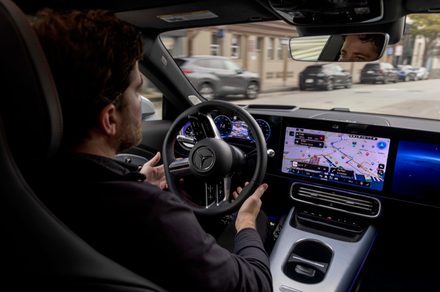

It’s a remarkably sunny day for San Francisco. The fog that often encases the city in the morning has lifted, opening up spectacular views of Golden Gate and its eponymous bridge. I’m sharing a 2026 Mercedes-Benz CLA-Class with two other people, and as we’re enjoying the scenery, the car brings itself to a halt at a stop sign, checks that the intersection is clear, and makes a left turn without any human intervention.
This is Mercedes’ latest driver-assist system in action. It’s called MB.Drive Assist Pro, and it’s coming to the United States in the redesigned CLA-Class later this year. Mercedes says it corresponds to Level 2 on the Society of Automotive Engineers (SAE) autonomy scale, meaning drivers have to stay alert and involved at all times. But right now the car doesn’t seem to need the driver.
We’ve seen Level 2 systems before — General Motors’ Super Cruise, for example — and Mercedes already has achieved a higher level of automation with its Level 3 Drive Pilot system. But instead of pushing for increased automation for its own sake, Mercedes is refining Level 2 tech with Drive Assist Pro — and making it more real-world relevant in the process.
It’s as smart as it needs to be

Instead of just releasing a system to keep up with the automated-driving zeitgeist, Mercedes is positioning Drive Assist Pro in a way that makes customers more likely to use it. This new system works on both highways and surface streets, albeit only while following a preset route from the navigation system. That makes it more likely that Drive Assist Pro will be available over an entire journey.
Drive Assist Pro also makes its U.S. debut (it launched in China in 2025) in an entry-level model. Mercedes hadn’t confirmed pricing for the system at press time, but the CLA itself starts at $48,500 — not bad for an EV from a luxury brand. That’s made possible by an extensive-not-extravagant hardware set including 10 cameras, five radars, and 12 ultrasonic sensors, but without the pricier lidar units used in Mercedes’ Drive Pilot Level 3 system.
As a Level 2 system, Drive Assist Pro requires drivers to keep their eyes on the road, something that’s managed with a driver-monitoring camera perched atop the infotainment touchscreen. Instead of expecting drivers to simply stand by until they need to take over, though, Mercedes took a more flexible approach it calls “collaborative steering.” You can keep your hands off the wheel if you want, or take over steering if you don’t like what the system is doing. Either way, Drive Assist Pro remains active so there’s no ambiguity. Deactivation is done via brake applications or hitting the cruise control “cancel” button, just like Mercedes’ adaptive cruise control systems.
To handle the chaotic nature of crowded city streets like those of San Francisco, Mercedes and software partner Nvidia emphasized a flexible decision-making process enabled by an AI that’s “like an LLM, but for [computer] vision,” Ali Kani, Nvidia’s vice president of automotive, told Digital Trends and other media ahead of this test drive. The model helps the system synthesize decisions from its sensor data, and is backed by a conventional software “safety stack” that ensures the system always follows the rules of the road.
It drives like a human

In practice, all of that allowed the Mercedes CLA to navigate the streets of San Francisco as well as the Waymo and Zoox robotaxis it shared those streets with — just without letting the driver go into the back seat and take a nap.
Drive Assist Pro accelerated and braked smoothly, while using the CLA’s forward-facing cameras to read traffic lights and signs to know when to stop, or when it wasn’t allowed to make a right turn on red. The system is programmed with region-specific rules like that, and will always follow them regardless of the situation. It wouldn’t cross a solid yellow line to get around a double-parked car, for example. Drivers can still override that behavior at their discretion; after ensuring a clear path ahead, the driver took over steering to get around that obstacle.
Conversely, when we encountered two double parked cars on a street with broken yellow lines, the system tried to drive around both of them in one go. But the driver wasn’t comfortable with the gap to an oncoming car, so he nudged the CLA back into its lane. It’s this ability to keep the driver in the loop at all times that turns Drive Assist Pro’s Level 2 automation from a limitation into an asset.
Further demonstrating that, when the car did hesitate in a complex situation, the handover to manual control was seamless. In fact, it wasn’t really a handover at all; the driver simply saw a problem and intervened. In this case, it was a left turn across an intersection with crossing pedestrian traffic shepherded by a crossing guarded, and another car trying to make a right turn into the same lane as us. Human intuition was able to parse this situation more easily.
It’s a more realistic approach to automated driving

As we made our way through the city, the numerous Waymo Jaguar I-Pace SUVs, their exteriors studded with whirring sensors, were a reminder of the difficulties of scaling up autonomous driving tech. A driverless experience is Silicon Valley’s dream, but after a decade plus of development, it’s only just barely available to the public. Issues like the recent unexpected shutdown of Waymo vehicles during a blackout are still cropping up as well, and the business case for robotaxi services is still unproven.
The collaborative approach between driver and computer that Mercedes has developed shows a more realistic path forward for this tech in the short term — albeit in a more limited capacity. Other Level 2 systems exist, including Super Cruise and Tesla’s deceptively named “Full Self-Driving.” But Mercedes has put more thought into how interfaces need to change if these systems are going to operate further away from the more predictable environment of highways and giving drivers more opportunities to use the tech.
MB.Drive Assist Pro feels like the next evolutionary step for driver-assist systems not because it’s trying to leap toward fully-automated driving, but because it makes the best use of the sensor and computing tech available today. It’s a product, not a promise.