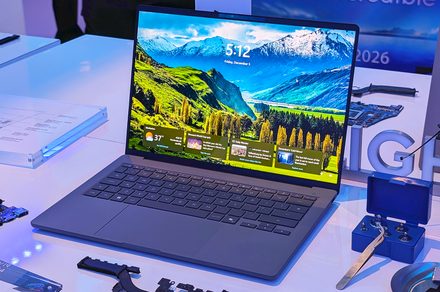

CES 2026 has arrived in a whirlwind, and floating down like Dorothy into Oz comes in the Asus Zenbook A14, practically lighter than air. It’s unclear if any wicked witches got smushed on the way down, but I can say that the MacBook Air would’ve done it first… because it is heavier. Yep, the Zenbook A14 is just that light. But is that really a good thing?
Every time I get a new laptop in my hands, I always judge the size and weight compared to the competition, but in recent years, laptops have been getting too small and too light. I felt this when I reviewed the Dell XPS 13 9345 back in 2024, where there was barely any room on the deck to comfortably type.
So at what point does a laptop get too light? Well, I got my hands on the Zenbook A14, and I have some thoughts.
Is lighter really better?
The Asus Zenbook A14 comes in at a shocking 2.18 pounds. For comparison, the M4 MacBook Air weighs 2.7 pounds. That’s half a pound heavier than the Zenbook. But does it really feel any different? Yes, in fact, it felt like a prop: effortless to lift, and if powered off, you’d have a hard time convincing me it was a real laptop. We’re dangerously close to getting notebooks as light as my child’s LeapFrog 2-in-1 laptop (1.3 pounds).
One of my biggest concerns with the Zenbook A14 was durability. My child could bump into me and send this thing flying like a paper airplane into my TV. While that very well may still happen, the laptop would survive, at least. My durability concerns were immediately shutdown by a shiny MIL-STD 810H certification badge. For those who don’t know, that badge means it’s undergone and survived testing against drops, shocks, dust, extreme temperatures, and more. So while it may have felt like a hollowed out piece of metal in my hands, it’s actually quite durable.
Yes, it is metal. Well, kind of. It’s built from Asus’ fancy ceraluminum, which is a material made up of ceramic and magnesium aluminum. Asus has been using it for a while — it’s an odd texture for a laptop, but I like it.

I had some trouble opening the lid, which wasn’t much of a shocker since it’s so light. However, at 12.23 x 8.42 x 0.53~0.63 inches, it maintains a good size, so my hands weren’t fighting for space on the deck. I clicked away at the keys, and they were pleasantly bouncy and well-spaced. I did notice a bit of flex on the deck, though. Meanwhile, the touchpad felt smooth, and was decently wide.
Then it was time to fall in love with the display. I love a good OLED screen, and now that Asus has updated all of its OLED displays to pump out more brightness than the previous generation, I was hyped. The Zenbook A14 is outfitted with a 14-inch, 1920 x 1200 OLED display rated for 600 nits of HDR brightness.
HDR isn’t always the best, but Asus improved the brightness in SDR as well. The 2025 model hit around 350 nits, so I’d be happy if it scored at least 450 nits. But the best part is that it’s rated to cover 100% of the DCI-P3 color gamut, so it’ll be oozing with color. I couldn’t change the screen in my hands-on, but I can say it looked bright and vivid in the space I was in.

Now, if we’re talking about what’s under the hood, there are some mighty claims from Asus. Of course, we have the shiny new Qualcomm Snapdragon X2 Elite chipset, but less concerned about the overall performance and moreso about the impact on battery life. Apparently, the Zenbook A14 is rated for 28 hours of battery life. That’s just for video playback, which doesn’t represent real-world usage, but that’s still a ridiculous figure. If the Zenbook A14 can pull that off, it will become a serious competitor to the MacBook Air in more ways than one.
Long battery life goes a long way for any kind of laptop, but I still don’t know how I feel about the Zenbook A14’s weight. It’s so light that I’m afraid I’d drop it all the time, and even if it can take a hit, that’s just incredibly frustrating.
If you want something a little heftier, you could opt for the new Zenbook A16. It’s still ridiculously light, at 2.65 pounds, beating the MacBook Air once again. But it feels more like a real laptop. It’s even outfitted with a superior 16-inch, 3K OLED display rated for 1100 nits of brightness. Now that’s shiny.
We don’t have the price for the Zenbook A14 just yet, but we know it’ll be available toward the end of March 2026. Stay tuned for more CES 2026 coverage as it comes through.