What designers can learn from the pioneers of “Long Design.”
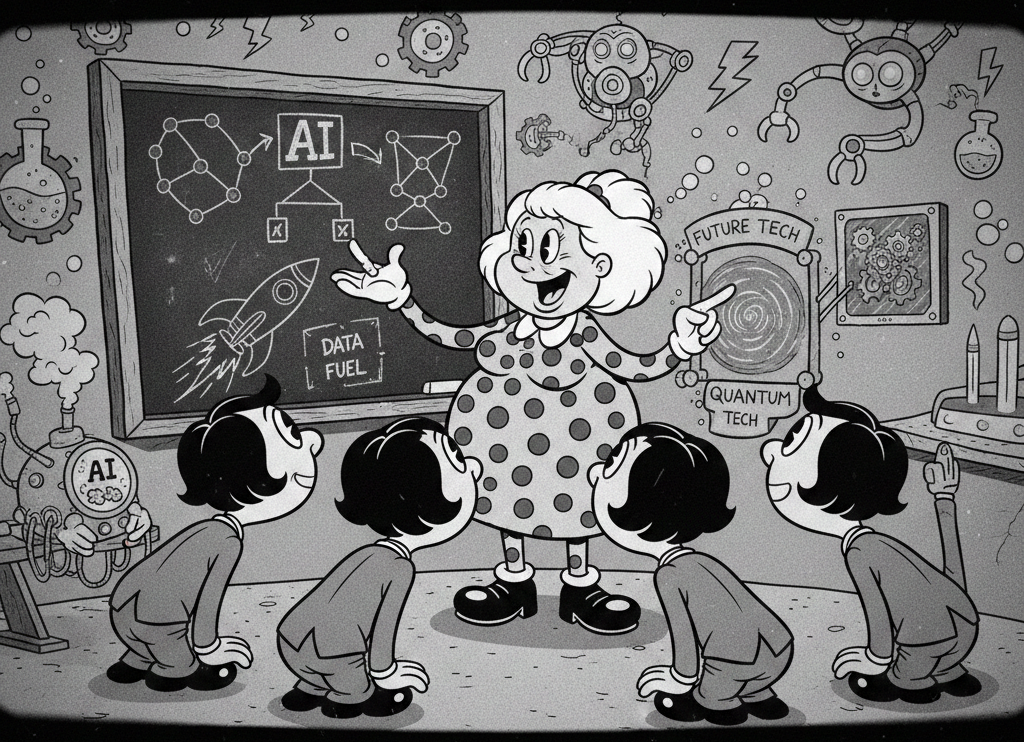
Did you know that I have a 70-year-old colleague in my workplace? She isn’t there for administrative support or odd jobs; she acts as a high-level consultant in a technical environment, grooming the next generation of product managers.
Her domain expertise stretches across 50 years. Starting as a designer specialising in woodcraft and furniture, she eventually made the bold transition into design education. That focus eventually shifted from “craft” to “people” when she stepped into the role of a school principal.
Later, she transformed again, learning to design complex systems as a “system owner” and was responsible for the processes and requirements used by teachers across an entire school network.
Today, her tacit knowledge of the EdTech landscape makes her invaluable. But it is her willingness to master new frontiers like Artificial Intelligence (AI) and Organisational Development (OD) that makes her rare. How many of us can say we have a 70-year-old peer with deep, institutional knowledge who is also the first to experiment with the future?
In my previous writing, I cited Masako Wakamiya as an example of an individual who flourished in tech despite her age. We often marvel at these figures as “exceptions”, assuming their achievements are unattainable due to luck or circumstance. However, looking beyond their accolades lies a “secret” to their success: one that combines three familiar psychological and professional frameworks.
1. Maslow’s Forgotten Pinnacle
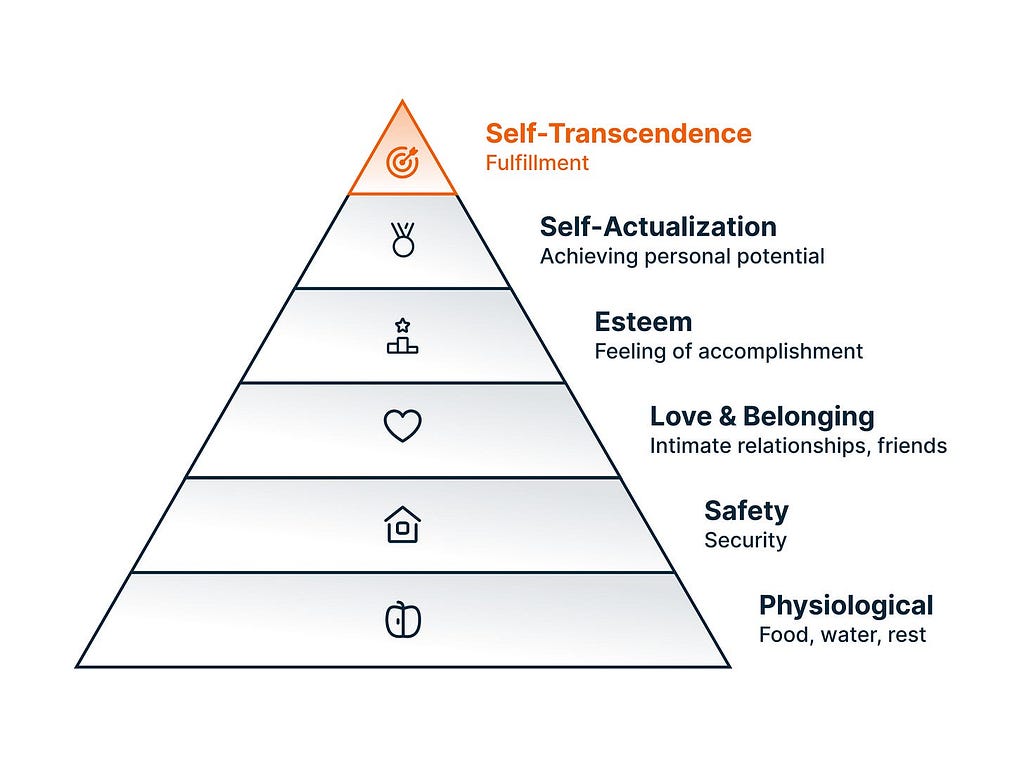
Most designers are familiar with Maslow’s Hierarchy of Needs. Usually visualised as a five-level pyramid, it explains human motivation: once basic survival and social needs are met, we can focus on self-actualisation.
However, toward the end of his life, Abraham Maslow realised that self-actualisation (realising one’s own full potential) wasn’t actually the “end” of human development. He added a sixth level: self-transcendence.
Self-transcendence is the desire to connect to something beyond the ego. It is a shift from “What can I get from the world?” to “What can I give to the world?” It is defined by:
- Altruism: Acting out of a genuine desire to help others without seeking personal gain.
- Peak Experiences: Moments of intense joy, awe, or oneness with the universe (often triggered by nature, art, or deep connection).
- Abolishing the Ego: Moving past self-consciousness to focus on higher goals like social justice or mentorship.
- Transpersonal Values: Living for truth, beauty, and excellence rather than just individual “success”.
Ageing does not automatically make one self-transcendent, but the conditions of a long career increase the likelihood of reaching it. This explains why a massive review of 51 studies (involving 178,000 participants) found that older adults were generally more “prosocial” than younger adults, specifically in the realm of sharing and providing for others’ needs.
2. The Triad Development Framework
In his book The 7 Habits of Highly Effective People, Stephen Covey (and the consultancy FranklinCovey) popularised a model for personal and organisational growth. To understand why seasoned experts stay relevant, we must look at how they balance these three pillars:
- Toolset (The “How” and “What You Use”): Toolsets involve the resources, technologies, and methodologies used to accomplish tasks. Probably the most common example is the mastery of software (e.g., Asana, Jira), physical equipment, and structured frameworks (e.g., Agile, Lean). Toolsets provide leverage but require more dimensions to accelerate progress and improve efficiency.
- Skillset (The “What” and “How You Do”): Skillset represents the specific competencies, expertise, and extended knowledge required to perform tasks effectively. This includes both technical skills (e.g., coding, data analysis) and soft skills (e.g., communication, critical thinking). Skillsets define execution. While toolsets earn the opportunity through signals, skillsets determine how far an individual can go in their career.
- Mindset (The “Why” and “How You See”): Mindset is the foundation. It refers to the attitudes, beliefs, and mental frameworks that determine how an individual or team perceives challenges and opportunities. Traits like growth mindset, resilience, curiosity, and accountability act as the “bridge” to a sustained, meaningful life. Without the right mindset, even the best skills and tools will fail to deliver long-term impact.
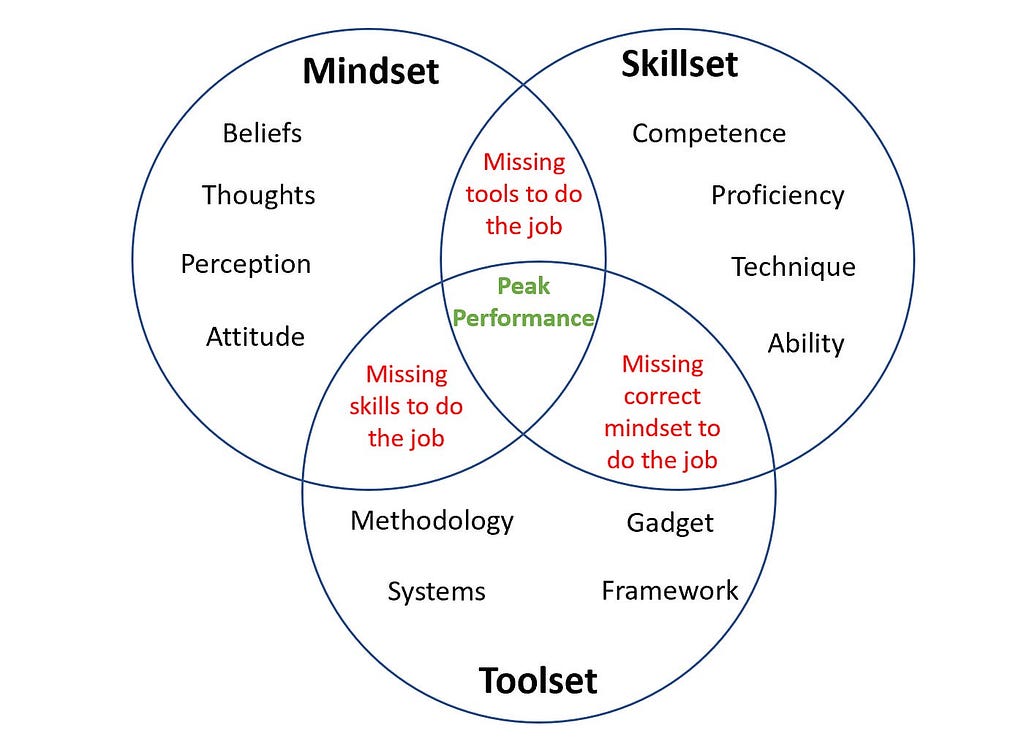
In our current obsession with AI, there is a massive risk of over-indexing on toolsets while neglecting the faculty of mindset. Tech companies, fuelled by the “Fear of Missing Out” (FOMO), promote a slanted emphasis on tools because they are easier to sell.
Older practitioners have lived through multiple technological waves. Because they have seen tools come and go, they are less likely to be rattled by a new software launch. Instead, they “stack” new tools onto a foundation of a mature mindset and a deep skillset.
3. Fluid vs. Crystallized Intelligence
A common criticism of ageing is the perceived deterioration of “mental load”. On the surface, older adults may have slower reflexes or take longer to learn complex new software from scratch. However, recent research suggests this isn’t a drop in intelligence but a shift in the type of intelligence.
In From Strength to Strength, Arthur Brooks outlines two distinct curves:
- Fluid Intelligence (The Innovator’s Curve): The ability to think flexibly and solve novel problems. This raw “intellectual horsepower” typically peaks in our 20s and 30s. It favours the young innovator who can process new information rapidly.
- Crystallised Intelligence (The Instructor’s Curve): The ability to use a stock of knowledge, experience, and wisdom accumulated over a lifetime. It is characterised by pattern recognition and the ability to synthesise complex ideas.


Crystallised intelligence increases through our 40s and 50s and remains high into our 80s. This is why my 70-year-old colleague thrives as a consultant and mentor. Her goal isn’t to “out-innovate” a 22-year-old in raw speed; her goal is to provide the synthesis that the 22-year-old hasn’t yet developed.
Synthesising longevity
When we merge these three frameworks, a clear picture of professional wisdom emerges:
- Wisdom is prosocial: As we age, our “Crystallised Intelligence” allows us to see patterns that others miss. When combined with “Self-Transcendence”, this intelligence is redirected toward helping others, making the seasoned designer the ultimate mentor.
- Flow through Transcendence: The ability to achieve a “flow state” often becomes easier with age because the practitioner has moved past the ego-driven anxieties of their youth.
- Mindset over Toolset: While learning new tools is essential for survival, the “Women of Wisdom” in our industry prove that a sustainable career is built on the “Why” (Mindset) and the “How” (Skillset), not just the latest “What” (Toolset).
Why does this matter for your career
The “So What?” for the modern designer is simple: Speed is a depreciating asset. There will always be a younger designer who can move pixels faster or a new AI that can generate layouts in seconds. If you only focus on being a “fast innovator” (fluid intelligence), your career has an expiration date. To design for 50 years, you must consciously transition from the Innovator’s curve to the Instructor’s curve.
Your action checklist
If you want to build a career with the longevity of a “Woman of Wisdom”, start these three habits today:
- Audit your learning: If 90% of your growth is spent on “Toolset” (software tutorials), rebalance. Spend at least 30% of your time on “skillsets” (systems thinking, psychology, or leadership), and “mindsets” (candor, care, or curiosity)
- Practise reverse mentorship: Don’t just teach your senior colleagues how to use the latest AI; ask them back on how they handled the shift from print to web or web to AI. Download their pattern recognition across the ages.
- Shift from portfolio to legacy: Start one project or initiative this year where you gain nothing personally (no portfolio piece, no raise) but which helps a junior designer succeed. This is your first step toward self-transcendence.
Back to my 70-year-old grandma. She is turning 71 this year, and has retirement active on her mind. Although we are likely to end our partnership with one another, she has left behind a strong sense of purpose with care for the people around her. She has inevitably become all of our grandmother: always watching out for the team, always adding a little something special, always imparting wisdom in a timely manner.
By moving toward self-transcendence, we stop designing for our egos and start designing for the legacy of the systems we leave behind. The veterans in our industry are a blueprint for remaining relevant, altruistic, and effective for generations to come.
Originally published at https://breathingdesign.substack.com.
The wisdom curve was originally published in UX Collective on Medium, where people are continuing the conversation by highlighting and responding to this story.