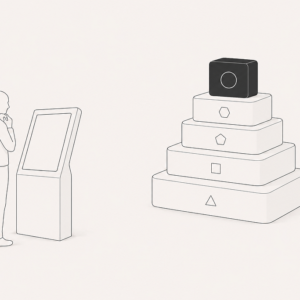
Maybe “mine” was never about origin. Maybe it was about what gets carried forward.
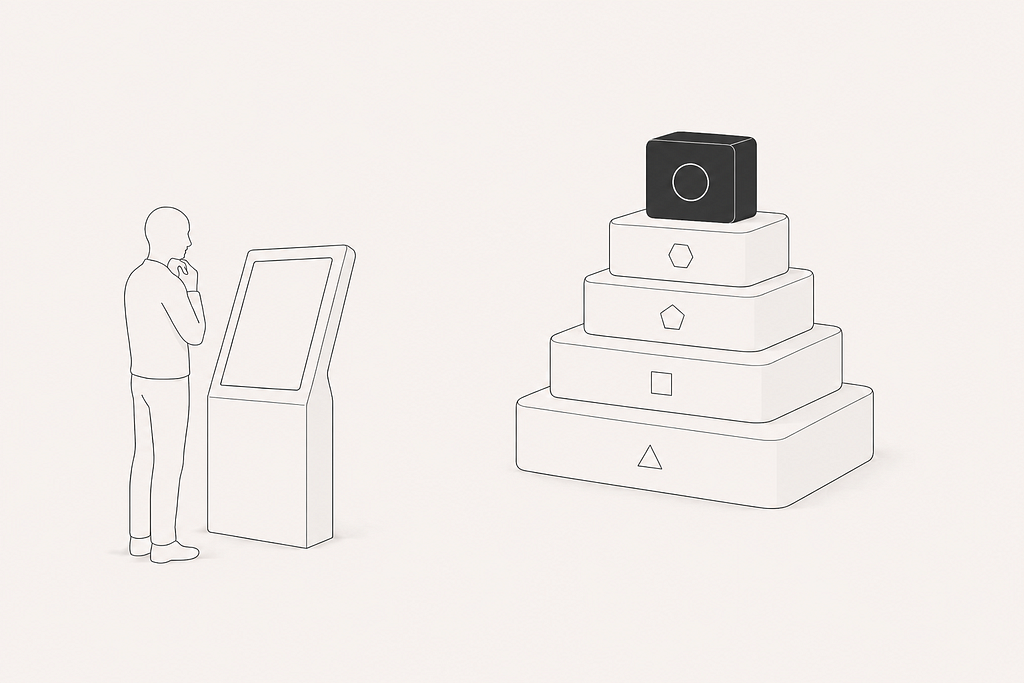
I’ve been trying to figure out when, exactly, an idea becomes mine.
Recently, I was working on a problem. It was some flow that wasn’t really working, and I did what I now often do: I opened Claude and started talking. Not with a clear prompt, really. More like thinking out loud into a box.
The first answer gave me something obvious, and not even that good. I pushed back. The second answer was less obvious and more refined, and I pushed back again. Somewhere around iteration ten, we landed on a framing I liked. Somewhere around iteration twenty, we landed on one I loved. That became the starting point for something I could make mine.
But no single turn in that conversation was brilliant. Claude didn’t hand me the answer. I didn’t hand Claude the answer. What happened is that the loop got fast enough to explore a space I probably would not have had the patience, or time, to explore alone.
Twenty iterations by hand would have taken me days. With Claude, it was an afternoon.
The output at iteration twenty was genuinely better than what I would have used at iteration five, which is where I would probably have stopped if I were working solo under pressure.
The uncomfortable question is whose idea that is.
For a while, I told myself: it’s mine, I steered. Then, it’s ours; we collaborated. But both answers felt like ways of closing the question too quickly. I realised I was trying to make the discomfort go away, rather than understand it.
Maybe the problem is not that AI makes authorship complicated but that it makes it visible.
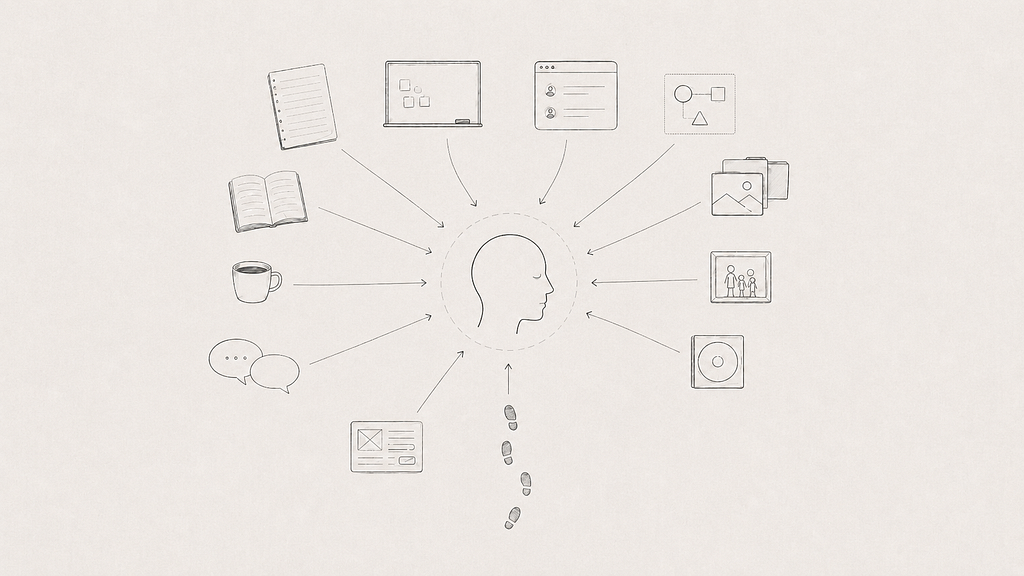
There’s an idea in philosophy called the extended mind, proposed by Andy Clark and David Chalmers in the late 1990s. The simple version is that thinking does not stop at the skull. Related work on distributed cognition makes a similar point: thinking often spreads across people, tools, artifacts and time. It leaks into notebooks, whiteboards, screens, diagrams, conversations, tools.
That sounds abstract until you do design work. Design has never been something that happens purely inside the head. You move a box and the page changes. The changed page changes your mind. You say something in a critique and hear that you don’t really believe it. You put a half-formed flow in front of someone else and their confusion becomes part of the work.
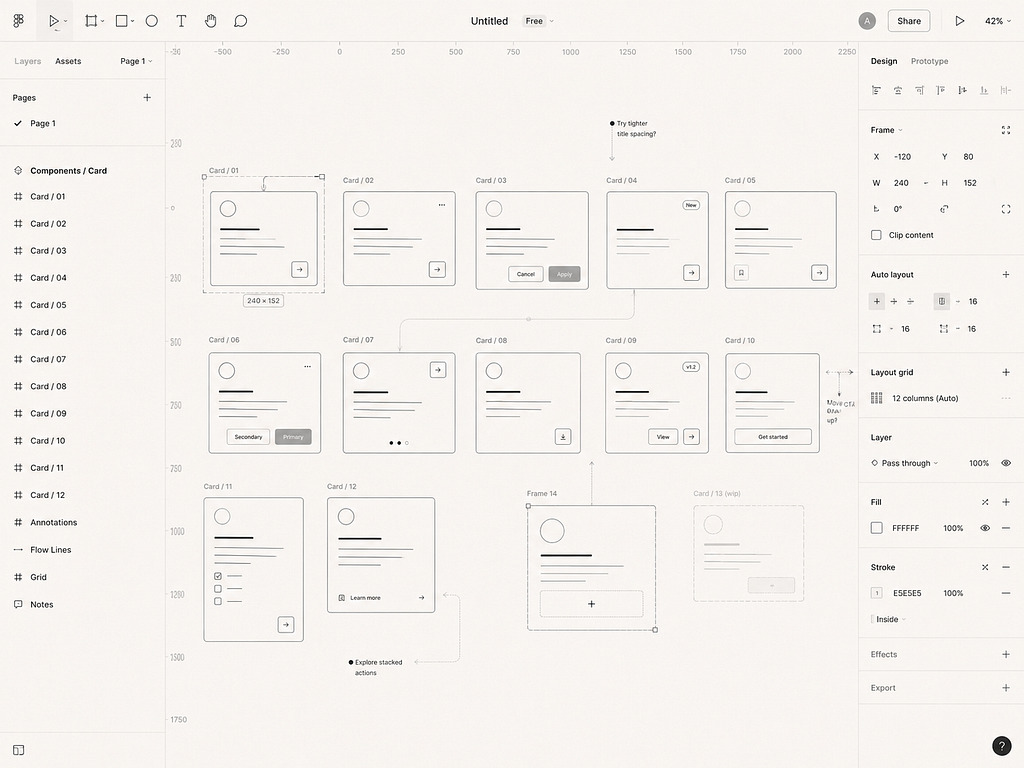
The artifact is not just the record of the thinking. The artifact is part of the thinking.
So maybe Claude did not introduce a new kind of creativity. Maybe it made one existing loop faster and more talkative. One loop, not the only loop.
That distinction matters, because it is easy to mistake speed for depth. Claude can help me generate twenty versions of an idea in an afternoon, but it cannot replace the slower material the idea has to be made from.
It cannot replace talking to users, reading the book that changed my perspective or the meeting where someone says something uncomfortable. It cannot replace walking away, making coffee, looking again or getting bored with your solution long enough to second-guess it.
It can help me work through the material, but it cannot choose the material for me.
The wrong conclusion would be: use AI more. I don’t think that’s it.
The iteration loop is useful, but I can’t live inside it. I still need to go outside it: talk to people, read things I don’t know yet, sit with a problem without typing at it and let boredom do some of the work.
And, probably, let some things remain inefficient. Because maybe not every part of thinking should be accelerated. Some inputs need time, references need years before they come back as instinct, some conversations only make sense later. Some ideas need to be forgotten before they can return as something useful.
That is where some of the current anxiety gets misdescribed. The risk is not only that we use AI too much. It is that we start feeding the loop with less life: fewer conversations, fewer books, fewer users, fewer strange references, less silence.
The strange part is not that the idea came from a loop. The strange part is that the loop kept receipts.
Where did my taste come from?
Designers I worked under. My favourite books. A manager who told me a layout I loved wasn’t working and was right. The way my professor talked about furniture. Fashion styles from old family photos. The covers of CDs I stared at as a teenager. Twitter, Dribbble, Behance. A thousand images saved to folders I forgot existed.
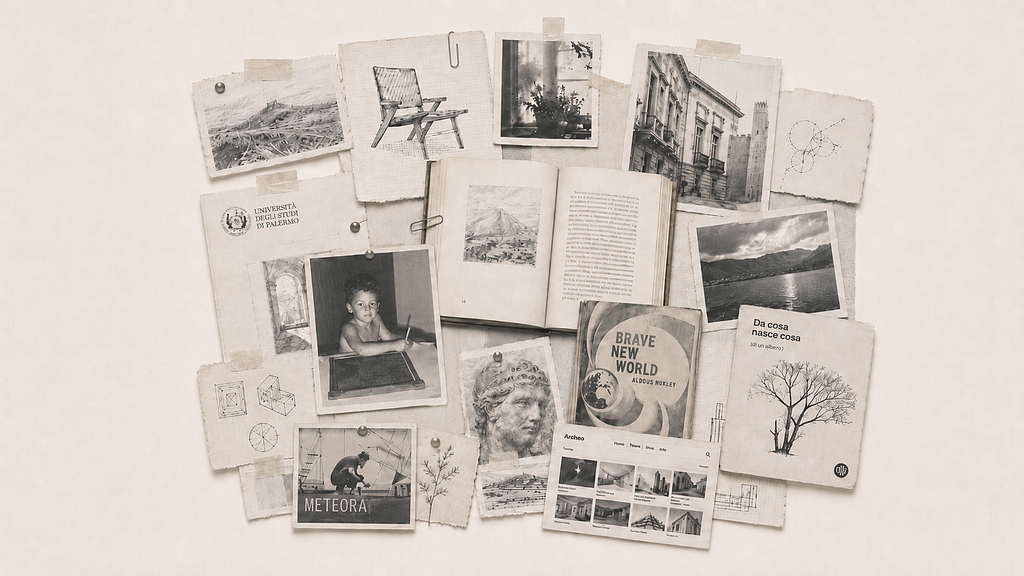
“The text is a tissue of quotations drawn from the innumerable centres of culture.”
— Roland Barthes, The Death of the Author
I did not generate my taste. I assembled it, mostly without noticing, from thousands of inputs that I now experience as me.
By the time taste becomes useful, it no longer feels borrowed. It feels like instinct, judgment and personality. But maybe taste is just influence after the labels have fallen off.
Kirby Ferguson makes a similar argument in Everything is a Remix: new work often comes from copying, transforming and combining what came before.
There’s a word from psychology that gets close to this: cryptomnesia. It describes the moment when you remember an idea but forget its source, so it feels like it originated with you. You don’t experience it as theft. You experience it as thought. Something comes back, but the little tag that says where it came from is gone.
I find that both embarrassing and comforting. Embarrassing because it makes originality feel less clean. Comforting because it explains something I think every creative person knows: we are full of other people.
When I sketch a flow, the thing that arrives on the page is the output of all that absorbed material. I don’t say, “the 2018 manager and I delivered this.” I say, “I delivered this.”
That’s not a lie. But it is a convention.
The convention works because the borrowing is invisible, distributed, slow, and unattributable. It doesn’t come with a neat list of references. You read a book and the book leaves something. That something mixes with something else. Six years later, something comes out of you and you call it yours.
Nobody can check, including you.
For a long time, that opacity was part of what made authorship feel safe. The more I think about it, the less the question feels like originality. It feels like recognisability.
Not: did every part come from me? The answer to that was probably always no. The better question is: what makes the final thing still recognisably mine after passing through so many other things?
It might sound like a bit of a stretch, but I’ve asked this before.
In 2014, I wrote my design thesis about evolving logos. The title was Progettare l’evoluzione, designing evolution. The subtitle was: Nothing lasts except change.
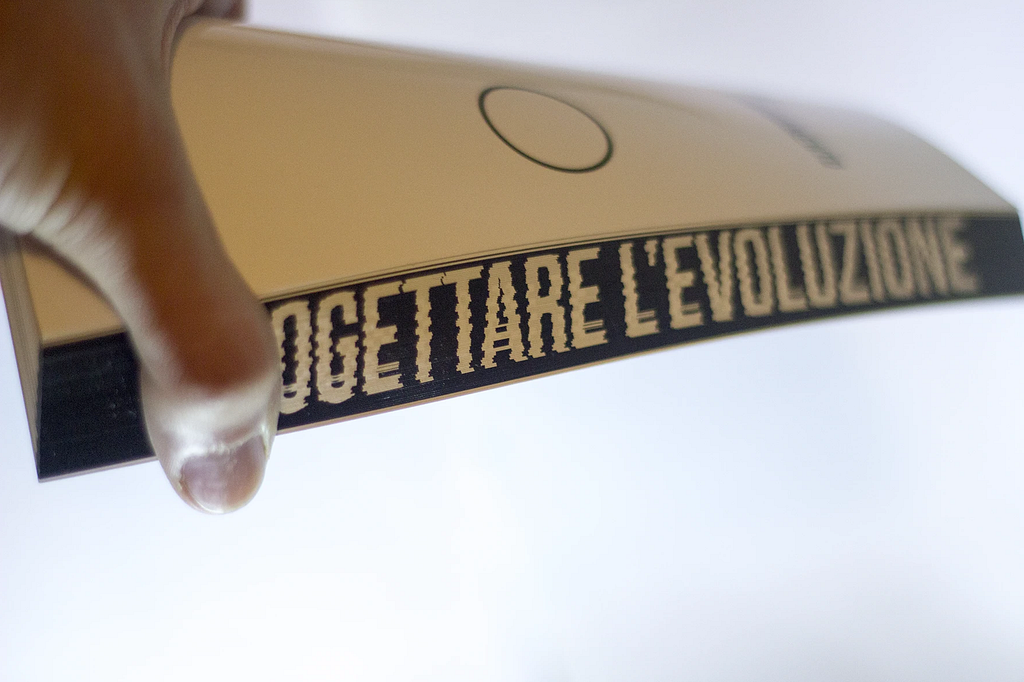
At the time I meant brands. I was interested in how a logo could evolve without becoming unrecognisable. How an identity could move through time while carrying something forward: a shape, a colour, a memory.
I spent months looking at marks that survived because they did not stay completely fixed. Alfa Romeo, Fiat, Renault. Identities that moved by keeping something still. Some changed almost imperceptibly and some changed radically and then had to find their way back. Others carried one element forward so stubbornly that everything else around it could move.
The question was not how to avoid change. The question was how to remain legible through it.
Apparently I’m continuing my nostalgic streak. My previous piece started with an old image I made in 2008; this one has sent me back to my thesis. Maybe I have been circling the same problems for too long.
That feels much closer to the Claude problem than I first wanted to admit. The fear is not that influence entered the work. Influence was already there. The fear is that, after passing through the machine, the idea might stop being recognisably mine.
That’s the part that makes the word “mine” wobble. Maybe “mine” is not the absence of outside influence. Maybe it is the continuity of selection: the pattern of what I keep choosing, rejecting, returning to, simplifying, defending.
Maybe authorship is not the fantasy of being untouched. Maybe it is the recognisable behaviour of a mind changing over time.
The Claude conversation is the same activity, sped up and made legible. Iteration twenty is the output of the same kind of loop that produced everything I’ve ever made: a loop between me and stuff that is not me, except now there is a chat history.
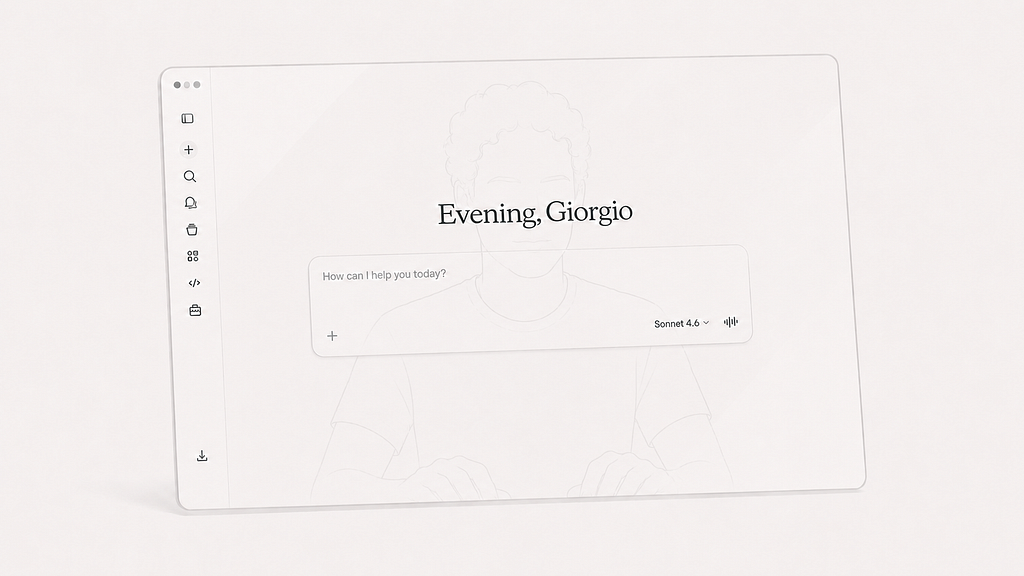
Now I can scroll back and see the suggestion I rejected, the phrasing I hated, the structure I almost missed, the line I accepted and then slowly convinced myself had been obvious all along.
The transcript is dangerous because it looks like evidence against me. It shows suggestions I didn’t make, phrases I didn’t write first, structures that arrived from outside.
But it is also evidence of judgment. Most of it was rejected, some of it was pushed further, some of it felt wrong for reasons I had to work out. And eventually, I decided the thing had become itself.
This is why iteration matters. Not because iteration magically washes away influence. Not because twenty prompts make something morally cleaner than three. Because the work is not the raw suggestion. The work is what happens through pressure.
A first AI answer is often just the average shape of an answer. Plausible and smooth. Almost lifeless. If I take that and deliver it, I have not made much.
But if I stay with it, argue with it, mistrust it, redirect it, bring in things it could not know, test it against scenarios it did not live through, then the loop becomes something else. Iteration is where judgment becomes visible.
The training data question matters. Ownership, disclosure, labour, consent: none of that is magically solved because I had a productive afternoon. But that is not the exact discomfort I’m trying to name here. I’m trying to understand what happens after the answer appears. Did I let the machine finish the thought, or did I use it to keep the thought open for longer?
Sometimes the AI version was wrong in a strange way. Not factually wrong. Not incoherent. Just too perfect. It kept trying to turn the discomfort into a solution, when the discomfort was the thing I was actually trying to understand.
That moment felt important, because the work was not in receiving a plausible version. The work was in noticing that plausible was not enough.
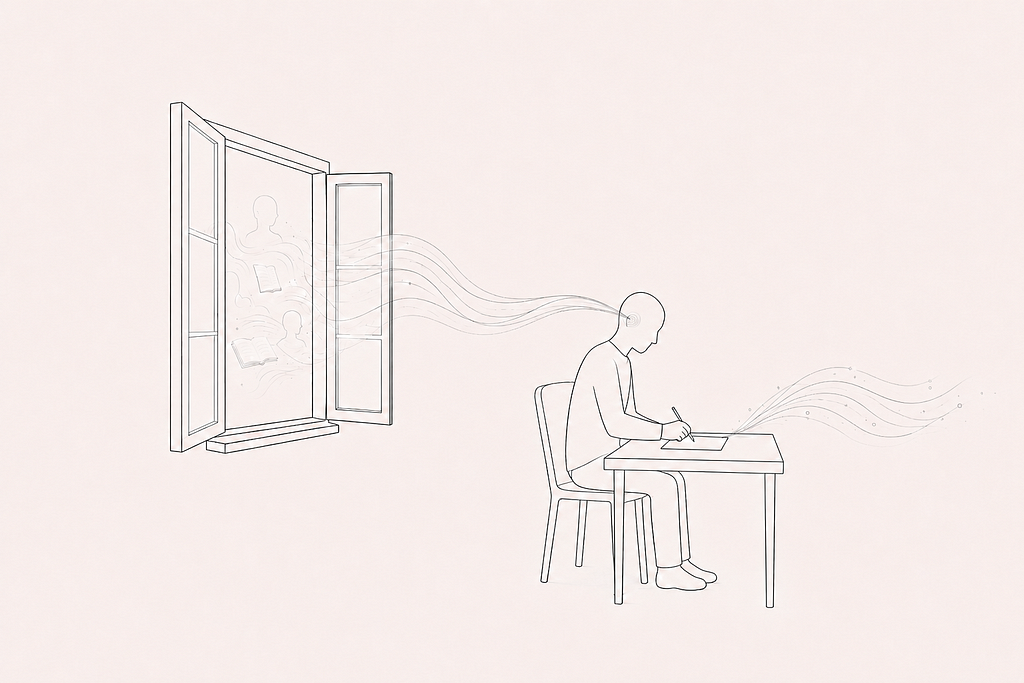
The myth was never simply “I made this alone.” Most of us know that isn’t completely true. We thank collaborators, cite influences, talk about references and make moodboards. But we still want a private place where the final transformation happens, where all the inputs become “mine”. A room nobody else can enter. A room without a transcript.
AI puts a window in that room.
That is the discomfort. Not that the work is assembled. That was always true. The assembly is now visible enough to make us uncomfortable.
Maybe the transcript is not a confession. It is just the process with less hiding: here is where I asked badly, here is where the model misunderstood, here is where I pushed back. Here is where I chose.
I chose.
And maybe that’s where authorship has to move. Away from the fantasy that I generated every part in a vacuum, and toward something more honest: I am responsible for the shape the thing finally took. I started the loop, sustained it, rejected most of what came back, recognised the good thing when it appeared, and decided when it was done.
That does not make the idea purely mine. But I’m not sure anything good has ever been purely mine in that sense.
Some part of me wants to call that cheating. And I notice that the part of me that wants to call it cheating is the same part that never asked where my taste came from in the first place. It was happy to accept all the invisible help. It only got nervous when the help started leaving traces.
In 2014, I was writing about logos and how to design an evolution without losing recognition. Now I think that can also apply to people.
A mind is a living identity system. It changes because it has to. It absorbs what it sees, it becomes outdated in places, it updates itself badly and then better. It carries forward old proportions and drops colours it once thought were essential. It borrows without always remembering where from.
And still, somehow, we recognise it.
Maybe that is what “mine” means: not pure origin, not solitary genius, not a sealed room. A constant inside the change. A particular way of carrying things forward.
Further reading
Andy Clark and David Chalmers, “The Extended Mind”
https://academic.oup.com/analysis/article-abstract/58/1/7/153111
Roland Barthes, “The Death of the Author”
https://en.wikipedia.org/wiki/The_Death_of_the_Author
Kirby Ferguson, Everything is a Remix
https://www.youtube.com/watch?v=zd-dqUuvLk4
American Psychological Association, “Plagiarism or Memory Glitch?”
https://www.apa.org/monitor/feb02/glitch.html
(I wrote this, but AI helped me shape it through endless iterations.)
The thinking was never just mine was originally published in UX Collective on Medium, where people are continuing the conversation by highlighting and responding to this story.