Stay relevant by honing your intuition, not your process
You likely know, or at the very least know of, a designer who just gets it. I’m talking about the designer who solves complex problems with elegant, user-centred, buildable solutions without breaking a sweat. Or maybe that designer who turns everything they touch into something genuinely beautiful. Or even the one who gets up on a stage and says what we’re all thinking more clearly and eloquently than we can. Maybe all three. Love or irrationally hate them, there they are, making the things that you struggle with daily look easy. You look skyward and wonder, “what is it they have that I don’t?”
The answer is intuition. They inherently understand what you don’t, and it’s the thing that separates good from great in every field. Paul McCartney just “gets” music. Einstein just “got” Physics. Chumbawamba just “gets” knocked down (and they get up again).
But what do we really mean when we say intuition when it comes to design, and why is it resurfacing so vehemently as AI comes into our practice, guns a-blazin’? And importantly, if you’re not feeling particularly intuitive today, how do you fix that? Can you even? The answer is everyone’s favourite “yes, but…”.
Intuition and Design
If you unpack the concept of intuition, what is it really? For psychologist Daniel Kahneman*, “intuition is thinking that you know without knowing why you do.” People who intuit correct solutions easily have trouble explaining their process in reaching them. (Zulz)
Cognitively, intuition is explained by unconscious processes, and might also be called “expertise”. The brain is very good at learning implicitly, and can compare stored memories, patterns, and even emotions with a current scenario without “thinking”. Your brain is even capable of activating what are called mental schemas, complex “chunks” of information, which is how I suddenly still know how to drive whenever I (rarely) find myself behind the wheel of a car. (Cockcroft et al.)
This figures into design as a practice more than other disciplines, because design trades in what are called “wicked problems”; those that are ill-defined, and lack a single “correct” solution. Design thinking pioneer Nigel Cross, writing in his landmark Designerly ways of knowing, separates design as a discipline, by the fact that it is solution, and not problem-focussed. (Cross 223). For Cross:
“What designers know about their own problem solving processes remains largely tacit knowledge — ie they know it in the same way that a skilled person ‘knows’ how to perform that skill. They find it difficult to externalize their knowledge, and hence design education is forced to rely so heavily on an apprenticeship system of learning.”(224)
Design-god Paul Rand, himself possessing a triumphant sense of intuition, stressed its importance, as a sense beyond instructions that can be followed, writing;
“No system of proportion, color, or space can possibly insure meaningful results. A system can be applied either intuitively or consciously, interestingly or boringly. There is always an element of choice, sometimes called good judgment, at other times good taste. Aside from practical considerations, in matters of form the typographer, for example, must rely on intuition.”
Intuition in design comes in many forms. For some, it’s finding harmonious visual balance– a nearly automatic application of Gestalt principles. For others, it’s an immediate jump to a solution that just works, or an immediate pivot from one that won’t. Maybe it’s that you connect the dots on where things are going naturally, without doomscrolling Medium. If you’re intuitive, you get to skip the steps. Within every superstar designer, you’ll find a refined intuition in some form or another.
(Note: Kahneman spends a large portion of Thinking Fast and Slow identifying breakdowns in intuition that we routinely make. So when I talk about intuition, it’s really intuition that turns out to be right. “Good intuition”. Lots of people trust their intuition and come to wrong answers, which is why it’s important to be critical of any idea that comes too easily. Gut-check your gut-check.)
Design’s Skill Cycle, AI’s Tornado
If you’re a student of history, or at the very least old, you know that change, when it comes to technology and work, follows a cycle. To begin, a small number of skilled workers produce a product or service that meets a need (demand). As that need expands, skilled labour runs short (supply), which triggers a process called de-skilling, which is exactly what you think it is; taking the skill out of the process in order to meet demand. This involves breaking down the process into small parts that can be done by anyone with training (think of the assembly line). Once a process has become as de-skilled as it can be, technology steps in and automates the process (once the cost of automation sinks below the cost of labour). This is classical economic theory, you’ll find it in both Adam Smith and Karl Marx.
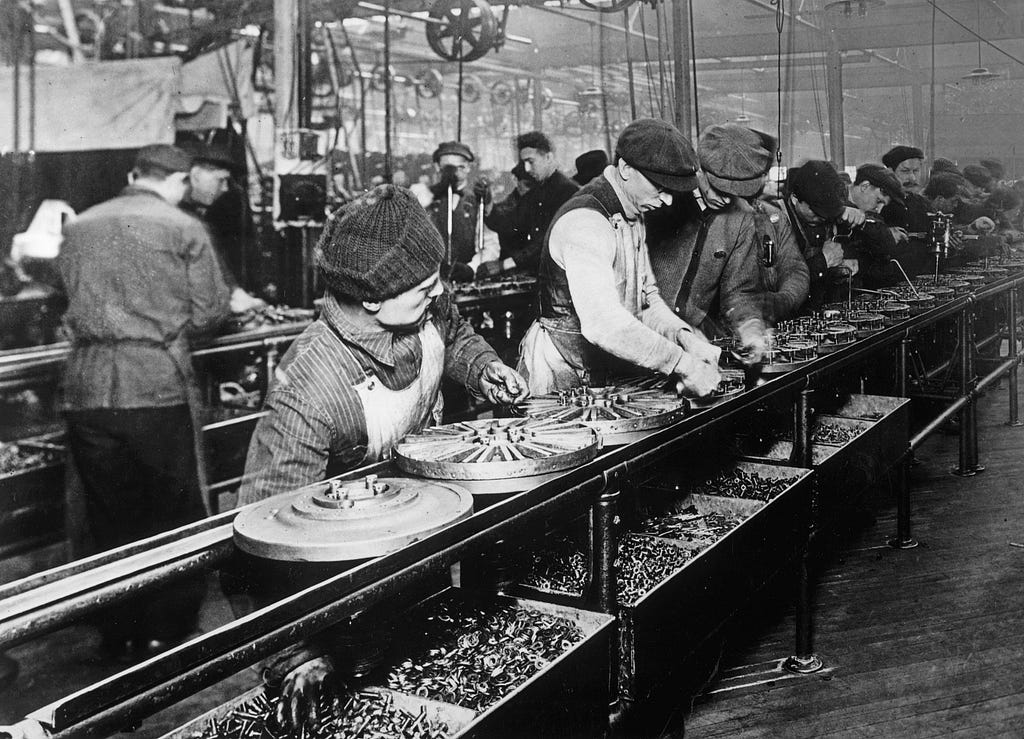
Design has been through this cycle more than once. The creation of movable type in the 1450s gave swathes of scribes the heave-ho, and launched the careers of typesetters, and printers. The need for more printed materials launched type foundries, and improved printing presses, de-skilling the printing process, and making it easier and cheaper to do. Eventually printing automated many of its processes, and the cycle began again.

By the time the personal computer started entering households in the 1980s, it brought with it desktop publishing, which wiped out the typesetting industry save for a small cottage industry. A new set of skilled designers emerged using those programs, the glut of materials produced expanded, and again automated.
Even product design (or UX, or whatever you call it) has been through this cycle before. Before UX software existed, designers used Photoshop (or maybe InDesign), slicing up assets, and redlining pdfs to hand to developers. As the demand for UX design has grown (thanks to the internet and an explosion of digital products), technical solutions have made it easier to do more with less.
UX today is well inside its de-skilling phase. With sky-high demand over the last decade, Human Computer Interaction, a field once reserved for artsy computer scientists, has ballooned into the field we know today. To meet the needs, it was imperative to de-skill the job. That began with the expansion of design education, and the creation of the “design process” in a formal way. UI kits, design systems, best practice resources, heuristics, playbooks, as well as the absolute dominance of easy-to-use Figma in the field has made it easier than ever for someone with minimal training to “trust the process” and expect that the outcome will be good. A conglomeration of a slim few tech companies that steer the look and feel of virtually all digital products means that they set “best practices”, and those are easy to copy. Even the separation of the production process into product, design, and engineering is itself a breakdown of a very complex system into more isolated parts. Not quite the assembly line, although sometimes it might feel that way.
But what’s the next step after de-skilling? Automation. We’re seeing it happen live, right now. When Jakob Nielsen posts about Gemini potentially producing better UI than humans, you might feel a bit like a blacksmith pounding a horseshoe while a car rolls by. AI brings with it an automation of the parts of the information economy (and just the economy at large) that have de-skilled. UX design as we know it is most certainly in that category.
(A side note about progress: Do we care if it’s bad? No! As much as we like to grump about how things were better back when ______(insert thing here), fortune typically favours the cheap over the good. Hooray for Capitalism! Will AI-generated UI initially suck? Yes. Will that stop it from becoming the default? No, not if you believe that history rhymes. Early assembly line produced products were horribly bad, but here we are.)
The re-rise of the intuitive designer
Don’t call it a comeback. But let’s look at the facts. AI can produce UI today. And tomorrow it’ll be a little better at it. Generative AI uses both training and models of inference to produce results. And it’s capable of producing multiple solutions at once, very quickly. Any principles or best practices or research that you’re working from can be ingested. So if your design skillset is centred around your diligence in following a process, or your ability to operate design software, well, things don’t look great for you.
Claude designer Jenny Wen, speaking at last year’s HATCH conference, said the quiet thing loud. In her talk “Don’t trust the process,” Wen observes that the good design work she’s seen happen is rarely a product of process, and instead born from intuition and play. The reality is that the pace of work has accelerated, and the “discover” phase of the design process is increasingly seen as extraneous, given that an automated solution can come quickly (to be clear I don’t personally love that this is happening, but it IS happening).
https://medium.com/media/7631d3b179288f2cc8ef6cdffde5e9b5/href
Not that they were unsuccessful before, but here is where the intuitive designer proves themselves to be more relevant than ever, perhaps exclusively relevant. Intuition provides the things that AI can’t do better– it can bring novel solutions to the table, and make judgments about potential solutions without certainty. Design intuition can also interrogate the problem, and the requirements set to ensure that they truly align. Recall the quote (apocryphally) attributed to Henry Ford, that goes: “If I had asked people what they wanted, they would have said faster horses”. AI can think of faster horses, intuition can think of cars. This has prompted some thinkers to posit the move from a knowledge-economy, to an intuition economy. (Rudin)
If the future of design involves democratising skills through automation by wielding AI tools, Wen says it best: “In a world where anyone can make anything– what matters is your ability to choose and curate what you make.” (Wen)
Let’s get intuit(ive)
Just as following a recipe doesn’t make you a great chef and learning dance steps doesn’t make you a great choreographer, flawlessly executing every step of the design process doesn’t make you a great designer. Bridging the gap requires using your intuition to elide processes, and to make correct decisions hundreds of times as you design.
If you’re feeling a little glum, and not particularly intuitive today, fear not. Intuition is like a muscle, and just about anyone is capable of building it.
One way is simply, experience. That’s not to say job experience, but it certainly helps. The more design you experience, the more you’ll build mental schemas and memories around design. Look at design, lots and lots of design. Think about it. Think about why things look the way they do, why this solution has been chosen. If it resonates with you, think about why that is. Develop your sense of taste. Have an opinion!
Understanding how something actually works might give you more perspective on the problems present, and the solutions available, and might allow you to make connections others can’t see. The great artist Michelangelo spent a creepy amount of time watching dissections, and even performing some. He was able to apply that knowledge to painting and sculpting in ways that showed the true dynamism of the human figure. If you’re a car designer, you should know how metal works. If you’re a digital designer, you should understand code.
Of course, design is not all about the artefacts, it’s about the people who use them. It’s not surprising that many a great designer, musician, artist, etc. turn out to be either charismatic or provocative. What resonates with people in the work is intuitive to the maker. You need to understand people. For UX designers, there’s a lot to know about how humans notice, perceive, understand, and generally think that should impact your decision making. Humans also exhibit biases, and while we can’t avoid them, we can study and understand them. Ultimately, you can turn all of this information back on yourself, and understand how and why you might be drawing conclusions.
Finally, design. And collaborate with others who do. With each problem you solve, the more you have to draw on for the next one. Collaboration and play, and time spent with peers and mentors are amazing ways to broaden your horizons. These are the reasons artistic movements, “schools” of thought and practice, musical scenes, and even elite sports dynasties succeed. Even a little healthy competition sparks the need to be creative and intuitive (consider men’s tennis’ “big three,” who collectively spent 900 weeks at number 1, who all claim that competition pushed them to new heights). While no one can teach you actual intuition, you can learn it “from” others.
Of course, none of your intuition matters if you ignore it. It’s time to listen to that perhaps quiet but still persistent voice in your head that tells you when you’ve really nailed it. Trying to be more like a machine is a losing battle. Might I suggest leaning into the whole “being human” thing.
***
Thanks for reading. Find me on LinkedIn.
References
“🧠 106 Cognitive Biases & Principles That Affect Your UX.” 🧠 106 Cognitive Biases & Principles That Affect Your UX, growth.design/psychology. Accessed 27 Jan. 2026.
“Technological Unemployment.” Wikipedia, Wikimedia Foundation, 7 Jan. 2026, en.wikipedia.org/wiki/Technological_unemployment.
“What Are the Gestalt Principles? — Updated 2026.” The Interaction Design Foundation, IxDF — Interaction Design Foundation, 26 Jan. 2026, www.interaction-design.org/literature/topics/gestalt-principles?srsltid=AfmBOorMb2L-KAfUCTrxzXSvboGPJfw73wM13Zk12rlL_yzBmTRDVzhV.
Cross, Nigel. “Designerly ways of knowing”, Design Studies, Volume 3, Issue 4, 1982,Pages 221–227, https://www.sciencedirect.com/science/article/pii/0142694X82900400. Accessed Jan 2026.
Jamie P. Cockcroft, Sam C. Berens, M. Gareth Gaskell, Aidan J. Horner,Schematic information influences memory and generalisation behaviour for schema-relevant and -irrelevant information. Cognition, Volume 227, 2022 https://www.sciencedirect.com/science/article/pii/S0010027722001913. Accessed Jan 2026.
Harrison, James. This is your brain on design: using cognitive science to design effective experiences. UX Collective. July 21, 2022. https://medium.com/loblaw-digital/this-is-your-brain-on-design-using-cognitive-science-to-design-effective-experiences-fb6b402047a5
Kahneman, Daniel. Thinking, Fast and Slow. Penguin Books, 2024.
Nielsen, Jakob. Generative UI from Gemini 3 Pro, Jakob Nielsen on UX, 19 Nov. 2025, jakobnielsenphd.substack.com/p/generative-ui-google.
Rand, Paul. “Observations on Intuition.” Paul Rand, www.paulrand.design/writing/articles/1987-observations-on-intuition.html. Accessed Jan 2026.
Rudin, Peter. “The Power of Intuition in Scientific Discovery and Ai.” SINGULARITY 2030, singularity2030.ch/the-power-of-intuition-in-scientific-discovery-and-ai/#:~:text=According%20to%20Nobel%20Prize%20Winner,without%20logical%20arguments%20or%20evidence. Accessed 27 Jan. 2026.
Zulz, Emily. “Daniel Kahneman: Your Intuition Is Wrong, Unless These 3 Conditions Are Met.” Thinkadvisor.Com, ThinkAdvisor, 16 Nov. 2018, www.thinkadvisor.com/2018/11/16/daniel-kahneman-do-not-trust-your-intuition-even-f/?slreturn=20181029115737.
Wen, Jenny. “ Why Designers Can No Longer Trust the Design Process.” Hatch Conference, YouTube, www.youtube.com/watch?v=4u94juYwLLM. Accessed 27 Jan. 2026.
The return of the intuitive designer in the age of AI was originally published in UX Collective on Medium, where people are continuing the conversation by highlighting and responding to this story.