Why design decisions take 5x longer to approve — and what to do about it
Every design decision carries a surcharge.
When your engineering counterpart walks into a meeting and says “we need to refactor the authentication module,” the room nods. It’s technical. It sounds expensive to ignore. Nobody asks for a prototype.
When you walk into the same meeting and say “we need to simplify the onboarding flow”, suddenly you need data. User research. A competitive analysis. A prototype. A business case showing projected impact on conversion. And even then, someone will ask: “But can’t we just add a tooltip?”
I’ve been paying this surcharge for 15 years — as a design agency founder, as a product designer building analytics tools, and now as a Chapter Lead managing 7 designers at a European bank. I call it the justification tax.
It’s not malice. It’s not ignorance. It’s structural. And it’s costing your organization more than you think — not in design hours, but in deals never closed, products never shipped, and designers who eventually stop proposing ideas altogether.
Or leave.
Where the tax shows up
You feel it in the small moments first.
The weekly sync where engineering presents a technical migration plan in three bullet points and gets a thumbs-up — while your onboarding redesign, backed by two weeks of user research, gets “let’s revisit this next sprint.”
The stakeholder review where a product manager’s feature priority gets debated on merit, but your interaction pattern change gets debated on taste. “I’m not sure I like the way that feels.” You’ve never heard anyone say that about a database schema.
The quarterly planning where infrastructure gets a dedicated budget line and design gets “we’ll find time for that.”
John Maeda put it well:
“Over half the designers still want to make things beautiful and can’t help it. To a business person that seems irrelevant. To the developer, it’s like, ‘I have to build that.”
Three disciplines, three languages, one meeting — and design is the only one expected to translate into the other two.
The tax isn’t one dramatic moment. It’s the accumulation of a hundred micro-negotiations where design carries the heavier burden of proof. It’s writing the business case that engineering didn’t need to write. It’s finding the data point that finance was never asked to find. It’s the extra hour preparing for a meeting that your counterparts walk into with a Post-it note.
And over years, it compounds.
When design breaks through
Sometimes the tax gets bypassed entirely. Not through better decks or more data — but because someone builds the thing nobody asked for.
A few years ago, I was working at Kantar — one of the world’s largest market research and data analytics companies. My role was fairly defined: review what developers were releasing, check for consistency, improve using existing component libraries. Important work. Also, after a few months, mind-numbingly boring.
So I started doing concept work that wasn’t on anyone’s roadmap.
Kantar’s main product was an all-in-one tool for sales agents — order tracking, store performance, sales peaks, agent bonuses. Everything lived on desktop. But these agents spent their days walking store to store. They didn’t sit at desks. They carried bags and clipboards and, increasingly, tablets.
I designed a tablet-first version of the entire experience. New information architecture, new interaction patterns, optimized for one-handed use between store visits. Then I built a mobile companion — quick access to the visiting schedule, route planning, ETAs. Nobody asked for any of it.
Then I did something that, in hindsight, changed my career. I pitched it directly to the CEO.
Not a deck. Not a document. I organized what I called a concept car event — inspired by the automotive industry, where manufacturers show vehicles they may never produce, just to demonstrate what’s possible. I invited the entire leadership team, including executives dialing in from Italy.
The reaction was immediate. They didn’t critique the typography or question the color palette. They saw the product. They saw the market position. One of the Italian leaders had an upcoming sales pitch to Barilla — the pasta giant — and he wanted to show my mockups as “work in progress.” A behind-the-scenes look at where the product was heading.
These were concept cars. There was no engineering plan, no timeline, no budget. They existed only in Adobe XD.
Barilla signed a multi-million euro deal, contingent on being the first client to use the new products.
I was promoted to oversee the implementation. The design team was expanded. For a brief, beautiful moment, the justification tax was zero. The concept car had sold itself.
…And why it still didn’t matter
Here’s the part nobody writes about.
The deal was signed. The leadership was excited. I had the mandate, the team, and the credit.
Except the product was built on a foundation that couldn’t support it.
Kantar’s codebase was legacy old. The kind of technical debt that isn’t a line item on a sprint board but a structural reality that shapes every decision the company makes. Rebuilding the architecture to support what I’d designed would have cost more than the organization was willing to invest, regardless of the Barilla deal sitting on the table.
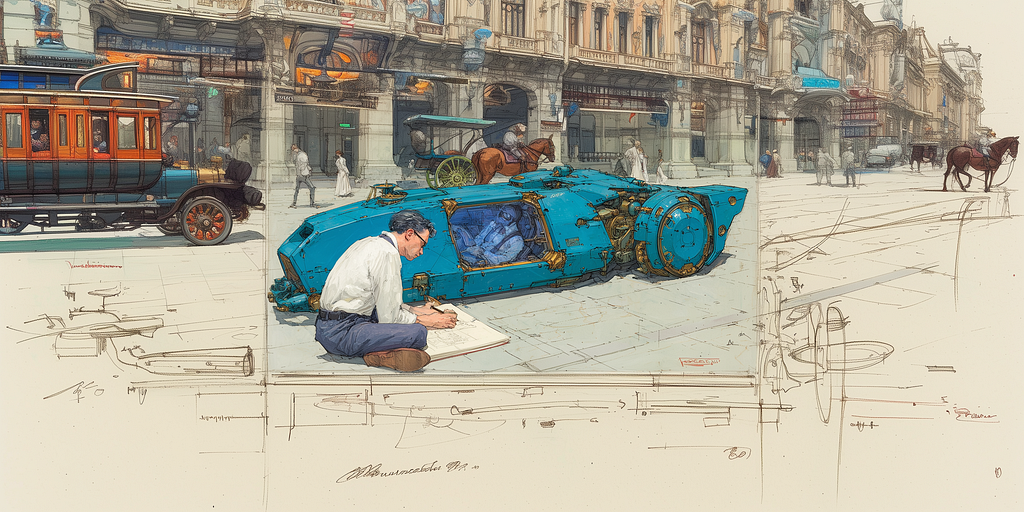
So they did what organizations do. They compromised. The concept car got bolted onto a horse carriage.
My tablet-first experience was squeezed into the existing desktop framework. The mobile companion was scoped down to barely functional. The vision that had landed a multi-million euro deal was diluted by the reality of what the system could deliver.
Nobody made a bad decision. The CEO wasn’t wrong to be excited. The Italian leader wasn’t wrong to pitch the mockups. The engineering team wasn’t wrong to flag the cost. Everyone was rational. Everyone was doing their job.
The system just couldn’t hold both conversations at the same time — where the product should go and what the product could do today. Innovation lost, not because it was rejected, but because it was absorbed. Made compatible with existing constraints until it was no longer recognizable.
I left shortly after.
And that’s the hidden cost of the justification tax that never shows up in a quarterly report. It’s not just slower decisions. It’s the gradual erosion of the people who generate the ideas worth justifying. The designer who builds concept cars eventually realizes the garage only fits horse carriages — and starts looking for a different garage.
The organization keeps running. The deal gets delivered in some form. But the next concept car never gets built — because the person who would have built it is gone.

The structural problem
Jared M. Spool once noted that designers have
“spent much of the last couple of decades trying to justify our existence.”
He’s right — but the question is why. It comes down to three structural realities most companies never examine.
First, design is visible. When you redesign an onboarding flow, everyone can see it and have an opinion. When engineering refactors an authentication module, nobody sees anything. Visibility invites scrutiny. Invisibility earns trust by default.
Second, design outcomes feel subjective. They’re not — there’s data behind every good design decision — but they feel that way. A CFO looks at a conversion rate and sees a number. The same CFO looks at a redesigned dashboard and sees a color scheme.
Third — and this is the one nobody talks about — most organizations evaluate design like a cost center, not like strategy. Engineering has deployment metrics, test coverage, uptime. Finance has margins, forecasts, compliance. Design has… satisfaction scores that take months to move? The measurement infrastructure simply doesn’t exist. So design leaders build it themselves, meeting by meeting, deck by deck. That’s the tax.
A reader of my previous article (FALD Studio) put it sharper than I could:
“Design decisions have been structurally positioned downstream of strategy, which means every decision requires justification to stakeholders who already defined the problem without you.”
When the decision-maker comes from a technical background, the conversation gravitates toward system stability. When they come from finance, it gravitates toward cost reduction. In both cases, design has to translate — not just the idea, but the entire value system behind it.
Most of us don’t work at companies where design drives strategy at the top. So we pay the tax.
Reducing the tax
You can’t fix it overnight. But you can reduce the rate.
Stop speaking design. Start speaking consequence. The single biggest accelerator I’ve found is removing design language from design conversations entirely. “We should simplify this flow” gets questioned. “We’re losing 34% of users between step 2 and step 3, and here’s what that costs us per quarter” gets funded. Same problem, different language — one carries tax, the other doesn’t.
Show, don’t argue. My Kantar concept car worked because nobody debated a slide deck. They reacted to a product they could see and immediately understand. This is where AI is changing the game. Today, I can feed a design system’s tokens to an AI prototyping tool and produce a working concept in hours instead of weeks. Not production code — but real enough that the conversation shifts from “should we explore this?” to “when can we ship this?” The concept car used to take months. Now it takes an afternoon.
Pre-align before the meeting. The worst place to make a design argument is in a meeting with twelve people. A ten-minute conversation the day before is worth more than a forty-slide deck the day of. Find the person who’ll ask the hardest question and answer it privately. Find the person who’ll champion your idea and give them the language. By the time the meeting starts, the decision should feel inevitable.
Build the measurement infrastructure. If your organization doesn’t have a way to measure design impact, build one. Don’t wait for permission. Pick one metric, track it for a quarter, present it in your CFO’s language. “Our redesigned onboarding increased 30-day retention by 8%, representing approximately €X in annual customer lifetime value.” One proof point makes the next conversation easier. And the one after that, easier still.
The tax decreases every time you pay it well. Each business case you land, each prototype that convinces a room, each metric you connect to design work — it compounds. You’re not just winning the current argument. You’re building infrastructure so the next one is shorter.
The tax is the job
I’ve been paying the justification tax for fifteen years. At a design agency I built from scratch. At a VoIP company where my prototypes ended up in a NASDAQ earnings report. At a European bank where I lead seven designers through the daily reality of translating design value into business language.
The tax is real. It’s structural. And it’s not going away.
But here’s what I’ve come to believe: the justification tax is exactly what makes design leadership valuable. It’s the hard part. The part AI can’t automate, junior designers can’t shortcut, and organizations can’t outsource. The ability to sit in a room full of people who think differently than you, who evaluate the world through entirely different frameworks, and make them see what you see — that’s not overhead. That’s the job.
The designers who learn to pay the tax efficiently won’t just survive the next decade. They’ll be the ones the organization can’t afford to lose.
And the organizations that learn to lower it? They’ll be the ones that keep their best people — and land the deals that concept cars are made of.
If this resonated, I’d love to hear your version of the justification tax. What’s the last design decision you had to over-justify? Drop it in the comments — I read every one.
This is Part 2 in a series about what design leadership actually looks like in 2026. Part 1 — The 80% Job: how design leads are using AI — and it’s not about mockups — explores the full reality of where your time goes as a design lead.
If you manage designers or work alongside them, follow me for the next piece in this series.
Resources & referrals:
- Jared Spool on “Everyone’s a UX Designer” — User Defenders Podcast
- John Maeda: “In reality, design is not that important” — Fast Company
- The Making of a Manager by Julie Zhuo
The justification tax was originally published in UX Collective on Medium, where people are continuing the conversation by highlighting and responding to this story.