
How chat, voice, and agentic AI are rewriting the first principles of UX design
Note: I used AI tools to refine grammar and phrasing in this article. Every idea, argument, and example is drawn from my own work — seven years designing AI products, building agentic retail experiences at Walmart, and a US patent I hold on intent-based AI recommendation interfaces. The AI assistance was editorial, not generative.

There’s a question I keep coming back to when I look at what’s shipping in 2026: what exactly are we designing anymore?
For thirty years, the answer was obvious. We designed screens. Menus, modals, buttons, carousels. We organized information into hierarchies, drew flows between states, and obsessed over pixels. The desktop metaphor: windows, folders, files, gave us a shared vocabulary, and we built an entire discipline on top of it.
That vocabulary is now breaking apart.
Not disappearing. Breaking apart, splintering into multiple new dialects that barely resemble each other.
Users today interact with software by talking to it, delegating tasks to it, and increasingly, not interacting with it at all because it’s already handled things in the background. The screen is still there, but it’s no longer the primary surface. The form factor itself, the fundamental contract between a person and a product is in flux.
This isn’t a trend piece about dark mode or rounded corners. This is about something more structural: the three new interaction paradigms that are reshaping what UX design actually means, right now, with real companies shipping real products.
Act I: The chat paradigm — when the interface becomes a conversation
The first shift happened fast enough that we almost didn’t notice it was a design problem.
In 2022, most people had never typed a natural-language command into a product interface. By 2025, 73% of businesses were using some form of conversational interface for customer interactions.
The text box became the most-visited UI element in the world.
But the early implementations revealed something interesting: chat is not inherently good UX. It’s a modality. And like every modality, it works brilliantly for some things and catastrophically for others.
This is a distinction Erika Hall draws precisely in Conversational Design (A Book Apart, 2018) — arguably the sharpest book written on this subject. Hall argues that conversation is the right design choice only when the system needs to negotiate meaning with the user. When the user already knows what they want — “add to cart,” “filter by price,” “submit the form” — conversation is overhead. Structure is faster, more accurate, and less exhausting. Conversation earns its place only when intent is genuinely ambiguous: when the user is exploring, when their goal is fuzzy, when they need the system to meet them partway.
This framework changes how you evaluate chat implementations in the wild. The products that figured it out early didn’t go all-in on chat. They built hybrid interfaces , structured UI for known, predictable tasks; conversational AI for open-ended, exploratory ones.
Notion’s AI sidebar sits beside your document without replacing it. Linear’s command palette handles the ticket you know you want to create, while its AI layer handles the ambiguous question (“what’s blocking the mobile team?”).
GitHub Copilot doesn’t delete your IDE and replace it with a chat window — it whispers suggestions inline, inside the environment you already live in.
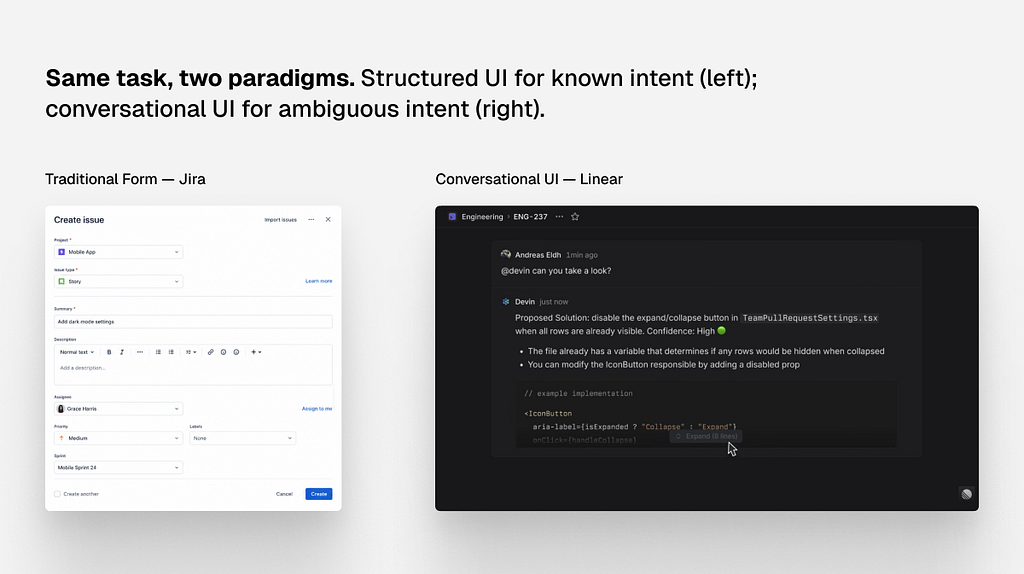
This distinction matters enormously. There’s a useful framework emerging in the industry: use structured GUI when the user’s intent is known, use conversation when intent is ambiguous.
The mistake that early chatbot deployments made, and that some products still make is treating chat as a universal solvent. It isn’t.
It’s a specific tool for a specific epistemic state: when the user doesn’t yet know exactly what they want, or can’t easily express it in clicks and forms.
This is the same principle embedded in my patent on multi-level intent-based recommendation systems, which distinguishes between micro-level intent (high-confidence, same-category requests) and macro-level intent (exploratory, cross-category goals) to determine which interaction mode to activate. Hall’s framework and that patent are describing the same underlying truth from different vantage points: intent clarity should determine interface mode, not the other way around.
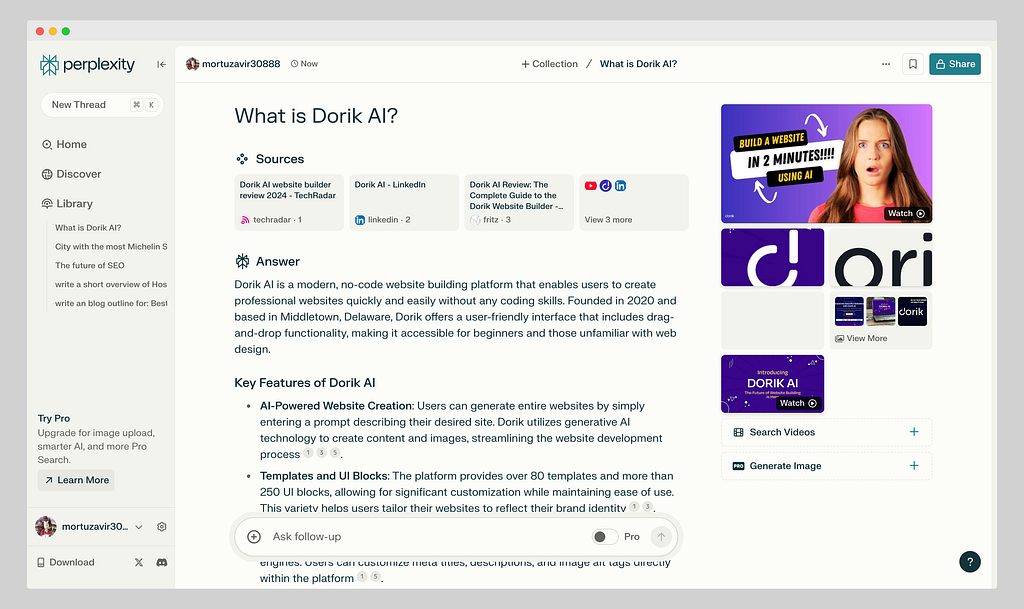
Perplexity understood this. Rather than building a better search box, they built a system that generates purpose-built answer pages — prose summaries, source citations, follow-up questions, structured data — assembled in real time around what you’re trying to understand.
Researchers have named this pattern “Generative UI”: instead of navigating to an app, you express what you want, and the interface assembles itself to serve that specific need.
The UX implication is profound. If the interface can be generated dynamically, the designer’s job is no longer to design every state — it’s to design the system that generates appropriate states. You’re writing grammar rules, not sentences.
The craft questions also evolve. Streaming responses (where text appears word-by-word, like someone typing) turns out to be a massive trust signal — users perceive the system as actively working, not frozen. Visible stop buttons during generation give users a sense of control over something that otherwise feels opaque. Source citations with clickable links transform a chatbot from an oracle into a collaborator. These are micro-interaction decisions with macro-level implications for trust and adoption.
Act II: The voice paradigm — the ear as the new screen
Voice interfaces have been promised, and under-delivered, for a decade. The smart speaker era taught us that “ambient computing” sounds beautiful in press releases and frustrating in kitchens.
But something shifted in late 2025, and it came from an unexpected direction: the ear.
Apple’s announcement of Siri AI in June 2026 is the clearest signal of where this is going. The new Siri isn’t a voice assistant bolted onto a phone. It’s a cross-device conversational layer — you start a question on your iPhone, continue it on your iPad, and the conversation persists. It has onscreen awareness (it can see what you’re looking at), personal context understanding (it knows your emails, your calendar, your photos), and runs the most powerful on-device model Apple has ever shipped, with privacy-preserving on-device inference for sensitive queries. Apple is building AirPods as a primary interface, not an accessory.
To understand why this matters, it helps to understand why the previous generation failed. Clifford Nass and Scott Brave’s research in Wired for Speech (MIT Press, 2005) established something counterintuitive: humans are neurologically predisposed to treat voice as a social channel, not a command channel. When we hear speech, the brain activates social cognition circuitry — we expect reciprocity, context, relationship. The old Siri model was transactional: issue a command, receive a result, interaction over. That violated the conversational contract our brains expect from voice. The new model is relational — it maintains context across a conversation, across devices, across time. That’s not a feature update. It’s a paradigm correction that Nass and Brave’s research predicted twenty years ago.
The failure cases here are instructive precisely because they confirm the same principle. The Humane AI Pin — a $240M bet on a screenless, voice-first wearable — launched in April 2024 at $699 and was discontinued less than a year later. Cathy Pearl, whose Designing Voice User Interfaces (O’Reilly, 2016) remains the field’s most practical guide to this discipline, identified latency and error recovery as the two variables that determine whether a voice experience feels capable or broken.
The Pin had two- to five-second response times on routine queries — in a modality where two seconds feels like an eternity. It also had no persistent context: each interaction was stateless, which meant it failed the most basic test of useful conversation. Pearl’s diagnostic, written a decade before the Pin shipped, describes its failure exactly.
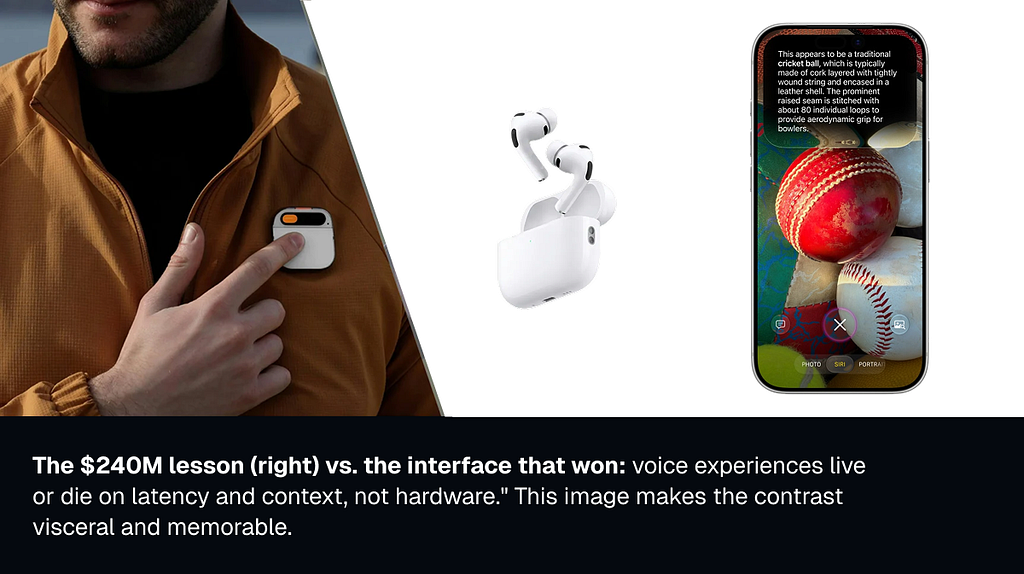
The Rabbit R1 stumbled for the same reasons at launch, then found its footing with the RabbitOS 2 update in late 2025 — not because the hardware changed, but because the software finally honored the interaction contract voice requires.
The lesson both devices taught the industry is this: voice UX is brutally unforgiving of latency and context loss. Unlike a screen, where users can scan and orient themselves, voice provides no spatial memory. If the system loses the thread, there’s no visual anchor to recover from. This means the infrastructure demands — response time, context retention, graceful error recovery — are substantially higher for voice than for any visual interface.
Spatial audio is emerging as the feedback layer. Apple’s AirPods use real-time audio scene analysis to distinguish signal from noise, which opens a design space where sound itself becomes feedback UI. Haptic pulses on wearables confirm actions without a screen. These are new design primitives that most of the field doesn’t yet have language for — because they weren’t in the toolkit until now.
The voice paradigm is not about talking to your phone. It’s about designing interactions that happen while you’re doing something else — cooking, walking, driving — where attention is partial, and context is embodied. That’s a fundamentally different design problem than anything a screen-based mental model prepares you for.
Act III: The agentic paradigm — when the interface acts for you
The most radical form factor shift isn’t chat, and it isn’t voice. It’s the one where the interface disappears entirely because the AI has already handled it.
Agentic AI — systems that don’t just respond to queries but take sequences of actions, use tools, browse the web, write code, send emails, fill forms — went from research demo to production product between 2024 and 2025. OpenAI’s Operator can book a restaurant reservation. Anthropic’s Claude, through its computer use API, can operate a web browser on your behalf. Salesforce’s Agentforce handles customer service cases end-to-end without a human in the loop. Gartner projects that 40% of enterprise applications will have integrated task-specific AI agents by end of 2026 — up from under 5% in 2025.
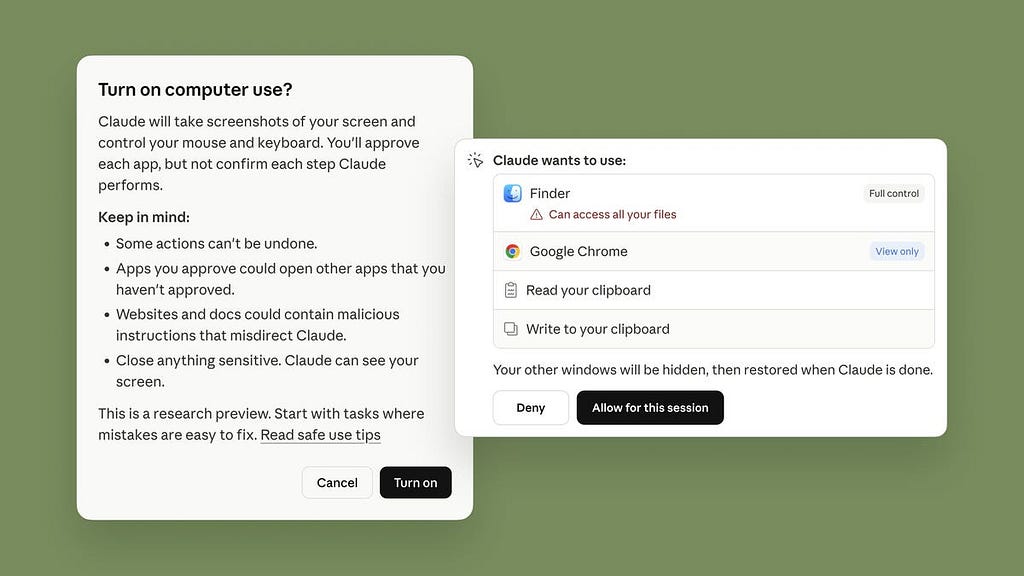
The UX problem this creates is the most interesting one in our field right now: how do you design an interface for an agent that doesn’t need an interface to do its job, but whose users absolutely need one to trust it?
Ben Shneiderman, in Human-Centered AI (MIT Press, 2022), has been asking a version of this question for years. He argues that the dominant framing of AI as an autonomous agent replacing human judgment is both technically premature and ethically dangerous — and proposes instead a framework of high human control combined with high automation. Not one at the expense of the other. The goal is not to minimize human involvement; it’s to make human oversight legible, accessible, and non-burdensome. Shneiderman’s model is the right north star for agentic UX: not autonomy versus control, but autonomy with control — designed into the system from the start.
This is the transparency paradox of agentic design. An agent that operates silently is efficient and terrifying. An agent that narrates every action is trustworthy and exhausting. The design challenge is finding the right level of visibility — enough that users feel in control, not so much that they’re overwhelmed by a stream of system-generated activity logs.
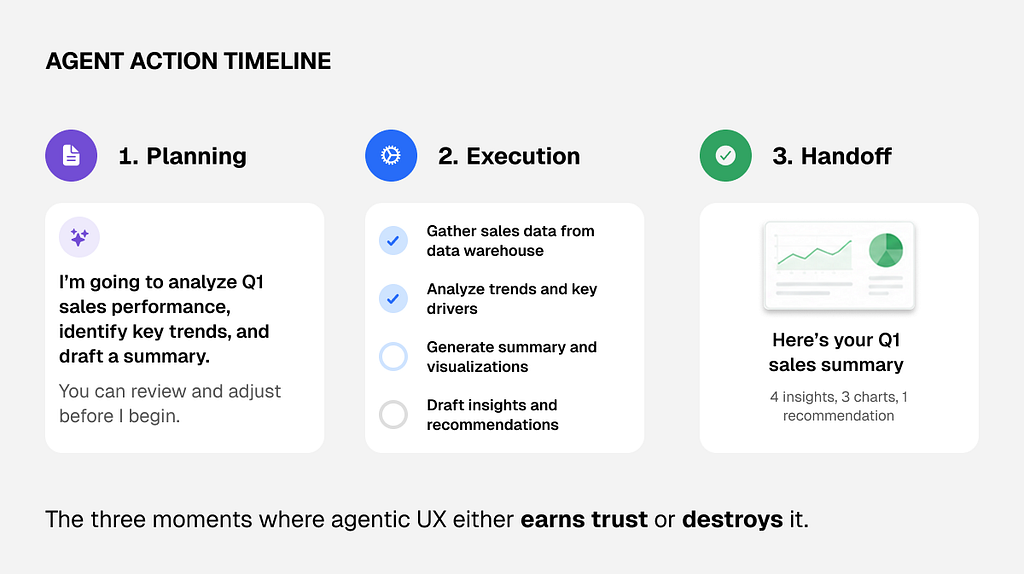
The best agentic UX patterns emerging from production deployments share three properties:
Planning visibility. Before the agent acts, it shows you what it intends to do. Not in system language (“executing POST request to /api/calendar/event”), but in human language (“I’m going to book a table for 7pm at the restaurant you mentioned — want me to check availability first?”). This preview moment is where trust is either built or broken. It mirrors the multi-step planning behavior described in multi-agent reinforcement learning research, where coordinated agents must communicate planned actions before executing them to maintain system coherence.
Progressive delegation. Autonomy is earned, not assumed. Systems like Intercom’s agent start by handling simple, high-confidence tasks, then ask permission before taking on riskier actions. The user’s approval history becomes the trust model. The agent gets more latitude as it demonstrates reliability. This is Shneiderman’s high-control-plus-high-automation principle made operational: the human remains in the loop not by doing the work, but by setting the boundaries.
Graceful override. At any point in an agentic workflow, the user should be able to say “stop” and take back control without the system catastrophizing. This sounds simple. Building it is not. Agentic systems often take irreversible actions (sending an email, booking a flight) that can’t be cleanly unwound, which means the design challenge is partly about surfacing the point of no return before it’s crossed, not after.
There’s a striking case study from healthcare: a clinical AI system that surfaced recommendations without explaining its reasoning was rejected by clinicians. The redesign showed one recommendation at a time, with a supporting evidence panel and a single-click override. Adoption followed immediately. The AI hadn’t changed. The interface had. This is the core insight of agentic UX: explainability isn’t a compliance feature — it’s the entire product.
The implications for designers are significant. We are now designing not just states but behaviors. Not just what the interface looks like, but what it does when you’re not watching. The questions shift from “what does the user see?” to “what does the user need to believe to trust this system?” That’s less visual design and more — honestly — philosophy of mind.
The through-line: from interaction to intent
Step back from the individual form factors and a pattern emerges.
Don Norman’s foundational work on mental models established that design fails when what users believe about a system diverges from how it actually works. For thirty years, that framework assumed users would arrive at an interface with intent already formed , needing only the means to execute it.
The menu exists because we assumed users would know which menu to open. The form exists because we assumed they’d know which field to fill. The entire edifice of traditional UX is built on the assumption that intent is already formed when the user arrives.
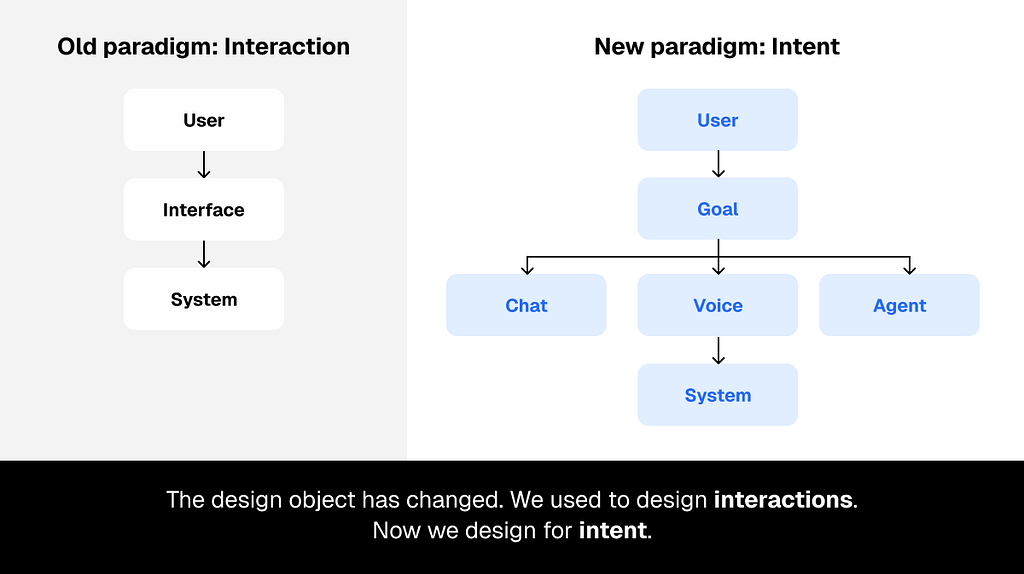
That assumption was always wrong — users arrive with goals, not intents — but it was a productive fiction that worked well enough for thirty years.
The new form factors don’t make that assumption. Chat lets users express goals in their own words and have the system figure out the intent. Voice lets them express goals while their hands are full. Agentic systems let them express goals once and have the system execute a multi-step plan to fulfill them. What unites all three is a shift from interaction to intent as the primary design object.
This means the designer’s job is changing in kind, not just degree. We are no longer primarily the architects of interaction flows. We are the architects of trust relationships between humans and systems that act on their behalf. We’re designing for delegation. We’re designing for ambiguity. We’re designing for the gap between what a user says and what they actually mean.
That’s a harder job than designing a checkout flow. It requires new tools, new evaluation methods — research on human-AI interaction has begun to propose frameworks for measuring whether users feel appropriately informed and in control, rather than just whether they completed a task — and new ethical clarity about what it means to hand over decision-making to a system you’ve built.
What this means if you’re a designer
The practical implications of this shift aren’t abstract.
If you design chat interfaces, your hardest problem is knowing when chat is the wrong answer. The products that are winning aren’t the ones with the most powerful AI — they’re the ones that know precisely which interactions belong in a dialogue and which belong in a form. That judgment is a design decision, not an engineering one.
If you design for voice, your mental model needs to expand beyond the screen. You’re now designing time (latency matters more than layout), context (what does the user know and remember?), and recovery (what happens when the system doesn’t understand?). The toolkit is different: audio feedback, haptics, spatial cues, conversational repair strategies.
If you design agentic systems, you are in the most novel territory of the three, with the fewest established patterns and the highest stakes. The design decisions you make about transparency, override controls, and progressive delegation will determine whether users feel empowered or surveilled, confident or anxious. These aren’t aesthetic choices — they have real consequences for how much autonomy people will extend to AI systems, at scale, across industries.
And if you’re doing all three simultaneously — which is increasingly what building a modern product looks like — you’re solving a coordination problem as well as a design problem: how do you build a coherent product experience across form factors that operate on fundamentally different interaction contracts?
A last word on what doesn’t change
All of this disruption can make it feel like the ground has shifted completely. It hasn’t.
Users still want to feel understood. They still fear losing control. They still punish opacity and reward honesty. They still abandon products that make them feel stupid or slow. The basics of human psychology haven’t changed — only the surfaces onto which they’re projected.
The best UX designers have always been in the business of making people feel capable and understood.
Chat, voice, and agents are new instruments for doing that work.
The music — clarity, trust, delight, respect for the user’s time and attention — is the same as it’s always been.
What’s changed is that the conductor now has a much bigger orchestra.
Further reading
- Erika Hall — Conversational Design (A Book Apart, 2018)
- Cathy Pearl — Designing Voice User Interfaces (O’Reilly, 2016)
- Clifford Nass & Scott Brave — Wired for Speech (MIT Press, 2005)
- Ben Shneiderman — Human-Centered AI (MIT Press, 2022)
- Don Norman — The Design of Everyday Things (Basic Books, 1988; revised 2013)
The interface has left the building was originally published in UX Collective on Medium, where people are continuing the conversation by highlighting and responding to this story.