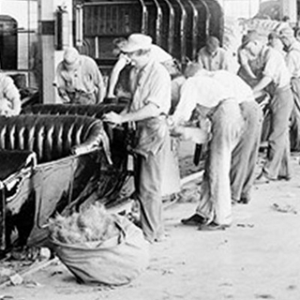
The intelligence revolution won’t be televised — it will be automated over a longer arc
If you want to understand where AI is taking us, stop staring at the future. Look back about 150 years.
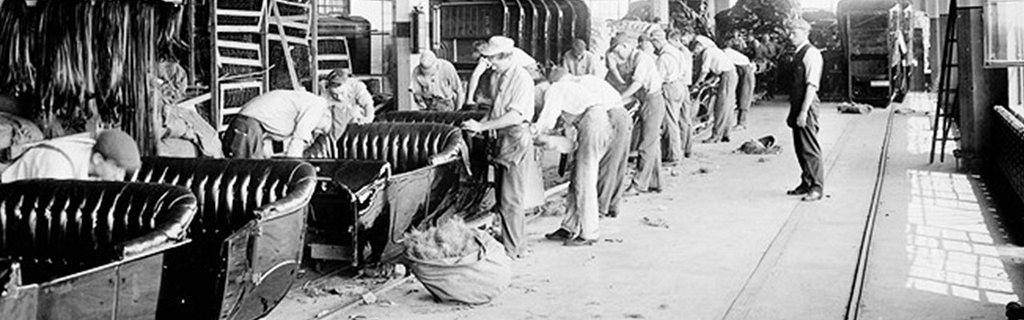
The Industrial Revolution didn’t just change what people made — it fundamentally changed how work was organized, who did it, and what society owed the people doing it.
We’re standing at a similar inflection point right now, which is a massive cliff where we have to jump before we’re pushed.
In the same way the Industrial Revolution rewrote how many things are made, the Intelligence Revolution is rewriting the rules of work, and the companies and leaders who understand history will be the ones who actually navigate it.
Everyone else will be improvising.
The Industrial Revolution
Understanding The Assembly Line

The initial concept of the Assembly Line traces back to Eli Whitney. He brought automation insight to the Agricultral Revolution — the cotton gin which ironically increased the use of slaves — and moved on to the Industrial Revolution. He popularized the use of interchangeable parts for manufacturing muskets — a radical idea at the time, since every component had previously been handcrafted and unique.
Whitney’s insight was that standardized parts meant ordinary workers could assemble complex products without being master craftsmen by following a simple set of steps.
Ransom Olds brought that thinking into the automotive world, introducing a stationary assembly line at his Oldsmobile factory in 1901 that dramatically cut production time. These two men laid the conceptual groundwork for something much bigger that was about to happen.
Henry Ford flipped the script in two ways: Moving the cars instead of the workers to be more efficient, and rewrote the social contract with his workers to accept their new role in the system.
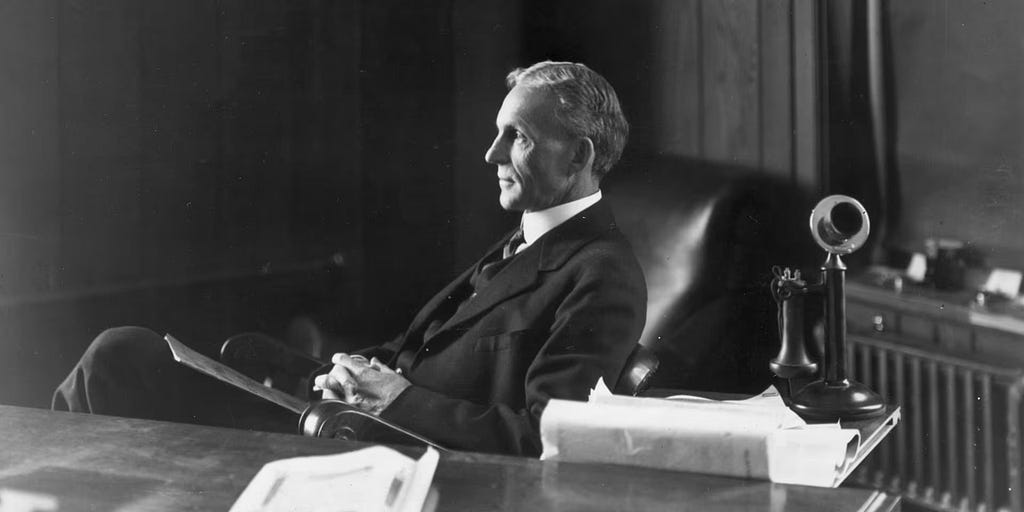
In 1913, Ford introduced the moving assembly line at his Highland Park plant, and the results were staggering almost immediately.
What once took over 12 hours to assemble now took about 93 minutes.
Ford’s genius wasn’t just mechanical engineering, it was understanding that production speed multiplies value only when every single step in the process is tightly choreographed. He succeeded where others had only theorized because he understood and mapped every single step in the production process, and then moved the car instead of the people to create the moving assembly line because it was more efficient.
When you control the entire process, you can actually redesign it. You can see the whole system, understand where the waste lives, and intervene at every point.
That combination — deep understanding of the process plus total control of its inputs — is what made the assembly line not just a concept, but a revolution. Without that vertical view, you’re just rearranging chairs.
The key here was that this took place over 120 years — evolution to get to revolution.
Rewriting of the Social Contract
Ford didn’t just redesign the factory floor — he redesigned the relationship between employer and worker by creating the incentives for adoption through a new social contract.
In 1914, he introduced the five-dollar workday, roughly doubling the prevailing wage, while also cutting the shift from nine hours to eight. The conventional wisdom said this would bankrupt the company.
Instead, it did something remarkable.
Workers stayed, turnover cratered, and productivity soared because people were no longer resentful of the repetitive work they were being asked to do because they were given incentives.
Ford understood that you couldn’t just impose a new way of working — you had to make it worth people’s while to accept it.
Here’s how Henry Ford rewrote the social contract through a simple framework:
- I (Choosers in the original position): Ford positioned himself as the rational architect of industrial society — a visionary selecting rules from behind a veil of ignorance about who would benefit most, framing his decisions as universal and impartial rather than self-serving.
- I* (Real individuals sharing reasoning with I): Ford’s workers, consumers, and shareholders were the real people whose lives his contract governed. Their input was implicit — their labor, purchasing behavior, and market response communicated what they’d accept. Ford absorbed this reasoning and claimed to act on their behalf.
- R (The rules endorsed): The $5 workday, the 40-hour week, standardized production quotas, and the expectation that workers could afford the goods they built. These rules restructured labor, leisure, and consumption simultaneously.
- M (The deliberative setting): The setting was the factory floor and the emerging mass market — not a legislature or courtroom. Ford made the assembly line itself the forum where terms were set, normalizing top-down rule-making as social progress.
- The rewrite: Ford collapsed I and M — he was both the rule-setter and the deliberative arena, effectively making corporate authority indistinguishable from social governance.
Ford’s $5 day made workers into consumers, aligning their interests with capital’s. By embedding fairness inside the wage structure, he made the factory feel like a social institution — legitimate, rational, and inevitable. Consent was manufactured, not negotiated.
Adoption isn’t about authority. It’s about the incentives needed for the social contract, including providing an enviroment where people can buy your products.
The Intelligence Revolution
White Collar Work Has Never Had an Assembly Line
Here’s where things get complicated for the Intelligence Revolution. The assembly line model worked because Ford controlled a clean, linear sequence of physical steps, with one hand on every input and output.
White-collar knowledge work has never looked anything like that.
Your marketing team uses five different platforms. Your product team has its own roadmap tool that doesn’t talk to engineering’s applications. Legal sits in a different building with different software and a completely different sense of urgency. Sales runs on a CRM that nobody else touches.
There is no vertical control, no unified process, no single system that governs the flow of information from start to finish, even with adjacent departments.
Automating white-collar work isn’t like speeding up an assembly line — it’s more like trying to choreograph a dance where half the performers don’t know what song is playing, by design.
That dance now needs different steps.
The White Space Is Where the Work Actually Happens
To really understand what AI can and can’t automate in white-collar work, you have to grapple with what I call the white space — all the work that lives outside the formal job description.
A job description tells you what someone is supposed to do, but the white space is everything else: the Slack message that unblocks a colleague, the informal negotiation that happens before a meeting even starts, the translation work between what a stakeholder wants and what a developer can actually build.
The white space explodes when people collaborate across teams, because every handoff creates ambiguity that someone has to resolve.
That resolution work is largely invisible, largely unstructured, and almost completely undocumented by design.
It’s also where the most valuable work happens.
The Intelligence Revolution Is a Ten-Year Shift or More, Not Eighteen Months
The hype cycle would have you believe that AI transformation is imminent and total — that organizations need to reinvent themselves by next quarter or fall behind permanently.
That’s not how systemic change works.
Ford spent nearly a decade refining his model before it became the dominant industrial paradigm. The diffusion of major technology shifts through complex organizations, legal frameworks, and social norms takes time — typically a decade or more. Because, well, it’s about people.
AI will reshape white collar work profoundly, but the full transformation is a ten-year arc, not an eighteen-month sprint.
Leaders who understand that will invest steadily and thoughtfully, rewriting the social contract along the way. They will be successful, just like Henry Ford.
Leaders who don’t will exhaust their organizations chasing a horizon that keeps moving.
Understand the White Space
The biggest mistake organizations are making right now is trying to automate work they haven’t fully mapped. Before you can redesign the factory floor, you have to understand what actually happens on it and provide incentives for change. Here’s where to start:
- Map the work, not the job through User Journeys. Run structured work observation studies and workflow interviews across your teams. Ask people what they did last week in detail — not what their role says they do. You’ll surface dozens of critical tasks that live nowhere in your org chart and that no AI initiative is currently addressing.
- Identify the collaboration seams. The most fragile, time-consuming, and AI-addressable work happens at handoffs between people and teams. Document those seams explicitly. Where does work slow down because it’s moving between two systems, two departments, or two people with different contexts? Those are your highest-leverage intervention points.
- Start small, learn fast, and document everything. Pilot AI workflows in contained, observable parts of the organization before scaling. Treat each pilot as a learning exercise, not a proof of concept for your board deck. The organizations that will lead this transformation in year seven or eight are the ones building genuine institutional knowledge right now, in year one. For the first time in history, we can collect the data and understand what it means.
- Create real feedback loops between workers and AI systems. The workers using your tools know things your system designers don’t. Build formal channels for that knowledge to flow back into how you configure, prompt, and deploy AI. The knowledge worker on the floor of your metaphorical River Rouge is an asset, not an obstacle.
- Most importantly, redesign the social contract before you deploy the tools. Before rolling out AI automation to a team, answer this question honestly: what are you offering workers in exchange for changing how they work? More interesting work? Fewer repetitive tasks? Real upskilling and career development? Ford had a clear answer. You need one too. Workers who don’t see a personal benefit will route around your AI tools with the same creativity they’ve always used to route around things they don’t want to do.
The Takeaway
The Intelligence Revolution is real, significant, and going to reshape work at a scale most organizations aren’t honestly ready for and may not be for years — particularly because people have to incentivized to do so.
Ford didn’t succeed because he had better technology. He succeeded because he could see the whole system, redesign the process, and offer workers a deal worth accepting.
We need to do all three of those things for knowledge work, and we haven’t done any of them particularly well yet. The white space is unmapped, the social contract is unwritten, and the timeline is longer than anyone wants to admit.
That’s not a reason to slow down. It’s a reason to start doing the actual work instead of talking about it.
The intelligence revolution won’t be televised — it will be automated over a longer arc was originally published in UX Collective on Medium, where people are continuing the conversation by highlighting and responding to this story.