
We built a messaging-app architecture for knowledge work. The recall failure that followed is structural, not optional.*
*Editor’s note: I wrote this article from firsthand experience as a founder and engineer. I used Claude Code as a writing assistant for structural feedback and copy editing. All insights, data, decisions, and stories are my own.*
*Disclosure: I co-found browser extensions that add memory and recall tooling to major AI chat products. I have a commercial interest in the recall problem being treated as worth solving, and I disclose this upfront so readers can factor it into the arguments below.

A few months ago I spent an evening with Claude debugging a production cron job. We worked through the timing window, the fix landed, the deployment held overnight. Last week the same class of issue came back. I knew Claude had explained the edge case clearly. I could not find the conversation. I remembered it used a cron job. The native search did not match “cron job” because the words were not in the conversation title, and Claude.ai’s sidebar search only matches titles.
The conversation is in there. I have no way to reach it.
A couple of weeks ago, someone posted on r/ClaudeAI: “Is there a skill or maybe a Chrome extension that enables Claude to actually search for text within chats? The native search seems to only search for chat titles.” The post is not unusual. A near-identical question appears in r/ChatGPT and the Gemini help forums on a roughly weekly cadence. The pattern is the same across every major AI chat platform, and the answer everyone receives is some variation of “no, the platform doesn’t do that, here’s a workaround.”
This is the forgotten conversation problem, and it is not a bug.
We wrote a decade of thought into a layer with no index
ChatGPT crossed 900 million weekly active users in February 2026, up from 800 million in October 2025 (TechCrunch). Claude has roughly 18.9 million monthly active users and now serves 70% of the Fortune 100. Gemini’s user base sits between the two and grew through 2025 with Google’s app integrations.
Lay those numbers next to the average power user’s chat history, and the scale becomes harder to ignore. A serious daily user of any of these tools, a developer, a researcher, a writer, a lawyer, accumulates hundreds of conversations a year, each with dozens of messages, each message often longer than a typical email. In aggregate, AI chat is now the largest single layer of new written human thought being produced on the internet. And that layer, across all three major platforms, is barely indexed for retrieval.
Claude.ai’s native sidebar search matches conversation titles. ChatGPT’s sidebar search matches conversation titles and a handful of metadata fields. Gemini’s search matches titles and the initial prompt of a thread, but does not index the deeper content of the conversation. None of the three offer a traditional Cmd+F across every word you have ever exchanged with the model.
Auto-titles do not help. The title is generated from the first turn of the conversation, which is rarely the part you want to find later. My cron job conversation was titled something like “Help with deployment script”. The word “cron” never appeared in the title, because the deployment script was the entry point and cron was the actual answer. This is not unusual. Auto-titles describe how a conversation started, not what it ended up being about.

The architecture came from messaging apps, not knowledge tools
The interaction model AI chat inherited is the messaging-app pattern: a chronological scroll, a single input field at the bottom, no anchors, no waypoints, no spatial memory. iMessage, WhatsApp, Slack DMs all share this lineage. So do Discord channels, ICQ logs, IRC. The pattern works for messaging because messages are mostly ephemeral. You read them once, you respond, and the relationship is the persistent thing, not the message.
AI chat is not messaging. It is knowledge work disguised as messaging. The artifacts have weight: code that ran, drafts that shipped, decisions that anchored a project. Treating those artifacts the way Slack treats a “lol” emoji has been costing every serious user of these tools real time and real recall failure for two years now.
Designer Amelia Wattenberger made the foundational version of this critique in 2023, in Why Chatbots Are Not the Future of Interfaces. Her argument was that chat inputs lack the affordances and signaling that decades of software design developed: no visual cues for what the system can do, no scaffolding for iterative refinement, no persistent representation of context. The recall problem is the long-tail consequence of the same design poverty.
We did not have to build it this way. The design vocabulary for persistent, retrievable thinking architecture has existed for eighty years.
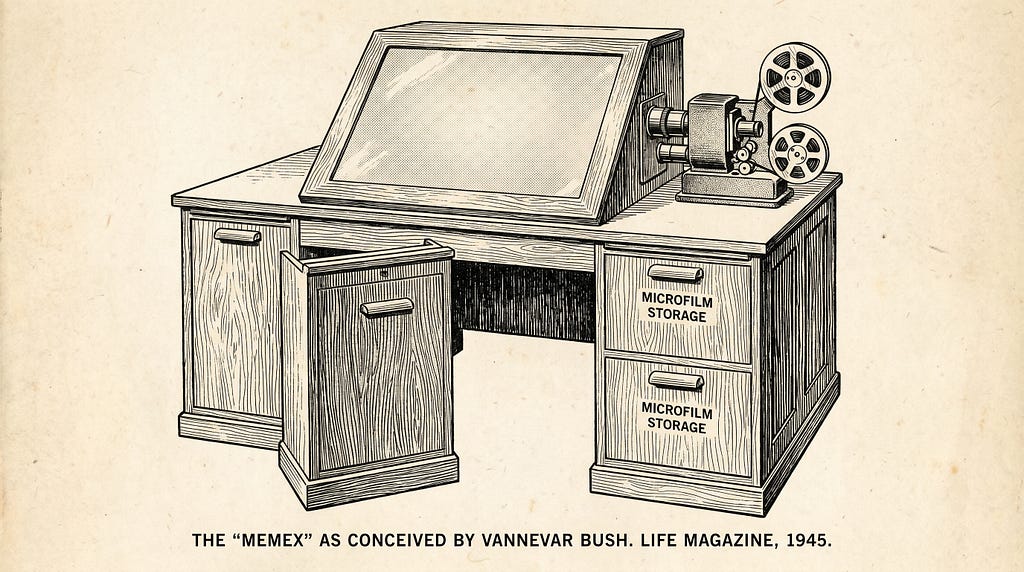
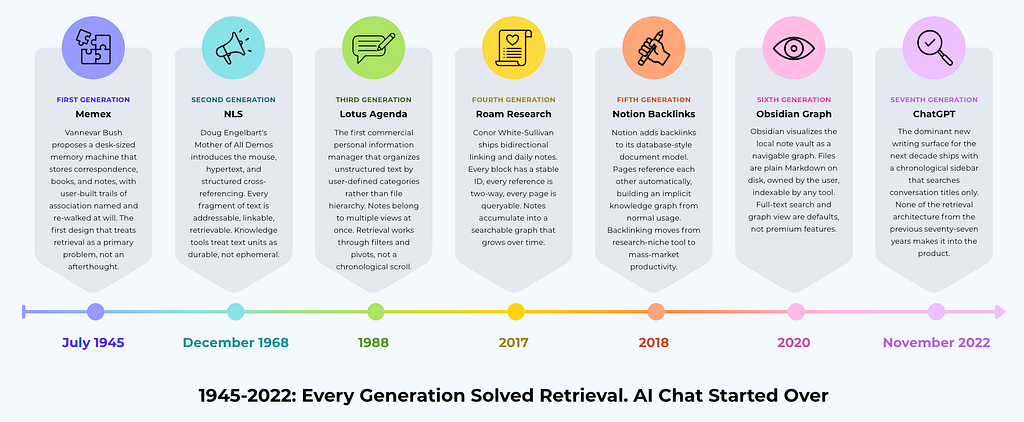
In July 1945, Vannevar Bush published “As We May Think” in The Atlantic Monthly. Bush described a hypothetical machine he called the memex: a desk-sized device that would store a person’s correspondence, books, records, and notes, and let the user build “trails” of association across the corpus, named and re-walked at will. The memex was a memory machine. It assumed the user would generate more material than they could remember, and that the role of the system was to make any of it findable later, on terms the user could shape.
Twenty years after Bush, Ted Nelson coined the term hypertext at the 1965 ACM National Conference, building on Bush’s trails to describe non-sequential writing where every fragment was addressable, linkable, and where links were bidirectional by default. Nelson’s Project Xanadu treated each unit of thought as a first-class object that knew about everything that referenced it. AI chat treats messages the opposite way. Every message knows nothing about anything else, ever.
Doug Engelbart read Bush in the late 1940s and spent the next twenty years building toward the 1968 NLS demo at the Fall Joint Computer Conference. NLS introduced the mouse, hypertext, structured documents, and live cross-referenced editing. It was, among other things, a working demonstration that knowledge work systems should treat every fragment of text as addressable, linkable, and retrievable.
Eighty years on from Bush, fifty-eight years on from Engelbart, the dominant interface for the most generative writing tools in history is a chat box with a sidebar that searches titles.
What the industry is quietly admitting in 2025 and 2026
The platforms are not unaware that recall is broken. They have all been retrofitting memory layers onto chat for the last twelve months. Read in sequence, the rollouts read as an industry-wide admission that the original architecture was insufficient.
In mid-2025, Anthropic shipped “Search past chats” on Claude.ai, available only on Pro, Max, Team, and Enterprise plans. The feature is conversational. You ask Claude in natural language what you discussed about a topic and it retrieves relevant context using retrieval-augmented generation. In early 2026, OpenAI added an internal tool called PersonalContextAgentTool to ChatGPT Plus and Pro, with the same conversational shape: ask a question, the system retrieves from your history, the answer is generated. In February 2026, Google extended Past Chats personalization to free Gemini users, letting the model reference relevant prior conversations when generating new responses.
Three platforms, three retrofits, the same approach. None of them is keyword search. All of them are RAG-based conversational recall. The architectural assumption is that the way to find your old thoughts is to ask the model to find them for you, in natural language, and trust the retrieval-and-generation loop to produce the right answer.
That assumption has two failure modes that designers have to take seriously.
First, RAG retrieval works well for concept-shaped queries (“what did we discuss about API rate limiting”) and badly for keyword-shaped ones (“the conversation where I used the phrase ‘cron job’”). The user often remembers the words, not the concept. RAG paraphrases its way past the words and frequently misses.
Second, RAG retrieval is opaque. The user does not know what the model searched, what it ranked highly, or what it ignored. If the answer comes back wrong or empty, the user has no way to inspect the retrieval and adjust their query. They are not searching, they are interrogating.
Both failure modes are mitigated by a parallel layer of plain keyword search across message content, the layer that desktop email, Slack, Notion, and every modern note-taking tool ship by default. None of the three major AI chat platforms ships it natively in 2026.
Sixty years of design research have already solved this
The thinkers who shaped retrieval-friendly knowledge work have not been quiet. They have been writing about exactly this problem for a generation, and the patterns they describe map directly onto what AI chat is missing.
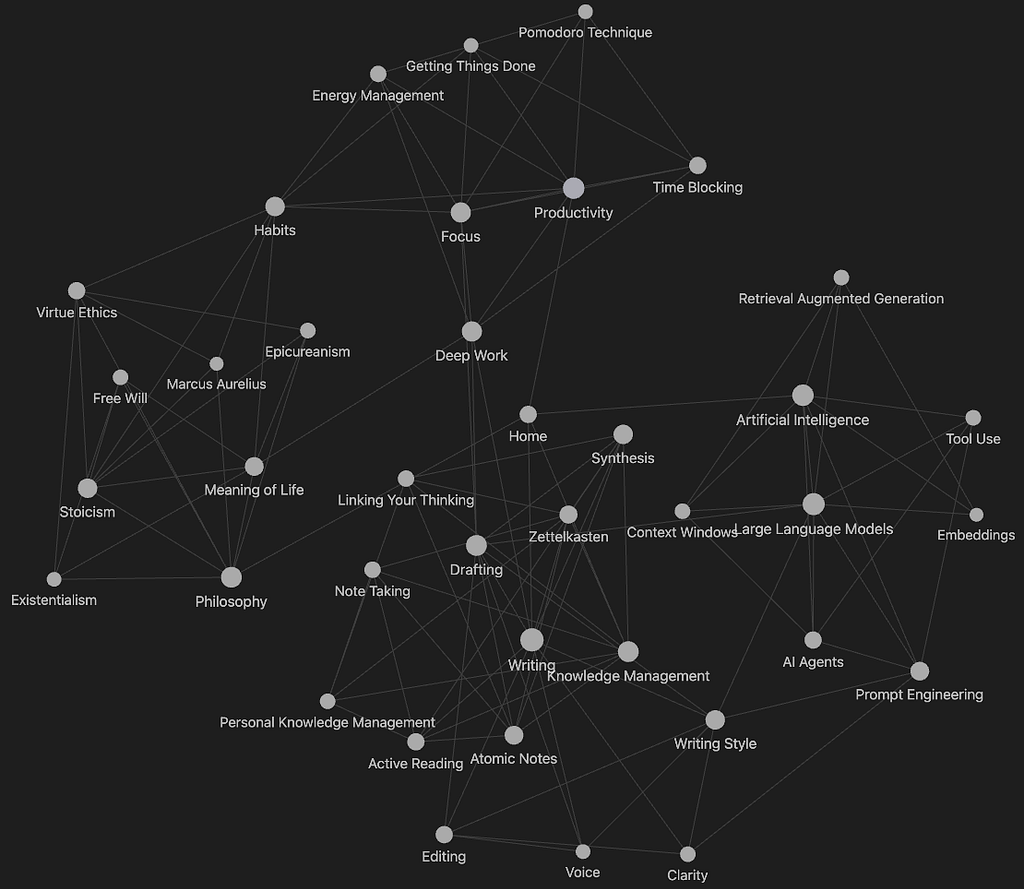
Andy Matuschak’s evergreen notes describe a knowledge architecture in which units of thought are atomic, concept-oriented, densely linked, and organized through association rather than hierarchy. AI chat messages, as currently structured, are none of these things. They are buried in chronological threads, addressable only by the conversation that contains them, linkable to nothing.
Tiago Forte’s PARA method organizes information by actionability rather than topic, using four categories (Projects, Areas, Resources, Archives) that map information to where the user actually needs it in their work cycle. AI chat has zero native equivalent. There is no project boundary that survives a session, no areas-of-responsibility tagging, no archive distinction beyond “old conversation”. Every chat lives in one undifferentiated chronological scroll.
Maggie Appleton’s Language Model Sketchbook makes the most direct argument for why this matters. Appleton calls chat-as-default “the lazy solution” to interfacing with language models. Her position is that LMs should be brought into thinking environments rather than exited into separate chat boxes, and that the prototypes of the future will treat the model as embedded scaffolding inside writing, research, and notebook tools rather than a destination on its own.
Read together, the lineage from Bush in 1945 through Engelbart in 1968 to Matuschak, Forte, and Appleton in the present makes the same point: persistent, retrievable, user-shaped knowledge architecture is a solved design problem at the conceptual level. The unsolved part is implementing it inside AI chat.
What an architecture that treated conversations as knowledge would look like
If we took the recall problem seriously and designed forward from sixty years of HCI research instead of backward from messaging-app conventions, the resulting AI chat product would have at least four properties.
Per-message addressability. Every message would have a stable URL, a bookmarkable identifier, and a way to be referenced from another conversation. Right now, citing a specific Claude or ChatGPT response in a separate thread is impossible. The smallest addressable unit is the entire conversation, which is the wrong granularity for knowledge work.
Keyword search across content, not just titles. A literal Cmd+F across every word the user has ever exchanged, with exact-match toggle and basic boolean operators. This is a 1995-era feature that has been routine in email since at least the introduction of Spotlight in 2005. The fact that it does not ship with AI chat in 2026 is not a technical limitation, it is a product decision.
User-controlled persistence. A way for the user to mark a message as load-bearing, archive it deliberately, tag it with a project or area, or pin it to a workspace. Currently the user has zero levers. Every message is treated identically by the platform, which means every message is forgettable.
Cross-conversation linking. The ability to anchor one conversation to another, to thread a project across sessions, to maintain a persistent context across days and weeks of work without re-pasting prior threads as input. The retrofit RAG layers are an attempt to simulate this, but simulation is not architecture.
Bret Victor’s Magic Ink (2006) made a related argument from a different angle: most software is information software, designed to help people see and learn, not to operate. Interactivity, Victor wrote, is a last resort to be used only when context cannot be inferred from environment or history. AI chat made the inverse error. It built pure interaction for what is fundamentally an information-software problem. The user does not want to chat their way back to a memory. They want to see it.
None of these patterns is speculative. Lotus Agenda shipped categorical organization for unstructured text in 1988. Notion has had backlinks since 2018. Obsidian has shipped a graph view since 2020. Roam Research shipped daily notes with bidirectional linking in 2017. The patterns exist. They just have not made it to the layer where most new written thought is actually being produced in 2026.
Key takeaways
- AI chat inherited a messaging-app architecture for what is actually knowledge work, and the recall failure across ChatGPT, Claude, and Gemini follows from that architectural choice.
- Across all three major platforms in 2026, native sidebar search either matches titles or works conversationally. None indexes message content for direct keyword recall.
- The RAG-based recall layers shipped through 2025 and into 2026 are an industry admission that the original architecture was insufficient. They mitigate the problem rather than solve it.
- Sixty years of HCI research, from Bush and Engelbart to Matuschak, Forte, and Appleton, already describe the architecture AI chat is missing. The unsolved work is implementation, not invention.
- The next interface evolution treats AI conversations as persistent, addressable, retrievable knowledge artifacts, not as ephemeral message streams that happen to contain valuable thought.
What is the oldest message in your AI chat history that you would want back tomorrow? Could you find it?
Follow me on Medium for more essays on AI UX and the design reality of building for global audiences.
About the author: Adi Leviim is a full-stack engineer and product builder with 7+ years of experience shipping commercial software to global audiences. He writes about AI UX, the design reality of building for millions of users, and the gap between AI demos and production AI. Follow him on Medium for essays at the intersection of engineering and design.
The forgotten conversation problem in AI chat was originally published in UX Collective on Medium, where people are continuing the conversation by highlighting and responding to this story.