
Algorithmic governmentality and the merging of government and corporations

.jpg)
‘The EU should be abolished,’ is what Elon Musk claimed in a recent post on X. In relation to this, in September, some of Musk’s peers purchased TikTok’s U.S. operations. Musk complains — I mean tweets — a lot, and tech acquisitions happen often, but these two examples illustrate how corporate interests and governments are connected. This text will show this corporate-governmental interplay. I will do this by looking at social media timeline design.
Facebook has been experimenting with algorithmically showing posts since 2011. However, the real transformation occurred in early 2016, when Instagram and Twitter adopted a smart timeline. From this moment on, users are bombarded with posts from accounts they never willfully subscribed to. This UX design adjustment, driven by KPIs and user engagement, has an impact in several ways.
I will use several thinkers to illustrate the social effects of these UX choices. I will begin with political theorist Jodi Dean, who lays out 4 features of neo-feudalism:
- Parcellated sovereignty — the fragmentation of powers
- Lords and serfs — a small group of elites holding power over an economically vulnerable population
- Hinterlandisation — the thriving of cities at the expense of rural areas
- Catastrophic anxiety
I will first turn to how anxiety has infiltrated society via social media feeds. For Dean, feelings of insecurity and anxiety are linked to a lack of stability in life. For instance, by not having financial savings or social security. Dean states that:
‘Neofeudalism’s catastrophic anxiety flourishes in the affective infrastructures of communicative capitalism where there is no commonly shared meaning. Lies circulate as easily as or more easily than truth.’
— Jodi Dean
This form of anxiety is about financial vulnerability. Still, less obvious aspects, like algorithm-driven information, also contribute to this feeling.
While someone in the past might have bought newspapers, people today often get their news through social media. Regardless, ‘[conventional] media outlets act in accordance with the incentives created by Facebook.’ Media, therefore, make their content more attractive for social media users. The number of likes or shares represent an online currency and functions as ‘popularity cues for editors.’
Media outlets thus adapt to social media’s ecosystem. They negotiate newsworthiness with engagement. This includes adding more emojis, question marks, exclamation marks, and emotional words?!!? Editors are also writing clickbait titles. This leads to Dean’s idea of catastrophic anxiety and less precision at the ‘detriment of journalistic quality.’
“When a free man is voting, it is not enough that the truth is known by someone else, by some scholar or administrator or legislator. The voters must have it, all of them.”
— Alexander Meiklejohn
One could argue that sensationalism might not per se harm being well-informed, but the simplification of news definitely does.
‘Less important aspects of a news story are exposed at the expense of the core information, leaving readers less or even insufficiently informed.’
— Source
Anxiety and sensation are prioritised over accuracy.
Not only does news become less reliable, the content shifts as well. Culture war topics have become more prominent than economic news. This started with the birth of U.S. cable news in the late 1990s and has been accelerated by social media. ‘Switching from an entirely cultural to entirely economic segment reduces viewership,’ therefore…
‘the focus on the culture war reflects a distinctive business strategy focused on audience size maximization.’
‘[News has] seen a shift in public politial attention: the tax, social insurance, and labor policies … have largely been eclipsed by cleavages over racial and gender issues, political correctness, immigration, religion, guns, and crime.’
— Source (all 3 quotes above)
Hence, social media platforms influence how journalism is conducted. It also impacts the content users consume and the topics relevant in public and political discourse.

The 2016 U.S. presidential elections and the Brexit referendum were the first major elections after the introduction of the algorithmic timeline. These events might suggest that ‘the fragmentation of social media and the role of sentiment, could enhance political polarization.’ The smart timeline has thus contributed to the perhaps somewhat surprising result of both elections.
These elections can help us understand the ongoing trend where culture-war issues are more important than economic policies. People become less engaged with socioeconomic issues. Musk and the TikTok investors are given an opportunity to further neoliberalise society, and they want to take it.
As comparative literature scholar Stephen Shapiro paraphrases philosopher Michel Foucault:
‘Neoliberalism insists on the necessity of relying on the competitive market as the normative model for all institutions, while on the other, it vastly amplifies the State’s institutional violence.’
The role of the government is not to leave the market alone, but to promote it. Neoliberalism relies on game theory. It assumes everyone is constantly thinking about how to maximise their self-interest. Endless competition.
Foucault argues that neoliberalism should be understood alongside governmentality. Governmentality doesn’t lean on traditional disciplinary action. Instead, it relies on mechanisms designed to ensure people continuously adapt to changing guidelines. Conditioning the herd.
For Foucault, new techniques of control are always a response to society’s demands and emotions. For instance, today’s sentiment about child groomers is used by the EU to justify giving intel organisations access to any individual’s private messages.
These forms of security (or biopolitics) create an optimal social balance. Security uses existing environments to ensure a desirable outcome, whatever that might be. “Decent” people mostly.
Social media timelines can be among the systems used to condition people. This is a process Foucault calls normation. Normation creates an optimal model with specific outcomes that should nudge individuals to comply.
Foucault’s security doesn’t result from intentional design but from a series of techniques and institutions that gradually converge.
‘The mechanism of security involves, in short, a series of processes which are, up to a certain point, aleatory and which it is only at the end and, as it were, a posteriori, that one will be able to say: this was a good security mechanism, it worked.’
— Michel Foucault
Belgian scholar Antoinette Rouvroy calls the way social media controls and shapes populations algorithmic governmentality.

A further impact of algorithms results from rich-get-richer dynamics. Popular content is promoted by the algorithm, resulting in feeds having less niche and more mainstream content.
Why this is problematic is explained by French philosopher Jacques Rancière. He claims that a broad police force decides who is allowed to speak, who should be heard, and who matters. For Rancière, the police refers to the act of policing and is about the institutions and systems that maintain social hierarchies.
‘The police is thus first an order of bodies that defines the allocation of ways of doing, ways of being, and ways of saying, and sees that those bodies are assigned by name to a particular place and task.’
— Jacques Rancière
Because algorithms enable the mainstream to push out minorities and their ideas, social media thus decides who belongs to the virtual society and who should be excluded. The excluded and marginalised are those Rancière calls those without a share (les sans-part). By being shadow-banned, these groups are wronged (le tort).
Personalised timelines also lead to filter bubbles. Because platforms optimise for engagement, users are shown content that interests them and aligns with their viewpoints. This creates aversion to the unfamiliar. This effect, called the algorithm paradox, reduces exposure to contradictory opinions. Something that is, of course, essential for a healthy debate. Normation happens when people become unfamiliar with the unfamiliar.
Whereas algorithms create filter bubbles, echo chambers result from individual users’ selection behaviour. Users tend to select channels they agree with and exclude conflicting information. They also join groups of like-minded peers.
‘According to group polarisation theory, an echo chamber can act as a mechanism to reinforce existing opinions moving the entire group toward more extreme positions.’
— Source
Group polarisation theory works alongside post-liking biases within the entire group. This ‘creates a self-perpetuating cycle, where attitudinally congruent articles remain at the top of the feed.’
Because of limited exposure to differing opinions and only reading posts from like-minded individuals, people rarely change their viewpoints. Users who ‘flip stances have significantly more neighbors engaging in a collective expression of the opposite stance.’
All the mechanisms discussed so far explain how social media supports the ‘neoliberal mode of government which produces the subjects it needs’ and how catastrophic anxiety is stimulated.
Today’s algorithmic culture is transforming the world into a post-truth political age. It makes the liberal decades almost obsolete.
[Social media algorithms] were never designed to operate through liberal principles, since the ensuing algorithmic profile is not a collective public, or even a counterpublic, but an entirely different entity altogether.
— Stephen Shapiro (and quote above)
Dean claims that the reduction of the power of the people has been intentional. While this process began in the 1970s, today’s state of affairs results in a situation in which ‘private economic power trumps public law.’ This not only reduces the policy options available to states but also actively erodes popular sovereignty.
Governments privatise their nation-state and hand over control to companies, supported by subsidies and tax breaks. This, in turn, puts governments ‘in a position where they can no longer meet basic social needs and so remain bound to private firms until the firms decide to leave.’ Corporations abuse this reliance and threaten to leave, thus bullying governments further.
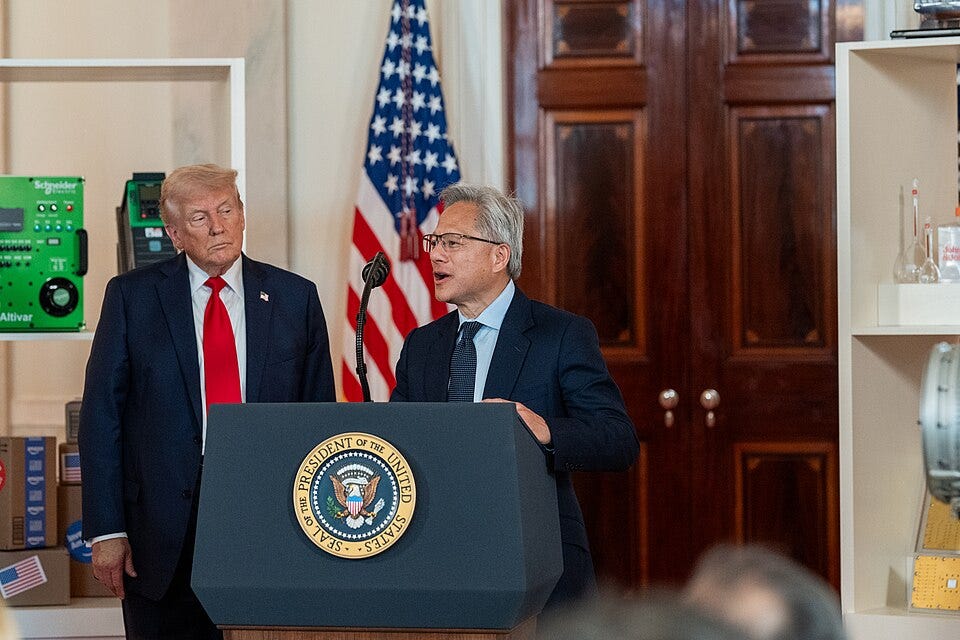
The corporate world is gradually becoming the government. You see where this is going. This trend is clearly visible at today’s White House. Lobbying practices, donations, and industry specialists move towards Washington, and massive corporate contracts circle back. ‘I donate a big bag of money to some nonsense event, and I get a nice tariff reduction or a government contract in return. I visit the White House and all of a sudden an Executive Order appears that blocks states from regulating AI.’

Corporate interests have been linked to American congressmen for decades. There are tons of influential people (e.g. Koch brothers) and (military, prison, pharma, etc.) industrial complexes. Yet, the tech sector’s coalition with the current Trump administration truly represents the merging of the corporate world and the state. Something Dean calls parcellating sovereignty.
Tech billionaire David Sacks is (and Elon Musk has been) hands-on in the daily operations of the government, supported by a bunch of Silicon Valley specialists in high positions.
Next to these government servants are Peter Thiel and Marc Andreessen. They are amongst the wealthiest and most influential tech investors, and have had significant sway in appointing Vice President JD Vance and specialists across all departments.
Have a look at the excellent research done by the authoritarian stack!
https://medium.com/media/5674af08c2736f010040874fa4b595c3/href
This brings me back to TikTok. Although Facebook, Instagram, LinkedIn, YouTube, and X are all products of American companies, TikTok is not. Or was not. This thus gives a challenge for the White House. How can they conduct algorithmic governmentality on TikTok if the Chinese own it?
They’ve used other platforms for a decade.
‘From the mid-2010s until today, social media entities have been persuaded to implement a range of restrictions on supposed “hate speech,” on supposed “misinformation” about medicine or elections, and even for a time on allegations that COVID-19 leaked from a Chinese government lab. Some of that persuasion (or perhaps pressure) has come from the U.S. federal government.’
— Source
American platforms have also been trying to influence the Gaza debate. Human Rights Watch claims Meta has ‘been silencing voices in support of Palestine and Palestinian human rights on Instagram and Facebook in a wave of heightened censorship of social media.’ In addition, YouTube has been accused of ‘inconsistent enforcement’ of content removal regarding the conflict.
With TikTok outside the American sphere of influence, yet with a big impact, this poses governmentality challenges. It may thus not be a shocker that a group of investors, including Oracle co-founder and IDF philanthropist Larry Ellison and Israeli tech ecosystem investor Marc Andreessen, is buying TikTok.
A senior White House official expressed that
‘ByteDance’s reworked algorithm for a U.S. TikTok would use data from only American users and would be overseen by Oracle. This person said the arrangement would neutralize the risk of Chinese interference.’
In other words, the techno-lords want to make sure that normation is effectively enforced on the scroll-conditioned serfs.

In the ByteDance statement, the White House basically admits that an ongoing algorithm information war is underway.
The European Union, through the Digital Services Act (DSA), and states like California, New York, Texas, and Florida want to arbitrate timelines and protect users. This is not always in the strategic interest of right-wing parties.
‘Algorithmic curation amplifies mainstream right-wing content more than mainstream left-wing content, compared to reverse-chronological selection.’
The DSA requires platforms operating in the EU to offer non-personalised feed options. This would be a strategic disadvantage for right-wing parties and their tech affiliates.
‘With the exception of Germany, we find a statistically significant difference [that algorithms are] favoring the political right wing.’
— Source (and quote above)
Does this algo-bias provide context for the American attack on the EU? On why Musk thinks the EU should be abolished and why JD Vance is acting aggressively?
Free speech is often used as a reason for these attacks, but the recent fines issued against X by the EU have nothing to do with censorship. On the contrary, the EU wants transparent data to analyse whether algorithms are secretly pushing certain viewpoints. This is illegal in the EU.
https://medium.com/media/1d0e63b93825b6584bfc86bbd2b36421/href
I need to look at the concept of suzerainty to put this inquiry into perspective further.
Sovereignty is becoming suzerainty. States exist as governments over people and territory, yet they lack the ability to act independently.
…
There isn’t a centralized world power or one world government; there’s a multilayered patchwork of crisscrossing agreements and treaties designed to benefit the powerful and to subject and contain the weak.
– Jodi Dean
Social media platforms, billionaires, and governments form an interlinked network that is almost impossible for people to influence. I argue that, in hindsight, Brexit has been great for the EU. Without the economically liberal Brits, passing regulations in Brussels has become much easier.
The Digital Markets Act (antitrust regulation), Digital Services Act (social media governance), and AI Act should protect individuals, small businesses, and public discourse. However, these regulations undermine the agenda of the very same techno-lords, who therefore use their influence to fight EU regulations. Bezos can’t prioritise his products on Amazon search results, Musk can’t disproportionately show specific content on X, and Altman can’t harvest all your personal data to train ChatGPT.
Import tariffs are used as negotiation tactics. This is done together with election interference, free-speech rhetoric, and even financial support for Hungary to influence its voting behaviour in Brussels. The recent US National Security Strategy explicitly states Washington is dedicated to ‘Cultivating resistance to Europe’s current trajectory.’ 8
These methods are used by big tech and big capital, with the hope of paving the way for further neoliberalisation or techno-fudalisation of the world.
Through Jodi Dean’s features of neofeudalism, I have shown that sovereignty is eroding. Corporations, billionaire lords, and suzerainised governments are trying to override national sovereignty.
The shift from chronological to algorithmic timelines amplifies catastrophic anxiety. It is not just a commercial design choice. The adjustments might have started from a market incentive, but the algorithmic governmentality that was once a byproduct may have become the primary feature.
On the one hand, algorithms serve as normation tools. They expose people only to selected content. On the other hand, they are anxiety-provoking distractors. They divert attention away from socioeconomic problems.
Platforms corrupt nation-states’ independence and promote a climate of polarisation and distraction. The creation of the EU and the regulations that followed might have been a form of suzerainty. However, individual European states can’t negotiate with forces as powerful as Silicon Valley.
Ceding some sovereignty to Brussels could be the only way to protect European democracy. Yes, the EU is far from perfect and has many issues to solve. Recent developments watering down EU tech laws, driven by corporate pressure on right-wing EU factions, have revealed how fragile the EU can be.
The Silicon Valley and White House are too powerful for independent European nations. But they now want to hinterlandify the EU itself. Musk wants to make Europe a hinterland of the US, and the EU is an obstacle that needs to be abolished.
Brussels wants a chronological timeline, and Silicon Valley doesn’t like it.
The deeper intentions behind the TikTok deal and Musk’s EU feud was originally published in UX Collective on Medium, where people are continuing the conversation by highlighting and responding to this story.