
AI, metaphysics, and the search for moral grounding in design

A Confession
If you had told me a year ago that I would be writing an article arguing that Catholic philosophy might be exactly what is needed to ground ethical design, I would have thought you were crazy. Yet here I am.
What makes this realization even stranger is that I am not alone. Increasingly, major AI companies and technology leaders have begun engaging with religious thinkers, particularly those of the Catholic intellectual tradition, when discussing the future of artificial intelligence and human values. One example is the Rome Call for AI Ethics, an initiative supported by the Vatican and several major technology organizations.
While AI systems and design are often discussed as separate domains, both ultimately shape human behavior through embedded values regarding what is good, desirable, and true. Both therefore force a confrontation with the moral frameworks guiding the technologies increasingly influencing human thought and behavior. And it is precisely the kind of problem Catholicism has wrestled with for centuries, and one for which it offers remarkable philosophical depth.
The Framework and Its Cracks
Last year, I launched Ethical Interface Design, part of my ongoing scholarship and research into developing a universal ethical framework for modern interface design. As the project continues to evolve, I increasingly realize that attempting to construct any universal ethical framework inevitably raises a deeper philosophical question: universal according to who?
My original approach is, admittedly, somewhat philosophically ambiguous. I justify the framework by arguing that its values are derived from familiar UX principles rooted in Western moral philosophy. Those ideas are distilled into five pillars: Inclusion, Autonomy, Transparency, Privacy, and Well-Being.
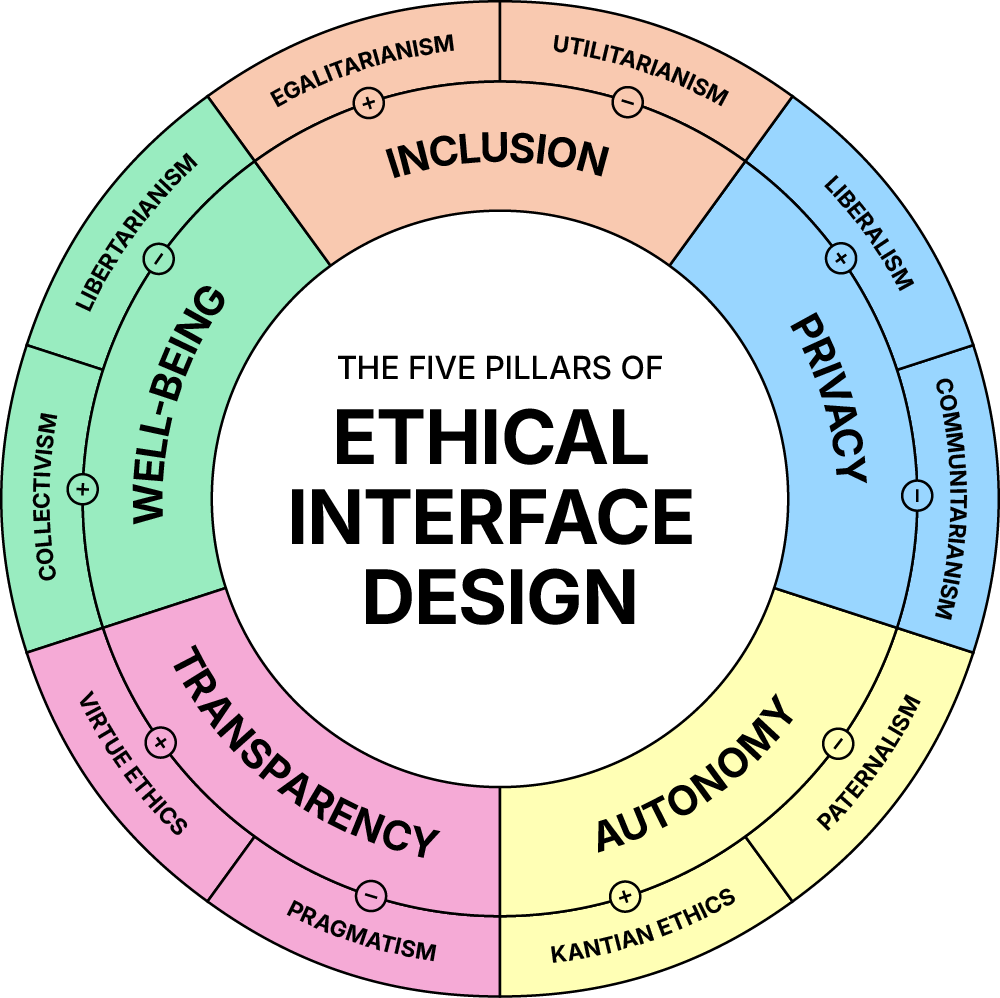
But the more I examine these principles, the more I realize that ethical systems detached from transcendent grounding inevitably drift toward relativism, where moral claims become reducible to negotiated preferences, cultural consensus, institutional power, or utilitarian trade-offs disguised as universal principles.
Even systems built with sincere humanitarian intentions still struggle to explain why one moral claim should ultimately supersede another beyond social agreement or subjective reasoning. This realization creates a serious problem for me. A framework cannot meaningfully claim universality while resting upon moral foundations that are themselves fluid, contingent, and culturally unstable.
That said, one of the core distinctions of my Ethical Interface Design framework is that it does not attempt to hide or flatten these ethical tensions, but instead explicitly exposes them as unavoidable conditions of interface design itself. I argue that whenever we design around a particular value, we inevitably move further away from another important value.
Rather than presenting ethical design as a process of achieving perfect alignment, the framework treats it as an ongoing negotiation between competing goods. However, some of these tensions may become more philosophically coherent when values are oriented toward a shared conception of the good, which is what led me toward exploring Catholic philosophy as a potential philosophical foundation for resolving what increasingly felt like an unresolvable ethical problem.
Augustine, Aquinas, and the Design Problem

Since starting as a professor at Seton Hall University last year, which is a private Catholic institution, I have found myself engaging more seriously with Catholic philosophy, particularly the writings of Augustine of Hippo and Thomas Aquinas. What initially felt intellectually distant has begun to feel increasingly relevant to the ethical problems emerging within tchnology, AI, and modern interface design.
It is Augustine’s ideas about ordered love, moral hierarchy, and humanity’s orientation toward ultimate truth that make many of the tensions within my ethical interface design framework feel more philosophically resolvable. At the same time, Aquinas’s emphasis on natural law, reason, and objective moral order pushes me to think about ethical design not merely as a matter of usability or human preference, but as a question of whether systems should guide people toward transcendent truth.
Modern digital systems, particularly those increasingly shaped by AI-driven optimization models, often prioritize engagement, convenience, stimulation, and behavioral efficiency. In many cases, these priorities are operationalized through interface decisions such as infinite scroll, persuasive notification systems, frictionless purchasing flows, algorithmically personalized content, and recommendation systems designed to maximize user engagement. Yet Augustine would likely argue that systems oriented primarily toward pleasure, self-interest, or worldly optimization ultimately pull people away from what is truly good.
The more I explore these ideas, the more I find myself viewing ethical design less as a technical optimization or human-centered design problem and more as a fundamentally philosophical and moral framework concerned with orienting people toward something higher than preference, efficiency, or consumption.
The Deeper Problem: Encoded Values and Occluded Assumptions
These philosophical tensions ultimately force me to confront a larger issue that extends far beyond interface design itself.
The problem is not simply whether systems, including AI-driven ones, contain bias or whether interfaces manipulate users through deceptive design patterns. The deeper problem is that every interface, recommendation engine, optimization model, and alignment system inevitably encodes assumptions about what human beings are, what they should desire, and what outcomes should be considered good.
As machine learning systems increasingly participate in their own optimization and design, many of these embedded value assumptions become progressively more difficult to trace, audit, or challenge. The ethical problem therefore extends beyond visible interface behavior and into the increasingly opaque systems shaping how those interfaces operate, adapt, and influence human decision-making.
The Alignment Crisis
Consequently, contemporary efforts to “align” AI with human values are constrained by the coherence of the ethical frameworks used to define those values. Most modern alignment frameworks operate within what Augustine termed the civitas terrena (the City of Man). They prioritize earthly goods such as comfort, efficiency, stimulation, material flourishing, and unrestricted self-direction when these are treated as ultimate ends rather than subordinate goods.
The difficulty is not that these goods are inherently bad, but that many modern ethical frameworks struggle to establish why certain goods should take priority over others in the first place. While such frameworks provide practical guardrails, they frequently lack a stable foundation for determining whether moral goods are objective realities or merely collective human preferences.
Once morality becomes detached from transcendent grounding, ethical systems can gradually drift toward relativism, where moral legitimacy is increasingly derived from social consensus, institutional authority, market incentives, or shifting cultural norms rather than from any enduring conception of objective truth.
Consensus of any form, however, cannot logically ground its own moral legitimacy. It merely reflects the dominant assumptions of a particular society at a particular moment in time. If that critique holds, then many current alignment frameworks may ultimately rest upon philosophically unstable foundations.
A Possible Metaphysical Anchor

This is where Catholic philosophy has started becoming increasingly interesting to me, particularly as a framework capable of addressing the deeper existential and moral questions raised by the systems increasingly shaping modern life.
It may be that ethical design and AI alignment ultimately require some form of metaphysical grounding — a proclaimed objective account of human nature, purpose, and the good itself. The Catholic philosophical tradition, particularly through natural law theory and teleological thought, may offer the kind of framework capable of addressing these fundamental questions in a more coherent way than many modern secular approaches.
By defining the human person as oriented toward objective goods rather than merely subjective preferences, Catholic philosophy reframes ethical design as a question of orientation toward transcendent truth rather than behavioral optimization.
What Would This Actually Look Like?
One obvious criticism of grounding ethical systems in Catholic philosophy is that it risks sounding either authoritarian or impractical within pluralistic technological societies. After all, what would it actually mean for interfaces or AI systems to be shaped by Catholic moral thought in practice?
I do not think the answer would involve explicitly religious interfaces, theological messaging, or systems attempting to forcibly impose belief. One reason for this is that the Catholic intellectual tradition, particularly through Aquinas’s concept of natural law, holds that certain moral truths can be recognized through human reason itself, because reason participates in a moral order created by God, rather than depending on divine revelation alone.
In theory, this makes at least parts of the framework accessible even within pluralistic societies composed of both religious and non-religious participants.
Some may reasonably ask why Catholic philosophy is necessary at all. Why not simply ground ethical systems in broader concepts such as Christianity, Judeo-Christian ethics, secular humanism, or generalized human-centered values? While each of these traditions offers meaningful moral insight, they can also become comparatively ambiguous when applied to technological systems requiring stable ethical foundations.
Secular humanism, for example, often struggles to establish why certain moral goods should take priority over others beyond social consensus or institutional agreement. Broader Judeo-Christian frameworks, while influential, can sometimes lack the metaphysical specificity and intellectual rigor necessary for resolving competing ethical claims in complex technological environments.
Catholic philosophy, by contrast, offers not only moral principles, but an extensive metaphysical and theological tradition developed across centuries of systematic inquiry into ethics, truth, reason, and the nature of human flourishing.
Rather, its influence would likely operate through the foundational assumptions embedded within technological systems, particularly assumptions about dignity, desire, virtue, behavioral influence, and the proper role of technology in human life.
For example, many contemporary digital systems are optimized around engagement, compulsion, frictionless consumption, emotional stimulation, and behavioral prediction because these metrics align with commercial incentives and increasingly hedonistic models of user satisfaction.
A framework grounded in Catholic moral philosophy would likely ask very different questions. Does the system cultivate virtue or dependency? Does it feed appetites or encourage self-regulation? Does it respect the dignity and moral agency of the individual, or merely optimize them as a behavioral resource? Does it orient people toward truth, reflection, community, and the soul’s development, or primarily toward consumption and stimulation?
Under such a framework, ethical success would not be measured exclusively through engagement metrics, retention curves, or behavioral efficiency. Instead, systems would need to be evaluated according to whether they help orient human desire toward a rightly ordered life.
Of course, this immediately raises another difficult question: who determines what a rightly ordered human life actually looks like? Different cultures, institutions, corporations, and political systems will inevitably answer that question differently. Yet this may be precisely where Catholic philosophy becomes relevant to the discussion.
While the tradition hardly eliminates disagreement, it does provide a comparatively stable moral and metaphysical framework developed across centuries rather than one primarily driven by quarterly market incentives, engagement metrics, or rapidly shifting cultural trends.
This does not necessarily provide easy answers. Catholic philosophy itself contains internal debates, interpretive complexities, and difficult tensions when applied to modern technological systems. Yet it may still offer something many contemporary ethical frameworks struggle to provide, namely a coherent metaphysical structure capable of grounding moral claims beyond preference aggregation, institutional consensus, or market logic.
Unresolved Questions
I am still very much in the early stages of exploring these ideas. This article is not meant to present a finalized framework, abandon my existing research, or claim that Catholic philosophy is the only possible path forward. Rather, it is an attempt to openly wrestle with a growing suspicion that ethical design may ultimately require a far more stable metaphysical foundation than modern technological culture is currently willing to admit.
At this stage, I view these ideas less as a replacement for Ethical Interface Design and more as an evolving philosophical direction that may help further ground and refine parts of the framework over time.
What I increasingly question is whether many of our current ethical frameworks are quietly borrowing assumptions about human dignity, objective good, and moral responsibility from older religious traditions while simultaneously denying the metaphysical foundations that once gave those ideas coherence.
If that is true, then the future of ethical design may depend less on inventing entirely new moral systems and more on honestly confronting the philosophical foundations underlying many of our existing ethical intuitions.
Given the philosophical and religious nature of these questions, thoughtful critique and alternative perspectives are welcomed. I simply ask that discussions remain respectful toward both religious and non-religious viewpoints.
Don’t miss out! Join my email list and receive the latest content.
The case for catholic philosophy in ethical interface design was originally published in UX Collective on Medium, where people are continuing the conversation by highlighting and responding to this story.