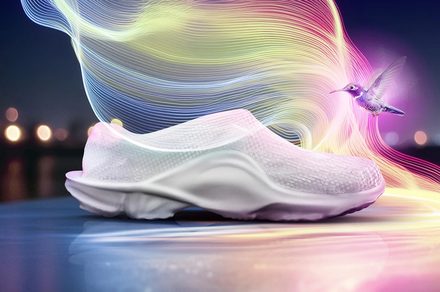
One of the key things about the people and companies we speak to as part of Trending Forwards is they must be doing something different… and that’s certainly what Syntilay is doing.
They have the lofty goal of changing the world of shoe production – not just in terms of the way they’re made, which is by 3D printing them based on reams of data – but by changing the way they’re ideated, designed and worn.
Syntilay uses sophisticated foot scanning technology to map and measure your feet, generating thousands of measurements that then get fed into a 3D printer that builds a shoe that precisely fits only you – for the price of off-the-shelf Birkenstocks.
That sounded really revolutionary, and you can read more about my colleague Peter’s experience when he decided to buy a pair for himself. However (spoiler alert), they’re the best-fitting pair of shoes he’s ever worn.
With that in mind, we contacted Syntilay to see if they’d join the Trending Forward series, looking at where technology is headed and how it’s going to change our lives in different ways.

Peter Horan and I were joined by Ben Weiss, Syntilay’s CEO and Joe Foster, the legendary founder of Reebok, representing the leadership team from the new brand.
In our conversation, we had the chance to talk to them both about not just the technology involved in using AI and 3D printing to make footwear, but also the cultural and fashion aspects of building highly customized shoes.
Joe, 90, has seen tectonic shifts in the shoe business over his career. Just after World War II he joined his family’s athletic shoe business in the UK.
It was, for its time, an innovator in the athletic shoe business, bringing in new production methods (similar to what Syntilay is doing now). But Joe and his brother recognized the running boom of the early 1970s and founded Reebok to capitalize on it.
Joe said the ‘white space’ that Reebok moved into, where it saw an gap in the market for more mainstream athletic footwear to grow into and build incredible success, feels similar to the space 3D printing shoes is offering now.
A technology company first

The personalized note that accompanies the purchase of new shoes
From the outset of our talk, it’s clear that the goal of Syntilay is not to just make cheaper, custom-made shoes (although that is a key part of the business model), but to disrupt. They’re already working with content creators and influencers to allow new shapes and ideas, reducing the cost of production by 99% in some cases.
“[Our question was] how do we give content creators their own shoes and brands…an original design from scratch,” said Ben. “How do you actually give creative expression that’s authentic, that’s different, that captures the brand or creator’s (vision) from the beginning?”
But the desire to disrupt goes further than that – while Syntilay uses advanced technology to produce the shoes, Ben believes the company will be known for technological changes rather than the shoes themselves. And it’s inspired by the disruption created by the big tech brands.
“We’ve seen the kind of dent that the Apple Watch has had in the watch industry,” says Ben. “I mean, it’s completely changed the way traditional watch companies have to operate. They’ve had their own versions of it.
“But there’s lots of great concepts from the Apple Watch that you could apply to footwear. I mean, the idea of one screen, with infinite design capabilities, is really cool. You know, you can have lots of customization like that (in shoes) and there’s a lot you can do. But I think [we can also give the user their] data, everybody seems to be interested in knowing more about themselves.”
This means sensors and batteries being integrated into the footwear, allowing more data on posture and health, while being naturally powered by the wearer’s movement. 3D printed shoes that speak to your connected ecosystem of gadgets – and perhaps even powered by your own motion.
They believe that in addition to using technology to build personalized shoes for individuals, Syntilay can offer customization that goes beyond any other brand can manage. Currently, the sneakers and slides are made from TPU (thermoplastic polyurethane), a highly versatile elastomer with unique properties that offers both superior performance and processing flexibility.
However, the company has mixed in additives to make it feel more like foam rather than hard plastic. That doesn’t help it overcome one big issue though: production is currently limited to half a million units, compared to the millions that brands like Nike can put out.
Finding a way past that will be key, as once the designs created by someone like a UFC fighter or influencer prove successful, they can then be produced in the millions.
There was plenty more discussed in our wide-ranging chat with Ben and Joe, such as how they can make a ‘leather effect’, letting people own a 3D-scan of their feet that can be used over and over again, and how they believe they can truly disrupt a multi-billion dollar industry.
Don’t forget to follow Digital Trends on Instagram, YouTube and TikTok to keep up with the latest technology and more from Trending Forward as we talk to the people trying to use tech to change the world.