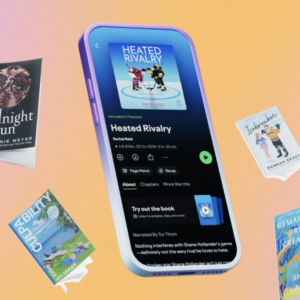
Spotify is about much more than music these days, and nothing makes that clearer than the company’s recent commitment to books—not just audiobooks, but old-school paper ones. Today, Spotify announced it’s coming hard for Amazon’s Kindle and Audible businesses, and will soon start selling physical copies of books in addition to audiobooks. Starting today, the company is also introducing “Page Match,” a feature that allows you to use your phone’s camera to instantly sync an audiobook with either a physical book, or one you’re reading on an e-reader.
How you’ll buy physical books through Spotify
Spotify’s physical book sales infrastructure isn’t quite ready yet, but the mere announcement is a surprising move in a few ways. Not only is a streamer making a big commitment to physical products, but the offering is being implemented in a way that could help local booksellers, rather than compete with them. This will likely bea relief to any bookstores that have struggled to compete with Amazon.
To bring physical book sales to market, Spotify is partnering with Bookshop.org, a site that connects shoppers with independent bookstores near them (although it doesn’t source inventory from them, but drop ships them from the distributor). Purchases deliver 30% of the sale back to a selected bookstore (which Bookshop.org says is the entire profit margin, though the site does keep a ); if the shopper doesn’t pick a specific bookstore to support, 10% of their purchase will go towards a general profit sharing fund for all bookstores partnered with the website.
It’s a stunningly market-friendly move, made possible by Bookshop.org’s B corporation status. But from a selfish perspective, it also means Spotify won’t have to deal with the logistics of selling books: In order to buy a physical book through the app, users will first have to navigate to one of the service’s audiobooks, then click a button that says Add to your bookshelf at home. After that, they’ll be taken to a checkout page on Bookshop.org.
It’s unclear whether Spotify itself will be making any money on these sales, or if it is simply acting as a middle-man. The company says it’s “meeting readers where they are” and is “excited to see the impact Spotify’s scale will have for local bookstores.” But even if there’s no direct profit incentive, I’m sure Spotify will be happy if it can drive some sales to a store other than Amazon, or use the new feature to convince readers of physical books to try the app.
How to sync your physical book with a Spotify audiobook
Speaking of Amazon, Audible has been able to sync audiobook progress with Kindle e-books for a while now, making it easy to jump between reading and listening. Now, Spotify wants to do the same, but with a more open approach. Rolling out today, with support expected to come to “most English-language titles” by the end of February, Spotify’s Page Match feature will sync your Spotify audiobook progress with your spot in a physical, paper-based book, or even an e-reader.
This works because it doesn’t use an account to sync, but instead works via your phone’s camera. To use Page Match, open a supported audiobook in your Spotify app, tap Page Match, then tap Scan to listen. Place your camera over the page you want to sync to, whether that’s in a physical book or one displayed on an e-reader screen. You can then tap Play from here to start listening from where that page kicks off in the audiobook, or Save for later to make a bookmark you can jump to at any time.
Once you’re done listening to your audiobook and want to go back to your physical book or e-reader, just open your audiobook, tap Page Match, and tap Scan to read. Place your camera over your physical book or e-reader, and after some processing, Spotify will tell you which page to flip to to start reading from where you stopped listening.
Unlike Spotify’s audiobook recaps, Page Match supposedly does not use AI, instead relying on computer vision and text matching. Still, I’m curious how the “Scan to read” feature will handle inconsistent page numbering between different editions of a book, which can be a major problem with e-books in particular. Spotify says that if the feature runs into snags, it will prompt you to try again.
Page Match is available to all audiobook listeners on Spotify, so there’s a good chance you can try it now. Premium subscribers and Audiobook+ members can use the feature with their monthly listening hours, while free users can use Page Match with supported audiobooks they’ve bought outright. I don’t subscribe to Spotify and I don’t own any audiobooks on the service, but the company says that to get started, you only need “make sure your Spotify app is updated.”
Spotify’s continued push into books and podcasts
Spotify might have started off as a simple app for streaming music, but now, it’s clear the company wants to maximize hours spent in its app, and that means branching out to all types of audio content. According to an interview with The Verge, it has seen a 36% year-over-year increase in customers starting audiobooks on a platform, and a 37% increase in overall audiobook listening hours. The growth is supposedly mostly coming from existing customers rather than new subscribers, so it remains to be seen whether Spotify’s enhanced audiobook support can dethrone Amazon. Page Match working with any physical book or e-reader is probably a good start.