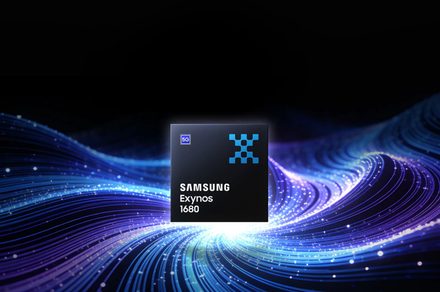
Samsung has officially taken the wraps off its new mid-range Exynos 1680 chipset, and it paints a promising picture for the company’s upcoming non-flagship phones. The chip brings meaningful upgrades, especially in the AI and graphics departments, and will hit the market with the recently announced Galaxy A57 early next month.
What’s new with the Exynos 1680?
The Exynos 1680 packs an upgraded Samsung Xclipse 550 GPU, which should deliver noticeably better graphics performance than the Xclipse 540 GPU found in the Exynos 1580. Samsung says the new GPU adds two additional Render Blocks alongside two Work Group Processors, resulting in a claimed 16% performance boost over last year’s model.
To improve AI performance, Samsung has equipped the Exynos 1680 with a new 8K MAC NPU that reportedly delivers up to 19.6 TOPS of performance, a 33% improvement over its predecessor. This should translate to faster on-device AI features.
Other notable upgrades include support for LPDDR5X RAM and UFS 4.1 storage, along with Bluetooth 6.1 for improved connectivity.
What hasn’t changed much?
Like last year’s Exynos 1580, the new chip is built on Samsung’s 4nm process and features the same octa-core CPU. It includes one high-performance Cortex A-720 core clocked at 2.9GHz, three Cortex-A720 cores running at 2.6GHz, and three Cortex-A520 efficiency cores clocked at 1.95GHz.
While the architecture remains unchanged, Samsung notes that one of the efficiency cores has been upgraded to a “mid-core” to better balance performance and efficiency. This could lead to slightly better battery life in day-to-day use.
Display support is still capped at FHD+ with a 144Hz refresh rate, and camera capabilities are also the same, with the Exynos 1680 supporting up to 200MP sensors and 4K video recording at 60fps. Connectivity features like Wi-Fi 6E, GNSS, and 5G NR are also carried over.
How these upgrades hold up in real-world use remains to be seen as the Galaxy A57 is put to the test.