The invisible walls for designers have been broken down. Maybe we don’t know it yet, but this year is the perfect time to start reframing the influence and vision of product design within and beyond companies.
In my experience in the industry, historically, all product design constraints have been driven by dismissing the value design can bring to companies and their products. Although this value is obvious, some companies and leaders still resist seeing design teams from a more protagonist perspective. Still, the point of this article is not to bring back old complaints or traumas, but to plant a new idea among the design community: the time of being more protagonist in the industry is here, and it might last for a long time.
Let me start on some common ground by pointing out where we were a few years ago and how the picture started to shift for us. The “walls” we struggled with in companies that delimited or sometimes stopped the design’s influence now seem to be falling away because of a new digital work revolution.
The product conversation wall
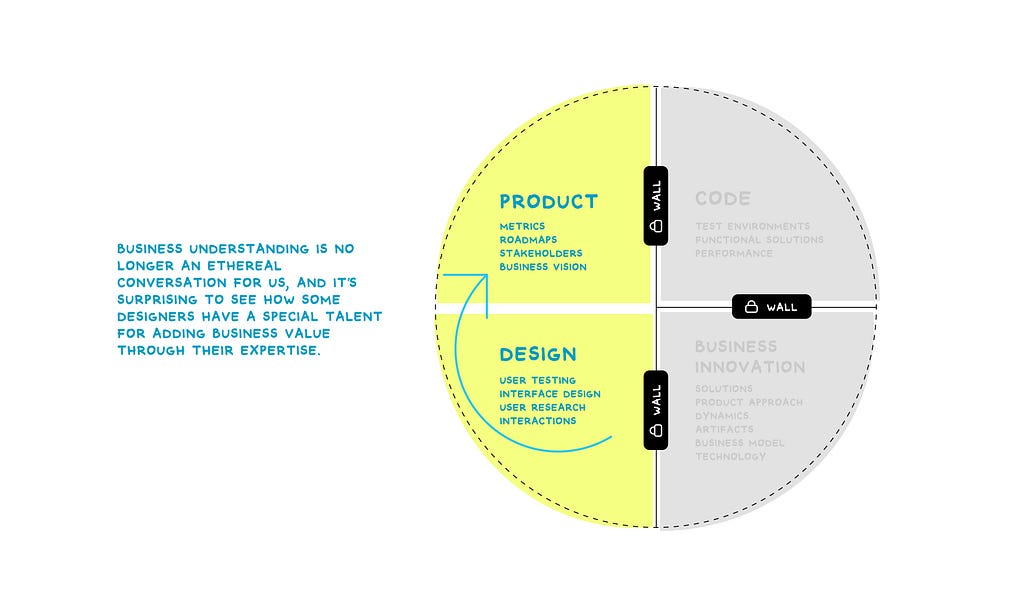
In some companies, there exists an executive-all-mighty product team vision in which this single unit sets the north star and makes all decisions. This product team is responsible for driving key conversations with users, stakeholders, competitors, and planning. The main purpose of this “executive” approach is to have one visible face for the product, serving as a messenger across stakeholders, business needs, and multiple areas, whose only job is to receive and execute what product teams bring to the table, with no room for negotiation.
This production model obviously didn’t work (at least for me, it is a flawed way of working), and it is so stressful for people to be the only ones responsible for handling information from multiple communication channels and plans.
What was the design influence here?
Since design teams and other areas were relegated to a blind production cycle, the influence was almost null; only in some conversation spaces, designers were able to speak up about questions or product improvement, but as this model structure worked, all ideas were confined to an endless backlog without having the opportunity to surface and shine.
When did this wall fall?
To be fair, this model died a long time ago; I want to believe it (although you can see it in some traditional companies today). When the product triad arrived in the industry, people realized it was better to drive a product through a multidisciplinary team approach, understanding business, user experience, and engineering as a whole.
How to take advantage of this from now on?
Since all product decisions are now made with a clear understanding of all product perspectives towards a common goal, designers can understand business decisions firsthand and even become more proactive in the decision-making process. Business understanding is no longer an ethereal conversation for us, and it’s surprising to see how some designers have a special talent for adding business value through their expertise. Now, since designers are close to users and the business, they can expand their influence by creating design solutions that are perfectly aligned with the business vision and drive growth. This new influence range also opens the door to engaging high-stakeholders and having hard conversations, increasing communication skills that were nonexistent before.
The code wall
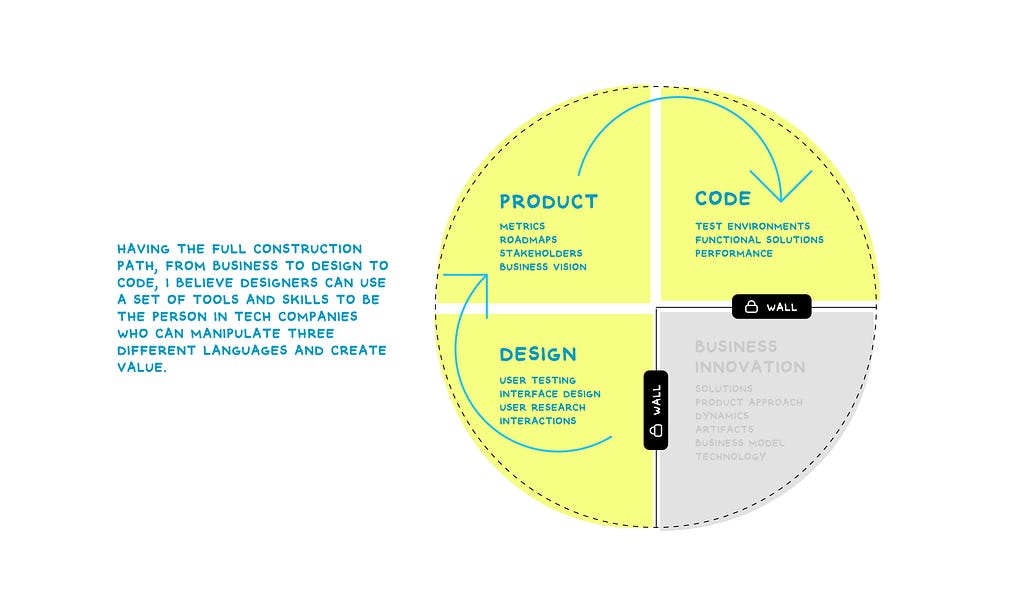
The fall of this wall (partially, maybe?) is the newest and most rewarding improvement for designers to celebrate since AI hit the market, well, for the vibe-coding enthusiasts. On the other hand, some designers are still refusing to enter the code conversation due to several reasons I’m not going to question here. The thing is, some years ago, the ultimate expression of functional design was recreating product flows in external tools like InVision or Zeplin. To be honest, this was a groundbreaking improvement for designers at the time, but it was also limited in its ability to represent an entire user journey with multiple variables and edge cases (it was only a sequence of static images). I stopped using those tools, and I assume they have evolved over the years, but even so, with the transition from a design file to code via AI, the biggest gap between designers and productive environments has been closed.
What was the design influence here?
Before AI, code language was a black box for designers; most of them. From time to time, rare designers could talk about JavaScript, databases, or HTML syntax, making them a sort of unicorn. For the rest of the designers like me, our influence in code reviews was limited; in only some situations did devs show lines of code to explain why our design was not viable, and that was it. Most of the time, many of the design ideas were discarded due to engineering “limitations,” so our ideas were always weakened.
When did this wall fall?
Since the AI boom, designers have discovered a new door to cross. The proliferation of AI companies whose purpose is to facilitate code transition for everyone has been the perfect catalyst for accelerating the disappearance of this barrier. Today, seeing people from different backgrounds and professions “making code” with Vibe coding tools and building businesses from scratch is to embrace the new reality that coding is no longer exclusive to specialized teams.
How to take advantage of this from now on?
You can argue a lot about the quality of code produced by a vibe coding experience; in this regard, there is a lot of controversy today, which I agree with, without renouncing my full expertise in this matter. Still, even with this variable taken into account, designers can now have their own code live for multiple purposes, which again expands their influence.
Having the full construction path, from business to design to code, I believe designers can use a set of tools and skills to be the person in tech companies who can manipulate three different languages and create value.
From the old triad model, designers have a huge advantage: the design itself. No one else has that ability. Even when creating designs with AI, the results aren’t perfect, and engineers and PMs can’t spot issues or generate ideas.
The innovation wall
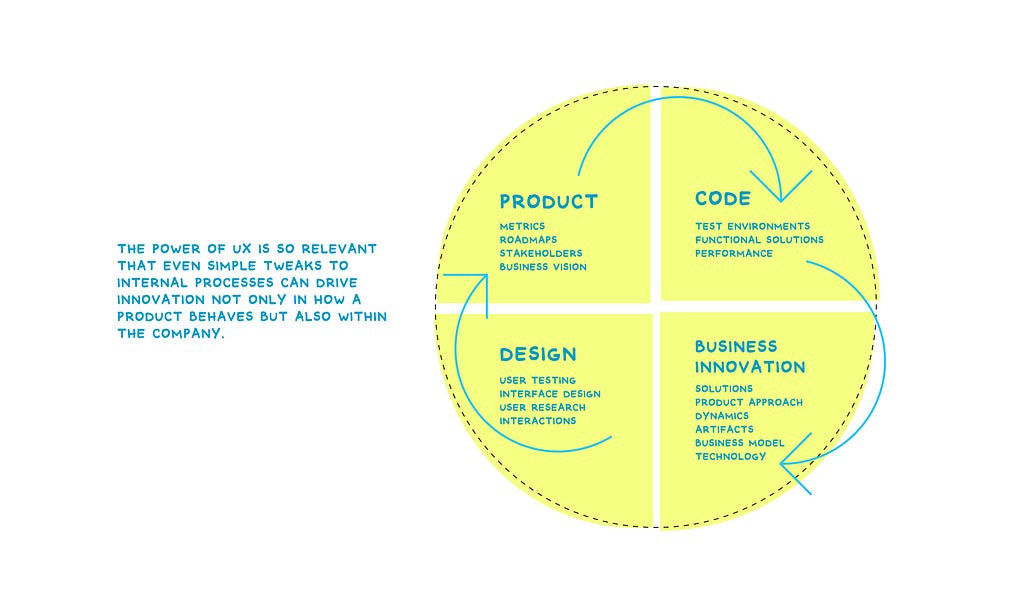
Who said designers can’t bring ideas to the table to change things? They are the ones for this job. Some years ago, innovation came from executives who dictated what to do with the product or the company’s dynamics, and sometimes they were not connected to audiences or the market. That wall of innovative thinking fell long ago when the product decision-making was split into a multidisciplinary perspective. Over the years, all designers thought that the only place to create value was in interfaces, but the truth is that even with simple design ideas, we can create revolution in companies or products.
What was the design influence here?
Some years ago, innovation in digital products was perceived by how well or how aesthetically pleasing the user interface elements were. It’s not new that, years ago, highly realistic visual metaphors were king when building websites. After that, we fell into a “flat language” in which solid colors and big fonts dominated design trends over the years, but to me, those changes were merely visual; the influence here was focused solely on communication.
How to take advantage of this from now on?
Since designers are more proactive in product decision-making, we began shifting the product approach to a more user-centric and business-centered experience, leaving behind the field of communication to enter and reframing how we communicate within teams, thereby creating more innovative processes and outcomes. The power of UX is so relevant that even simple tweaks to internal processes can drive innovation not only in how a product behaves but also within the company.
Now we have the technology that shortens the gap between our way of thinking and the impact we want to achieve, but a tool alone is not enough to validate this impact. That’s why I believe that, from this year on, we can see the evolution of design as we know it.
The rise of the new designer/builder
New standards: the power of imagination
My colleague and VP of Design, Carlos Pinilla, said something the other day that blew my mind. It was a statement that reframes designers’ skills nowadays, now that we have all the tools at hand and the walls have fallen.
“New designers should be measured on how big their imagination is, instead of how much they know about tools.” — Carlos Pinilla.
This idea complements my thesis on how a new design approach and influence can emerge from this technological revolution. Now we have the tools, but as I said before, tools by themselves only deliver limited or generic solutions, and that is where a big imagination can make a difference. This design impact can extend beyond interfaces, thereby expanding designers’ influence.
Another point raised by Carlos is that design influence can’t be broadened if the company is not aligned with this direction of innovation. Not having a clear vision for design teams will build all the walls that, as I said, limit our full potential; those are the types of companies to avoid. On the contrary, companies that start thinking about using product design as a foundational innovation vision, along with new AI tools, are places where invention from another perspective can thrive.
The end of manual design and the rise of strategic design
Let’s be honest here: design as we knew it is over. Taking days, weeks, months, or even years in Figma to create components, interfaces, and connect prototypes can start to sound expensive for companies; this is an ugly truth, but after all, the truth. Why do we need an army of designers or engineers to validate an idea? That’s a question to start thinking about, since we have advanced tools like Claude Design or Google Stitch (among others) that accelerate the product creation.
In my opinion, the craft is shifting toward a new way of thinking, where we delegate the craft to tools to accelerate the process. Still, as designers, our experience and expertise can be exploited in new ways in strategic fields for companies and businesses.
Deliver complete tools and services, not just mockups; that’s the new design destiny. As I mentioned above, all the walls that might keep us in secondary or even tertiary roles are down, and this is the time to start using what we have learned so far to discover a new design value that transcends mockups and points to the entire business, functional product, and services.
My question for you is: how do you want to be the protagonist in this new scenario without falling behind?
To write this article, I want to credit all the fantastic information sources and other authors who have written about related topics, each from an exciting, different perspective.
The Year You Finally Follow Through
UX Design 2026: from asking to choosing in the age of abundance
Experiment Like a Child, Build Like a Founder
10 UX Design Trends Driving Business Growth in 2026
Product design in 2026: the beginning of a fantastic voyage? was originally published in UX Collective on Medium, where people are continuing the conversation by highlighting and responding to this story.