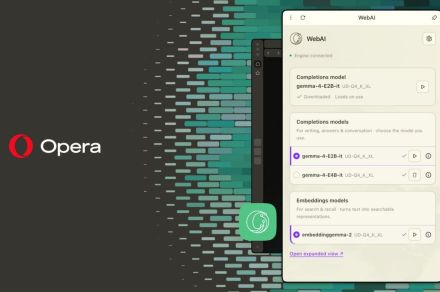
Opera wants to move routine AI work out of distant data centers and onto the computer already sitting on your desk. Its new WebAI preview lets websites and browser extensions use local models inside Opera One without requiring another AI subscription or sending the information they handle to a cloud service.
WebAI also opens local AI to third-party developers instead of reserving it for Opera’s own features. Your laptop supplies the computing power, provided it has enough to spare.
How WebAI puts models to work
WebAI is a proposed web standard that gives websites and extensions access to AI through the browser. Opera says the effort has backing from Google and Microsoft. Its implementation is model-agnostic and centered on open models.

Opera One can tap Google’s Gemma models, while compatible Macs can also use Apple’s on-device foundation model. Developers can generate or classify text without maintaining their own AI servers or paying for every request sent to an outside service.
Opera’s examples are deliberately practical and a little nosy. One extension can sort a messy tab collection, while another can flag clickbait before it eats another five minutes of your life.
What stays under your control
Opera has kept WebAI disabled by default. Nothing is downloaded until the user enables it, and each site needs permission before it can access the browser’s local AI. That extra layer is important when websites, rather than only Opera, can call the models running on your computer.
No data center will rescue weaker hardware, however. Speed and capability depend on the computer, and Opera hasn’t disclosed minimum performance requirements beyond the supported platforms. Opera GX and Opera Neon are scheduled to receive WebAI later.

Why Opera also built a bulldozer
Opera is pairing WebAI with a separate experiment called HTML-in-Canvas. It lets developers place functional webpages inside 2D and 3D scenes, where buttons and forms keep working as the page moves through virtual space.
The showcase includes a Gamer Room with live webpages on its screens and Webpage Bulldozer, which turns site elements into objects you can shove around. Both demos already work in Opera browsers without setup, so the bulldozer is the part anyone can try while WebAI remains an opt-in early preview.