Last month, following reporting from The Wall Street Journal, OpenAI confirmed it was working on a desktop super app that would combine ChatGPT, its Codex coding agent and Atlas web browser into one cohesive experience. OpenAI is not releasing that application today. Instead, it’s pushing out a major update to Codex that significantly expands what that software can do. However, the new release offers a glimpse of what OpenAI hopes to build with its latest effort.
“We’re building the super app out in the open,” said Thibault Sottiaux, the head of Codex, during a press briefing held by OpenAI. “This release is about developers. In the future, we will broaden it up to a wider audience.” Until then, the latest version of Codex offers developers multi-purpose AI agents that can work across a “larger surface area,” while being more proactive. In practice, that translates to a host of new capabilities, starting with computer use.
The agents inside of Codex can interact with other apps on your PC. When prompting one of OpenAI’s models, you can name a specific program or let it determine the best application for the job. Computer use is available in competing apps like Claude Cowork, but where OpenAI believes Codex offers an edge in that department is in the “secret sauce” it built to allow an agent to run an app without bogging down your entire system, so the two of you can work in tandem. At the same time, OpenAI is releasing 111 new plugins for Codex that combine skills, app integrations and model context protocol server connections to give Codex more ways to gather context and use the tools developers depend on for their work.
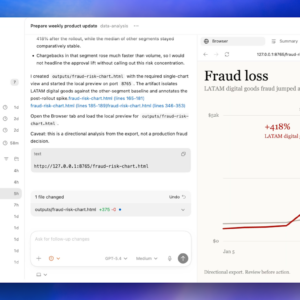
The company has also added a built-in browser, with a commenting system that allows you to prompt Codex to make tweaks to specific parts of a webpage or web app you’re building. In the demo OpenAI showed, one member of the Codex team used this tool to instruct Codex to change the margins on a graph so that the y axis wasn’t cut off. Complementing this is built-in image generation. Codex can use gpt-image-1.5 to create product concepts, mockups, frontend designs and even assets for simple games. It also allows Codex to use screenshots to verify it’s on the right track with a user request.
With today’s update, OpenAI is also previewing a pair of memory features. The first allows Codex to recall context from previous tasks to inform how it goes about future prompts. According to OpenAI, with time, this will allow Codex to complete requests faster and to a higher standard. The app will also use the context it’s gathered to suggest proactive actions. For example, at the start of your day, it might suggest you respond to a comment a coworker left on a Google Doc draft you wrote.
If you want to try the updated Codex for yourself, OpenAI is starting to roll out the new version to desktop app users who are logged in with their ChatGPT account. Computer use is available to macOS users first, with availability for people in the EU and UK to follow soon. Similarly, Brits and Europeans will need to wait to try the memory features OpenAI has built into Codex.
This article originally appeared on Engadget at https://www.engadget.com/ai/openais-latest-codex-update-builds-the-groundwork-for-its-upcoming-super-app-170000019.html?src=rss