
The future of digital advertising should feel less like a distraction and more like recommendations from a friend.

I’m a product designer and for the last four years I have been working in digital advertising for tech. I wouldn’t have imagined building part of my career in advertising, but here I am, and I have found myself honestly enjoying the challenge. Through this experience, I have learned that healthy and fair advertising is actually a good thing for the industry. It helps brands reach people, and it helps people find what they are looking for. When ads are well-executed, they are great content. There have been amazing pieces of advertisement across history, and when you pair great ads with great products, magic happens.
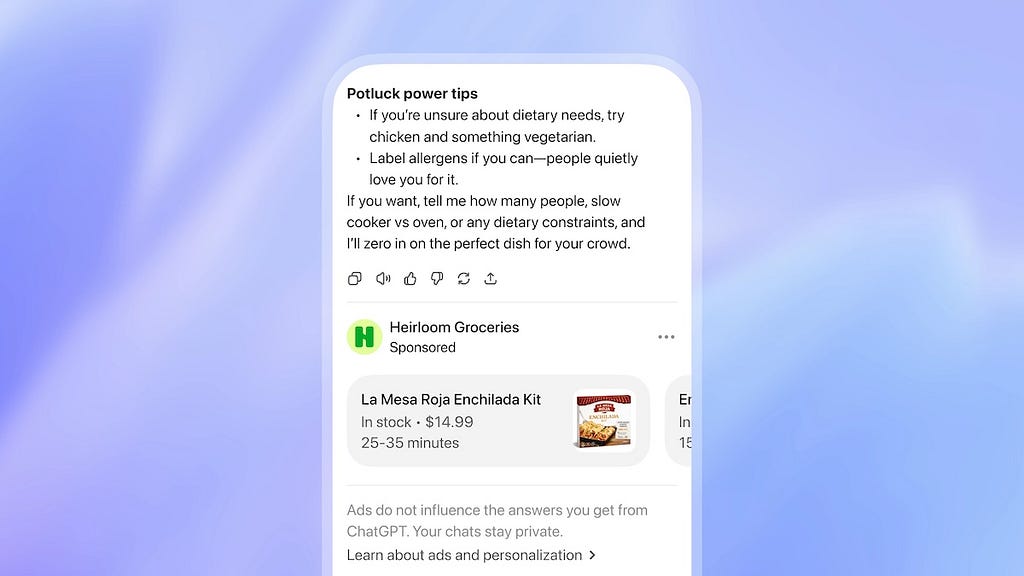
A few days ago, ChatGPT started testing ads within its conversations. The first screenshots show a safe and expected approach: a user starts a conversation around a specific vertical, the model gives a standard AI answer, and then it shows an ad related to the conversation keywords. This replicates the model used in other media platforms by capturing signals and showing inventory that matches them. It’s a safe starting point, but it feels simplistic considering the possibilities of AI. There should be a more sophisticated way to do this. We need a model that treats ads not as an interruption, but as high-utility content that actually improves the experience.
The immediate reaction from many is that ads in ChatGPT will harm the user experience. I think that if the strategy is well executed, it could improve the quality of recommendations. My rationale is based on the data source. When platforms create an ad ecosystem, they have a real incentive to digest merchant catalogs, local service listings, and travel databases. Once this content is set up for advertisers, it can be used to power general responses, too.
Currently, when you ask ChatGPT about a product or local service, it likely scrapes multiple websites. This doesn’t guarantee the metadata is right or updated. A direct integration with a business’s database ensures freshness and reliability. It is the technical difference between scraping a UI and communicating directly through an API. I don’t doubt that advertisers, from global retailers to local barber shops, are waiting for the moment they can upload their catalogs and service lists directly to OpenAI. As industry reports from ROI·DNA suggest we are entering an era where brand-verified catalogs become a fundamental part of the reasoning layer, allowing the model to ground its advice in high-quality, real-time data rather than just scraped noise.
Think of it this way: if you ask about running shoes today, the model analyzes your context and scrapes the web. It reads reviews and influencer videos, but it is unlikely to find professional, unbiased benchmarking. Most of these sources already have sponsored rankings, so the content is already biased by SEO games. The model might show you an organized summary, but it’s coming from already biased and probably sponsored sources. The products might also be out of stock or the technical specs might be outdated.
In a new model, the AI would bypass this noise by directly integrating with rich catalogs of shoes, boutique hotels, or specialized medical services. These databases include real-time price, stock, and local availability. When doing research, the model could cross-reference this first-hand data with community reviews or scientific research. This also levels the playing field, as smaller, local brands could be part of that same inventory.
By leaning into this infrastructure now, OpenAI is pulling ahead of most competitors. They are building a better recommendation experience under the guise of an ad network, establishing the technical pipes required for commerce before others even begin. Google remains a unique incumbent here. Through its shopping features, it has spent years perfecting an ecosystem of real-time merchant data. While Google may be better positioned to activate these features when they decide to fully commit to AI ads, OpenAI’s moves are defining a new standard for what a helpful recommendation engine in the AI world looks like.
My take on the recent Anthropic ad campaign, which brilliantly mocks the scenario where ads become intruders in the conversation, is that while it is a great piece of marketing, it only addresses the “noisy” version of advertising. In a scenario where ads are treated as high-quality, verified content, this satirical picture no longer fits. More importantly, LLMs that fail to integrate these APIs and catalogs soon risk falling behind in the race to provide the best commercial recommendations because that is a primary use case for AI users today.
I often think of the analogy of a friend recommending a product. If you tell a friend who is passionate about bikes that you’re looking for a weekend ride, they don’t just shout a brand name at you. They ask about your taste, your budget, and your local terrain. They are a friend first, understanding your context before suggesting a solution. This is the difference between advertising as noise and advertising as advice.

This analogy brings us to a “neutrality paradox.” A good AI analysis should rank options based on what is actually best for the user, rather than who paid the most. Critics will rightly ask: how can the model remain an unbiased advisor if it’s also the salesperson? To get this right, OpenAI must maintain a strict wall between the model’s reasoning and the ad auction. The AI should first determine the ideal solution for the user, and only then see if there is an ad that matches that specific intent. If the best suggestion happens to be sponsored content, everyone wins. If the model starts nudging users toward an ad just to hit a revenue target, the trust is gone.
For this neutrality to feel real, it has to be visible. This means following the rules of digital advertising, like clear labeling. If a recommendation is sponsored, the user should know exactly why it’s there and have the power to opt out or mute specific ads entirely. Trust isn’t built by camouflaging the ads, it’s built by giving the user visibility and control.
This new paradigm also has massive implications for user agency. Think of a scenario where, when planning a trip, the model surfaces a tiny local coffee shop that just opened in your destination: a business that otherwise could never afford to compete with big brands for global SEO. Perhaps because the user specifically asked for small local businesses. For this to work, OpenAI has to solve the “pay to play” barrier. If only the giants can afford to bid, the user’s preference for local shops becomes a dead end. A fair game requires a model where relevance and values can occasionally outrank a large ad budget.

This leads to a shift away from one-way communication. Most ads today are static broadcast. In this new model, an ad becomes a two-way dialogue. Instead of a generic banner, the ad can become an interactive experience that answers specific questions about a product’s features. It moves from interruption to consultation, surfacing only the parts of a product relevant to your current need. The model becomes more like a great salesperson that answers your questions, one who knows when to say, “I have nothing to offer you right now, but it was great having a conversation with you.”
This approach also enables better discovery. Traditional search is limited by what we know to ask for. In a conversation, an AI can identify a need that the user hasn’t yet put a name to. This is a shift toward a discovery-based experience, similar to what platforms like Pinterest have spent years perfecting. As Pinterest Engineering notes, ads are most effective when they are designed to inspire and connect users with ideas they genuinely love rather than acting as a simple distraction.
Of course, this level of personalization raises the stakes for privacy. To be the “friend” in the analogy, the AI needs to understand your context deeply, but that data must remain a private secret. The real opportunity is in zero-knowledge advertising, where an advertiser knows their ad was shown to the right person, but never knows who that person is or what they said to the AI. The proof of success will be found in ad performance, not data harvesting.
Ultimately, the success of this shift depends on one thing: OpenAI’s willingness to be rigorous enough to decide when not to show an ad. The business hunger for growth often leads platforms to flood every empty space with sponsored content. If OpenAI shows an ad just to collect the incentive, even when it doesn’t truly help the user, they become just another search engine. If they make it right, they can leverage the power of the ads as content.
There are broader challenges in the AI landscape that need to be addressed. Like any powerful technology, AI must be governed by priorities like safety and ethics. Safety concerns must always come first. It is only when all necessary guardrails are met, and the model identifies a clear and safe shopping intent, that a healthy advertisement ecosystem can exist.
This new paradigm opens a significant opportunity for ads to evolve from a tax on our attention into a service for our needs. A well-executed advertisement could be a win for everyone involved. We’re jumping into the next phase of human history, and yes, there will be ads. I don’t think anything will stop this change, so the best thing we can do is get it right by ensuring the value of the answer is never traded for the price of the ad. That’s what I’m hoping to happen.
Rodrigo Osornio is a San Francisco-based product designer with training in visual arts and industrial design. He is passionate about shaping the future of human-technology interaction.
Illustrations created by the author using mixed media. The screenshot of the OpenAI ads test was taken from their announcement.
OpenAI: from ads to content was originally published in UX Collective on Medium, where people are continuing the conversation by highlighting and responding to this story.