The shallowness of the “empathy machine.”

I once saw a “poverty simulation” designed to help raise funds and “put people in others’ shoes.” I felt… weird. Can you imagine someone going through a 10-minute fancy VR experience and suddenly claiming they understand the struggles?
VR allows users to step into any experience from a first-person perspective. Some people call it an “empathy machine” and argue that it could influence decision-makers. I bought into it at first. However, after going through several simulations, I noticed that no matter how moved I was in the moment, none of it led to any real behavioral change.
Is it just me? Or is this “trigger empathy and cause behavioral change” design goal too impractical and overhyped?
Why do people believe that VR can trigger empathy?
VR allows users to inhabit avatars, and their brains might start believing that the virtual body is theirs (researchers call this “sense of embodiment”). Some designers believe this can encourage perspective-taking, reduce implicit bias, and eventually induce empathy.
In theory, it makes sense. But in reality, this assumption is too ideal and shallow. First, your brain isn’t that easy to trick. A tiny glitch — a slight delay between movement and render, or weird skin texture — will remind you it’s fake. More importantly, embodiment alone is just a shallow representation of identity. For example, putting users in a Black body doesn’t give them hundreds of years of history or lived experience. It doesn’t make them part of the Black community, and it certainly won’t create sustainable empathy.
What is empathy, exactly?
This word seems a bit abstract, so let’s define it better here. When researchers and designers discuss empathy, they’re usually talking about two different kinds: emotional and cognitive.
Emotional empathy is immediate and direct, like seeing someone in pain makes you feel discomfort too. Cognitive empathy goes deeper. It’s when you actively try to understand someone’s mental state and decision-making process, and this kind of empathy is what usually leads to behavioral change.
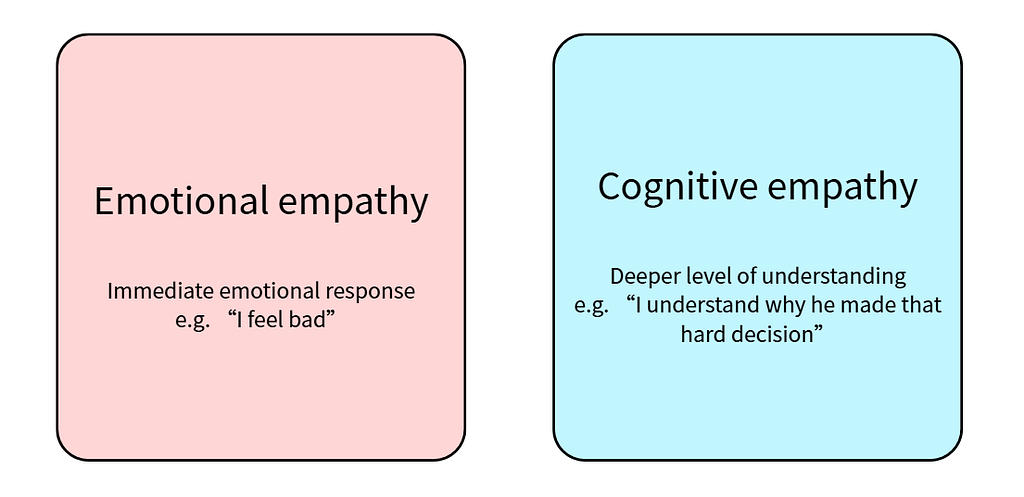
VR is pretty good at triggering emotional empathy because it provides users with intense sensory information. But the reaction doesn’t last. For me, it usually starts fading about 10 minutes after removing the headset. I think the problem is that while I’m in the experience, I’m so overwhelmed by everything I’m sensing that I can’t actually think about what the character is going through mentally. Without that deeper engagement, cognitive empathy never gets triggered.
VR’s shallow content
Beyond sensory overload, VR simulations lack the depth needed for cognitive empathy.
The content is often shallow. Let’s compare it with other storytelling media: movies and books are usually built on years of research and interviews, while VR simulations prioritize technical execution, focusing on realistic graphics and interactions over storytelling depth. Users often end up distracted by the novelty of technology instead of engaging with the issues.
Time is another constraint. Most VR simulations run under 10 minutes, which isn’t enough to convey background or context. Understanding social issues often requires hours of learning and engagement just to grasp the basics. However, creating longer experiences isn’t practical either because VR headsets are bulky and uncomfortable, and the sensory intensity creates fatigue quickly.
When VR simulation might work
VR probably isn’t the best tool for creating sustainable empathy or long-term behavioral change. However, it can still be effective when applied with clear, specific design goals instead of vague “triggering empathy” objectives.
Take healthcare training for example. Research shows that medical students better understand conditions like Alzheimer’s through VR, improving their compassionate care. It works because VR complements their existing education. These students already study these topics extensively through patient shadowing, workshops, and reflective practice.
Unlike general audiences with no background, these students approach VR with clear learning objectives. They know they’re not trying to “feel like” elderly patients but learning to recognize specific physical symptoms. They’re less likely to get distracted by the technology and can navigate the experience better. The actual empathy develops later, when they interact with real patients.
No one can really “walk in others’ shoes.” Empathy is a complex emotion. Social issues are far more complicated than any simulation can capture, and technology only scratches the surface: loud explosions simulate sound, not fear. Disorientation replicates physical sensations, not the psychological toll of experiencing it every day.
New technology isn’t always the shortcut to the solution. Real perspective-taking requires a more time-consuming traditional approach: engaging with communities, reading, and listening. As a developer, I try to remember these limitations instead of chasing technology hype with vague, overambitious goals.
Reference:
- Milk, C. [TED]. (2015). How virtual reality can create the ultimate empathy machine [Video]. YouTube. https://www.youtube.com/watch?v=iXHil1TPxvA
- Martingano, A. J., Hererra, F., & Konrath, S. (2021). Virtual Reality Improves Emotional but Not Cognitive Empathy: A Meta-Analysis. Technology, Mind, and Behavior, 2(1). https://doi.org/10.1037/tmb0000034
- Dyer, E., Swartzlander, B. J., & Gugliucci, M. R. (2018). Using virtual reality in medical education to teach empathy. Journal of the Medical Library Association : JMLA, 106(4), 498–500. https://doi.org/10.5195/jmla.2018.518
- Sora-Domenjó C (2022) Disrupting the “empathy machine”: The power and perils of virtual reality in addressing social issues. Front. Psychol. 13:814565. doi: 10.3389/fpsyg.2022.814565
No, VR can’t make you walk in others’ shoes was originally published in UX Collective on Medium, where people are continuing the conversation by highlighting and responding to this story.