
The designer, engineer, and PM each evolve into different kinds of specialized ‘builders’.

“Design is dead.” “AI is so good at design now, we don’t need designers anymore!” “AI will replace designers.” Our social feeds are flooded with posts like these. But they come from a myopic view of design. Many design leaders think the obituaries are premature. And I agree with them. Figma leaned all the way into the joke and threw design a funeral, which I loved them for.
And this isn’t only design’s problem. The same eulogies are being written for engineering and product — that AI will simply replace them. But the reality is that AI is not omnipotent. Fundamentally, the AI technology has flaws and constraints — context window limits, hallucination, sycophancy, context anxiety, to name a few.
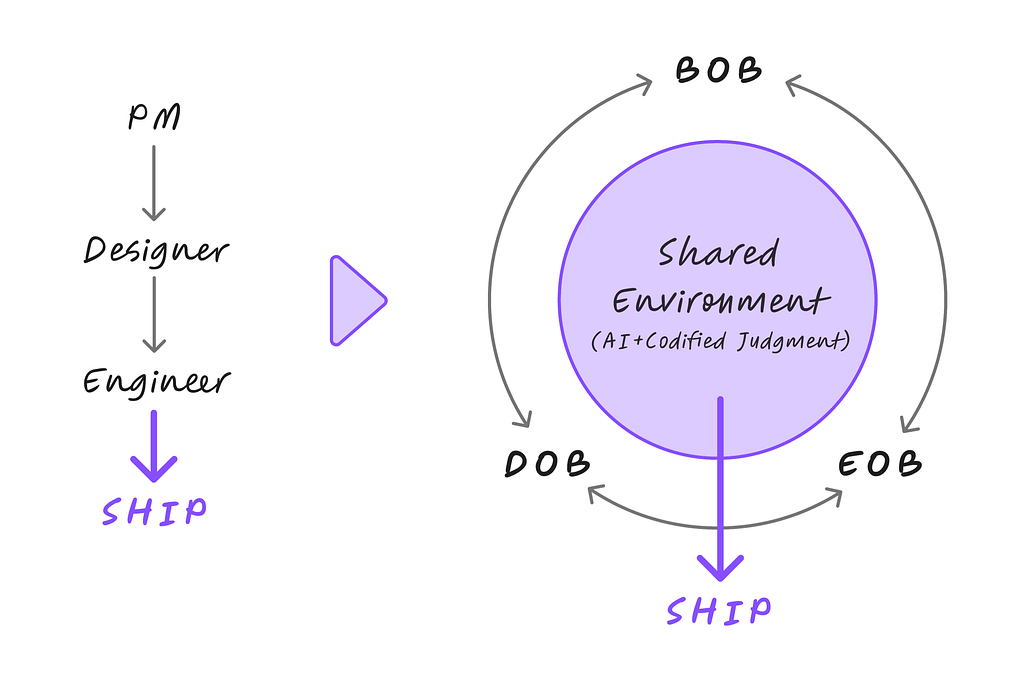
I think the three functions — design, engineering, and product — aren’t going anywhere, but the roles built on top of them evolve significantly. The designer, engineer, and PM all turn into a new kind of animal: the specialized builder. And the teams that win the next decade will be small groups of three of them working in concert: design-oriented builders, engineering-oriented builders, and business-oriented builders. DOBs, EOBs, and BOBs.
Why we still need all three
If AI is this capable, why not just have generalist builders who do everything?
Because the value of having three different roles wasn’t only the coverage of skills, but also the tension between those lenses. A designer, an engineer, and a PM arguing their way to a decision is a forcing function that pushes the team toward building the right product, in the right way. You can wear three hats in sequence, but you cannot hold three competing accountabilities at the same time. Try being the person fighting for solving the problem in the right way, for engineering the solution in the right way, and for creating business value, all in the same decision, at the same moment and you’ll find you can’t. As humans, we’re wired to favor one lens. The tug-of-war that balances the perspectives only exists when distinct people own different stakes.
But wouldn’t AI help balance the stakes? It does not. AI doesn’t correct for the perspective you removed. Rather, it amplifies the one still left. On top of that, it’s optimized to please you over being correct. Picture an all-engineer team that spins up AI agents to play the roles of PMs and designers. Those agents won’t balance the team out. They’ll in turn absorb its engineering bias and amplify it. The reason is what the agents run on: an AI agent making design or business calls is only as good as the judgment it’s been given, and on an all-engineer team that judgment was written down by engineers. People who aren’t design or business experts can’t encode design or business expertise they don’t have. That’s why agents built by them would fall short. Ultimately, a product that solves the wrong problem, or solves it the wrong way, fails no matter how expertly it’s engineered.
Furthermore, if AI agents make all the design and business decisions, who is accountable when something goes wrong? You certainly can’t hold Anthropic or OpenAI accountable if your business loses money when their models make errors. It’s the people who build the agents who answer for them. Which means someone with real expertise in the domain has to be the one directing how those agents work. That’s what AI is good for here: multiplying an expert’s reach, not standing in for one.
In bigger organizations this goes past three functions. Research, data, security, and other disciplines need to stick around for the same reasons: each carries a perspective the others won’t naturally argue for, and someone needs to be accountable for each one.
How it would actually work
Let’s start with tactical execution. In this model, AI does nearly all of the tactical work. A DOB describes the design, an EOB the engineering approach, a BOB the problem and the business model, and AI builds against it. The builder stops making things by hand and starts directing and checking instead — telling AI what to do, then verifying it did what was asked.
That shift frees their bandwidth for the work that actually needs deliberation. Each builder owns the strategy and long-term vision for their function, and released from tactical execution, they can make those calls with far more rigor than before.
The way they work together changes too. Instead of throwing artifacts over walls, they build in a shared environment. The old relay, PM to designer to engineer, is where things slowed down and where the original problem got garbled in translation. Most of that goes away.
The shared environment operates on codified judgment (design judgment is often called ‘taste’ in recent discourse). Each builder encodes the reasoning behind their routine, low-level decisions, so AI can make those calls on its own. Design systems like Material Design are early, primitive versions of this — design judgment written down so others can apply it without the designer in the room. But codifying judgment does something bigger than enabling AI automation. It lets a non-designer make a sound design decision, a non-engineer ship working code, a non-PM make a defensible business call — each working off judgment an expert codified. That’s the shift that turns them into builders. Everyone builds and ships directly. No more waterfall.
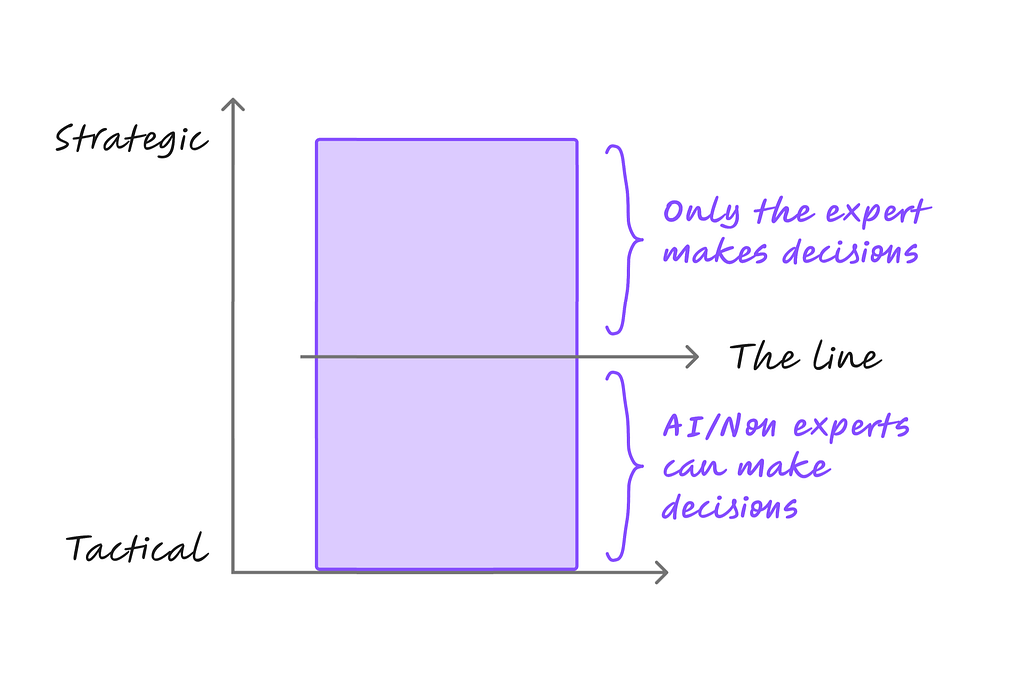
The counterpart to codified judgment is the boundary. You can’t write judgment down well enough to match a real expert, partly because a lot of it is tacit knowledge, and partly because it is highly contextual — the right call shifts with the situation in ways rules don’t capture. So each builder also draws a line: how far other people and AI can go without their sign-off. A DOB might let anyone ship a single screen inside the system but keep the core product abstractions and the high-level user journeys for themselves. Where that line sits depends on the org, the context, and how good the AI is that week, and builders keep redrawing it as they evolve.
This democratization carries one big risk: quality. When everyone can ship, the bar slips — even amid a flood of new products, their usage stays low because they’re simply not good enough. Holding the bar is part of the builder’s job: codifying the quality standards AI agents must meet, and setting up mechanisms like audits and manual sign-offs for high-stakes calls.
So beyond setting strategy, a specialized builder’s core ongoing work is maintaining that encoded system itself: keeping the judgment current, the boundaries validated, and the quality bar enforced, so everyone else can operate independently and AI can scale without quietly wrecking things. And of course, they hold the accountability for their function.
This model fixes something about the old setup, too. The classic triad bred silos and sign-off bureaucracy, the overhead that makes flattening look attractive in the first place. Keeping the three perspectives while sharing judgment, standards, and one environment takes most of the drag out, because there’s no handoff left for a silo to form around.
AI is going to metamorphose how we build. It isn’t going to retire design, engineering, or product. The work doesn’t collapse into one generalist ‘who can do everything using AI’. It concentrates into a few people who decide what good means and stay on the hook for it.
More works that informed this article:
UX design isn’t dead, you’re just confused — Meghan Logan
Is Product Management Dead? — Stanford
Times Are Changing: Coding Is Dead, Software Engineering Isn’t — Segun Akinyemi
The most important part of building your taste is to hand it off — Kai Wong
Product design in 2026: the beginning of a fantastic voyage? — Kike Peña
7 things that Vibe Design can’t replicate — Arin Bhowmick
No, design is not dead. Neither is engineering or product. was originally published in UX Collective on Medium, where people are continuing the conversation by highlighting and responding to this story.