As outdoor setups grow more complex, power solutions are evolving to keep pace
There was a time when heading outdoors meant packing light and unplugging completely. That version of outdoor life still exists, but it no longer reflects how many people actually spend their time outside. Today’s setups often include cameras, drones, laptops, mobile internet, and lighting that extends well past sunset. Whether it’s a weekend campsite, a van parked off-grid, or a remote work session in the mountains, power is no longer occasional. It’s constant, and it changes throughout the day.
That shift has quietly reshaped expectations. Bringing a single battery and hoping it lasts is no longer a reliable plan.
The Limits of Traditional Portable Power
Most portable power stations still follow the same design: a single, self-contained unit with a fixed battery and a set number of ports. While functional, this approach introduces trade-offs.
Users either carry everything, even if they only need a portion of it, or they leave it behind and lose access entirely. For shorter trips, the weight can feel unnecessary. For more complex setups, capacity may be insufficient or require additional planning.
This all-or-nothing approach often forces people to pack for the worst-case scenario. The result is more weight, more bulk, and more gear than they actually use. That disconnect is becoming harder to ignore as outdoor routines grow more varied.
The Shift Toward Modular Outdoor Systems
Across outdoor gear, modular design is becoming more common. Camera systems now rely on interchangeable rigs and mounts. Lighting setups break down into smaller, movable pieces. Even batteries in tools and e-bikes are designed to be swapped, stacked, and scaled depending on the task. The idea is simple: instead of a single fixed setup, you build what you need for now.
Power is starting to follow that same path.
Rather than relying on a single device to do everything, newer systems are experimenting with ways to distribute energy across smaller components that can work together or independently. It’s less about having a single central source and more about building a flexible network.

Why Modular Power Is Gaining Traction
There are a few reasons this shift is happening now.
First, energy use has become less predictable. A short hike might only require a phone charger and a light. A basecamp setup could involve cooking gear, cameras, and overnight lighting. Trying to cover both with one fixed system rarely feels efficient.
Second, mobility matters more. Lighter, smaller components are easier to carry, especially when plans change throughout the day.
There’s also a practical side. Spreading power across multiple units reduces reliance on a single source. If one component runs out or fails, others can still operate.
Finally, different environments call for different setups. What works for a campsite may not translate to a power outage at home or a mobile work setup. Flexibility becomes part of the design, not an afterthought.
Case Study: NjoyNook X-Sphere
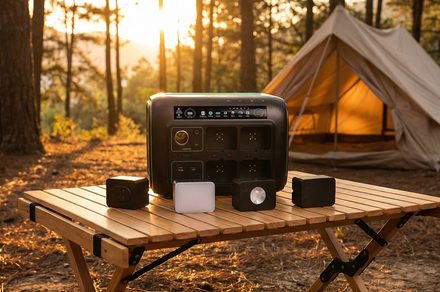
NjoyNook, a company whose current projects include applying modular architecture to portable energy systems, created theNjoyNook portable power station with distinct components that contain built-in batteries, thereby allowing them to operate independently of the main power station.
These four detachable components include a spotlight, a panel light, a Bluetooth speaker, and a power bank. The power station as a whole features 800W steady input and 1600W surge, 10 outlets, a 12-protection safety system, and an LFP battery supporting up to 4,000 life cycles.
In practice, this means that, unlike traditional integrated power stations, one module running out of power won’t prevent the rest from working as long as their own batteries are still functioning.
These components being modular makes it possible for users to only use the features they need while still having the others on hand to be reattached as needed. Additionally, because the system employs detachable battery-powered modules, the system’s power supply is distributed rather than centralized.
How the System Works Together
Modularity only succeeds when it feels seamless. The X-Sphere uses secure quick-mount connectors and intelligent battery management to make attaching and detaching modules intuitive. Each component operates on its own dedicated battery, meaning it does not rely on the hub to remain functional. When docked, modules recharge efficiently without complicating the overall setup.
Hot swap capability allows changes without shutting down the entire system. The result is a configuration that feels dynamic rather than mechanical.

Real-World Implications for Everyday Use
This shift becomes clearer when you look at how people actually use their gear. A short hike might only call for a compact battery and a small light, rather than an entire power station. Back at camp, that same setup can expand with additional lighting or devices connected to a central hub.
In emergencies, spreading power across rooms can make a difference. Instead of relying on one source in a single location, smaller components can provide light or charge where they’re needed most.
For remote work or content creation, separating power and lighting can also simplify setups: fewer cables, less congestion, and more flexibility in how equipment is arranged.
Even for casual use, like a weekend trip, having options reduces the need for overpacking.
What This Means for the Future of Outdoor Gear
Outdoor equipment is moving toward systems that adapt rather than dictate how they’re used. Power, in particular, is starting to feel less like a single device and more like part of a broader setup. Like something that can expand, shrink, or shift depending on the situation.
Looking ahead, that could mean more interchangeable components, closer integration between devices, and smarter ways to manage energy across different environments. It may also introduce new challenges, such as compatibility across systems or the need to think in terms of ecosystems rather than standalone products.
But the direction is clear.
As outdoor life continues to blend work, travel, and recreation, the tools people rely on are evolving with it. Power is no longer just something you bring along. It’s becoming something you shape around the way you move.
Digital Trends partners with external contributors. All contributor content is reviewed by the Digital Trends editorial staff.