AI assistants have gotten really good at answering questions and walking us through complicated tasks. But the next wave of AI is aiming for something much bigger: doing those tasks for us.
That’s the idea behind Meta’s new Muse Spark 1.1. Instead of simply telling you which buttons to click, the model is built to interact with your computer on your behalf. Whether it’s searching across multiple websites, filling out forms, or switching between apps, Meta says Muse Spark 1.1 can navigate software much like a person would, choosing the fastest way to finish the job. It’s a notable shift from purely conversational AI to AI designed to take action.
The era of point-and-click AI is here
The biggest upgrade is that Muse Spark 1.1 can take control of the task itself. The company says the model is designed to work across desktop apps, web browsers, and even mobile interfaces. Depending on what’s faster, it can either interact with apps the way you would — clicking buttons and navigating menus — or automate the process by generating scripts behind the scenes.
3/ computer use: it can operate desktop, browser, and mobile. muse spark 1.1 is trained to know when to automate and when to use interfaces directly. it scripts when that’s faster, clicks when direct interaction is simpler, and batches actions at each step. pic.twitter.com/oyw1x4q1av
— Alexandr Wang (@alexandr_wang) July 9, 2026
For instance, if you’re planning dinner with a group of friends, an AI agent could take care of most of the legwork. Instead of bouncing between Google Maps, restaurant websites, and your group chat, it could compare places, check opening hours, gather the important details, and present you with the best options. You still make the final call, but the tedious research is already done.
That’s where the AI race is heading. Companies are no longer competing to build the most talkative chatbot — they’re trying to build assistants that can actually get work done. Muse Spark 1.1 also comes with a sizable memory upgrade, supporting a context window of up to one million tokens. That means it can keep track of lengthy conversations, massive documents, and complex projects without constantly needing a refresher.
Can it really handle the messy stuff?
Like every major AI release, Muse Spark 1.1 arrives with a stack of benchmark wins. Meta says the model holds its own against some of the biggest names in AI across coding and agent-focused tests, and even comes out ahead in several. Those results are certainly eye-catching, but benchmark charts have never been the final word. What really matters is how the model behaves once it leaves the controlled environment of a test. Can it navigate dozens of websites without losing track of what it’s doing? Will it adapt if a webpage suddenly changes? Can developers trust it to work through large codebases without needing constant supervision? Those are the questions that will determine whether Muse Spark 1.1 is genuinely useful.
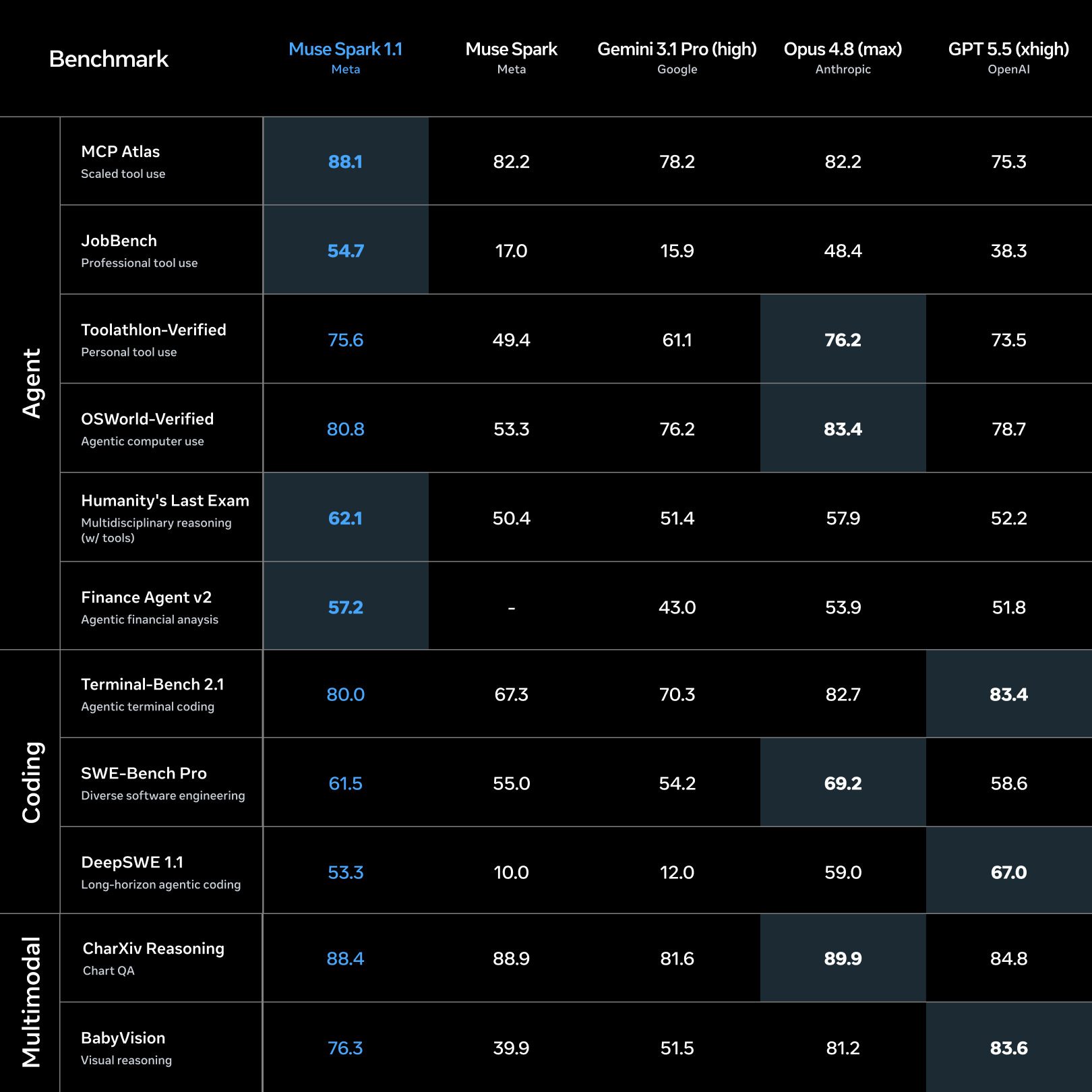
Meta is giving developers the chance to find out for themselves. Muse Spark 1.1 is now available in public preview via the new Meta Model API, enabling developers to build applications and run the model through real-world workloads. Whether Muse Spark 1.1 becomes the AI assistant people actually depend on remains to be seen. But one trend is impossible to ignore: the race is no longer about building chatbots that write better responses. It’s about building AI that can roll up its sleeves, take over the repetitive work, and let you focus on everything else.