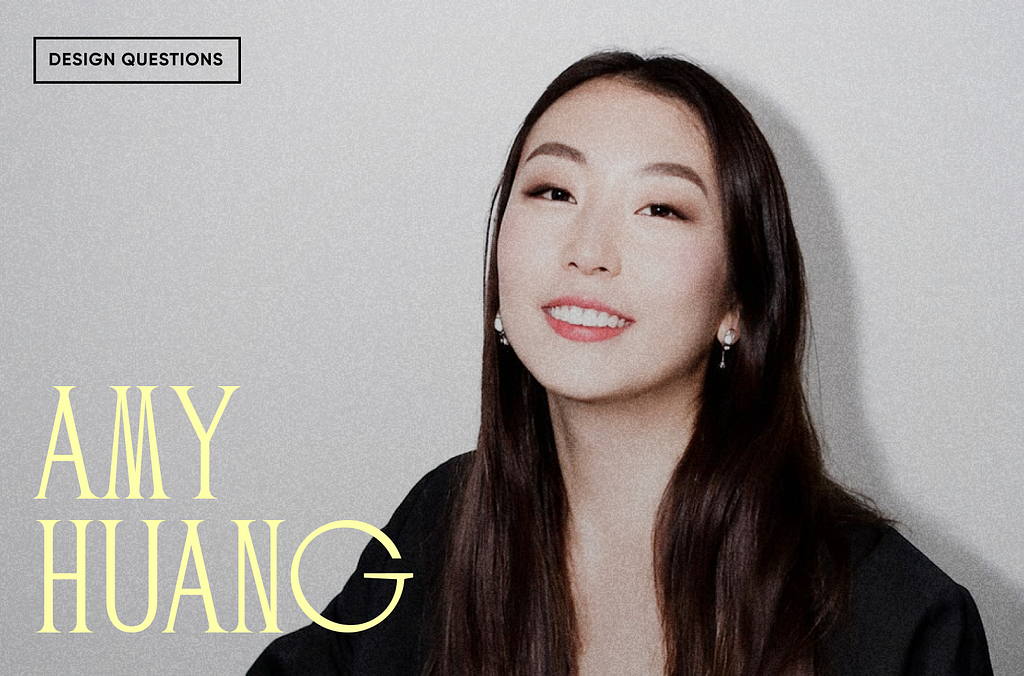
Amy Huang has a fintech and healthcare background including creative direction at Citibank and consulting for BCBSRI.
She has a B.F.A. in Industrial Design from RISD as well as various other qualifications in business and tech including Harvard Business School Online.
Amy moved from China to New Zealand when she was five years old and currently lives in the Dallas, Texas area with her dog Dolly and two cats Tiger Lily and Sesame.
You can find her on LinkedIn.
Can you tell us a little bit about your career background?
I started in health tech and moved into fintech, working across consulting, startups, and corporate environments. Along the way, I’ve gone from shipping MVPs to building design systems and leading broader product experiences. Those layers have shaped how I think and lead design teams today. It’s not just about designing products, but about designing teams and systems. I focus on setting up people for success so great outcomes can happen naturally.
What was your journey getting into product design?
I’m one of the people actually doing exactly what I went to school for. Early on, I knew I wanted to work at the intersection of design, engineering, and business, building things that work for people. I studied design at RISD, took business courses at Brown, completed Harvard Business School Online, and pursued a computer science minor and a Master’s in Information Studies. I approached it like a sponge, intentionally absorbing from each discipline and looking for ways to connect them. Initially, when I would describe it, that vision felt abstract to a lot of people, but over time those pieces came together in the role I have today where I’m often the connection between those different worlds. It’s like the design process: I started with a vision, then I put the work in to do the research and iterate until it became real.
How do you think your parents’ family friends are culture influenced, how you approach problem solving in your day-to-day work?
I grew up as the child of immigrants and moved across the world twice, once with my family, and later on my own for school and work. That experience taught me not to take anything for granted. Each time I entered a new environment, I had to start from scratch, figuring out how things worked. That became an instinct. I automatically try to understand systems, question assumptions, and look for ways to make things better. It also shaped how I connect with people. I’ve learned to understand different perspectives and not just to “speak their language,” but also immerse myself in other people’s worlds and learn from them, which has been incredibly valuable when working cross-functionally.
Yeah, if you don’t mind sharing like what did your parents do for work when you are growing up?
Both of my parents studied civil engineering, but their careers took a very different path after we immigrated. We moved from China to New Zealand for a simpler life, and they had to start over. My mom went into property valuation, and my dad, who was on track for a doctorate, couldn’t find work in engineering, so he picked up a hammer and became a builder. He learned everything from scratch, coming home covered in dust every day. Seeing that had a big impact on me. It taught me the humility it takes to be a beginner and it taught me that no work is “beneath” you. You do what it takes to support your family and build something meaningful. Today, my parents run their own building business together, and that mindset has stayed with me.
What are the most important qualities you look for in a design leader?
I think it comes down to three things. First, the ability to balance managing down, up, across, and sometimes diagonal. You need to support your team, communicate effectively with leadership, and collaborate with cross-functional partners and their leadership. Strong design leaders don’t over-index on just one, they balance all three. Second, having a clear but flexible vision. Your team is constantly looking to you for direction, so you need to know what you’re doing, why it matters, and be able to translate that into clarity and momentum. Third, trust and respect for the craft. That means being knowledgeable and hands-on enough to mentor and guide, but not micromanage, creating space for your team to do their best work and grow.
How do you balance business goals with design integrity? When they’re at odds?
I don’t actually see business goals and design integrity as being at odds. When they feel misaligned, it’s usually because there isn’t a shared understanding of how they connect. At the end of the day, both are working toward the same goal, creating value for the customer and the business. The real work is in bridging that gap. Designers need to understand the business context, and business partners need to understand the impact of design decisions. That often means having honest conversations about trade-offs, what you gain, what you lose, and why. With the right alignment and validation, it becomes less about compromise and more about making informed decisions together.
How do you foster collaboration between product engineering and design teams?
I’m a big believer in “no throwing things over the fence.” The best collaboration happens when design, product, and engineering are working together, not handing things off. A lot of it is just talking to each other. Knowing your partners, staying in constant communication, and making it easy to ask questions early and often. I also try to model that at my level so my team sees that it’s normal to reach out across functions. Honestly, as long as you’re talking to each other, that solves about 80 percent of the issues. It really comes down to communication, communication, communication.
When you start on a new design team, where do you spend your time and energy?
There’s always a bit of a paradox when you start on a new team. You’re the person who knows the least, but everyone is looking to you for leadership. Early on, I focus on being transparent about how I’m ramping up. I’ll share my plan and be honest about what I don’t know yet. That helps build trust and sets expectations. I also prioritize getting to know people, both learning how the team works and letting them understand who I am. That foundation matters more than jumping straight into decisions. At the same time, I’m digging into the work, systems, and details. I know though, that at some point, the team needs clarity and direction, not just vision.So, I keep a clear timeline in mind for when I need to shift from learning to delivering and showing up for the team in a tangible way.
What are the most common aspects in designer portfolios that bother you?
I actually think we over-index on portfolios. They’re helpful, but they’re not the deciding factor. What matters more is how you think, make decisions, and validate or iterate on said decisions based on research and feedback.. That said, I use portfolios as a quick read on fundamentals. The biggest issue I see is a lack of reasoning. I want to understand why choices were made and what trade offs were considered. I also look for originality. If something feels copied or lacks intent, that’s a red flag.
Do you have any tips for designers trying to break into the product design world?
If you hate it, don’t do it. I understand that sometimes it can seem like the most strategic move if you are trying to strike a balance between a creative and a practical career, but from what I’ve seen, doing something that is creative but not in the way you’re truly passionate about while also relying on it to make a living causes a lot of people to burn out. . Product design requires a level of curiosity and investment that’s hard to fake long term. If it is the right path for you, focus on finding your niche. Think about what you naturally gravitate toward and how that translates into product. The people who succeed long-term are the ones who know what they bring to the table and why they want to be here..
What design tasks do you think AI will automate in the next three to five years?
The obvious answer is generating designs. Gen AI: it’s in the name.. AI can create iterations quickly, making it easier to move from idea to implementation. But what I’m personally most excited about is how the use of AI is going to help automate brand implementation and consistency. I have pretty extensive experience leading design systems which, when the system is mature enough, is a form of automation which serves as a precursor to some of the changes that we’re seeing with AI today. Even when I’m not working on design systems directly, I lead my teams to design at a system level where we’re applying and evolving a set of design decisions rather than going back to the drawing board for each new project. That set of design decisions then becomes your product’s visual brand. With AI-powered tools that help consistently interpret and implement this brand system, instead of thinking screen by screen, teams will rely on AI to apply patterns, maintain hierarchy, and ensure consistency while designers are working to evolve the system itself. That’s where I think the real impact will be.
What parts of design do you think AI will never replace if any?
“Never” is a big word. There’s one version of the future where we reach a kind of utopia, where technology perfectly meets every need and we don’t have any more problems to solve.. Maybe we’re all just sipping margaritas on the beach. But as long as there are problems to solve, there will be a role for designers. At its core, design is about understanding human needs and translating them into solutions. In the near term, I don’t think AI replaces ownership of rationale. AI is great at generating possibilities, but it doesn’t truly understand why something is right. Designers are still needed to connect the dots, apply judgment, and ensure we’re solving the right problems. AI can generate a wide range of different ideas, which is useful, but it still requires a human to evaluate, refine, and meaningfully apply the outcome. Over time, the role will shift, but that layer of intent and responsibility remains.
What responsibilities do designers have when building AI products?
At a baseline, designers need to understand the problem they’re solving and the impact of their decisions. With AI, that responsibility expands. You can’t treat it like a black box. You need to understand how it behaves, where it works well, and where it breaks down. I think of AI like a material. Just because something is possible doesn’t mean it’s appropriate. For example, people used to use leather flasks to hold water, but they could only do that because they sealed the leather with beeswax since it’s a porous material, and even then, we now use much more durable and function-appropriate materials. The same thinking applies here. Designers are responsible for understanding the limitations, anticipating risks, and making intentional decisions about how AI is used.
How do you see AI changing the relationship between designers and engineers?
I see both designers and engineers leveling up, spending less time on execution, and more time on strategy and direction. Ideally, AI reduces the need for rigid handoffs. Instead of throwing work over the fence, it becomes a more collaborative process where both roles are contributing in real time, often in the same tools or environments. There’s a lot of fear around AI, but I think one of the positives is that it frees both designers and engineers from repetitive work. That creates more space for deeper collaboration and more meaningful contributions.
Do you think AI will change the size or structure of product teams?
AI is already making teams leaner, but I think the bigger shift is structural. Product teams as we know them were designed around execution, and as that changes, the structure itself will need to evolve. We’re moving toward a world where roles are less about doing the work and more about guiding it. As that happens, I think teams will become more interconnected. Instead of clear lines like “your team does this, my team does that,” there’s more shared ownership, shared knowledge, and collaboration across groups. I also think this starts to challenge the idea of teams as rigid units. Teams will still exist, but ideally with fewer silos. Rather than being confined to one area, people will have more flexibility to contribute across different problems based on their expertise. We already see different types of organizational structures across companies, and I expect that to continue. But overall, reducing silos and increasing interconnectedness feels like one of the most meaningful shifts AI could enable.
What skills will matter most for designers in an AI First World?
The obvious skill is knowing how to use AI, but that’s just the baseline. Designers need to understand context, where value is created, and how to apply AI intentionally. It’s not about using “AI” everywhere, it’s about knowing where AI-powered tools actually make sense and what tools to use. Another thing that’s going to matter more is actually creativity. As execution gets automated, designers are going to be pushed to think more, define direction, and create at a higher level. That’s exciting, but it also forces people out of their comfort zones if they’ve been relying on execution as their core strength. Ultimately, the designers who stand out will be the ones who can combine all three: using AI fluently, applying strong judgment, and bringing a clear creative point of view to their work.
Do you think designers should ever refuse to work on a product? Because of ethical concerns? Have you experienced that?
That’s a tough one, and fortunately not something I’ve personally had to face. If I were in that position, I’d first ask whether the product is inherently unethical or if there’s a version of it that could be responsible and beneficial. Then I’d ask whether I’m in a position to influence it in that direction. Designers often see the potential of a product, for better or worse, and it’s important to separate what could happen from what will happen, and consider what role you can play in shaping that outcome. Sometimes that means advocating, bringing data, or pushing for better decisions. That said, there are definitely situations where it’s out of your control, and it ultimately comes down to individual circumstances. For me, there are certain organizations or types of work I would choose not to engage in, not always because they’re unethical, but because they don’t align with the kind of impact I want to have.
When something goes wrong with an AI system, who should be accountable, the designers, the engineers, the company model creators, what?
It depends on what went wrong. I think, on one hand, you can’t be responsible for everyone else’s job, but on the other hand, you also need to understand enough of the system to do your job responsibly. That means not being blind to how the AI works, how decisions are made, or how the product impacts users. At the same time, you have to trust your partners and hold them accountable, those two things go hand in hand. Good teams create clear expectations, communicate openly, and flag issues early based on their expertise. You’re responsible for raising concerns in your domain, but also for collaborating with others to catch what you might miss. At the end of the day, failures are rarely caused by one person, they’re usually systemic, so accountability should reflect that. It’s about doing your due diligence individually while also supporting and holding each other accountable as a team.
What’s an AI product trend that worries you right now?
What worries me most is how many AI products overpromise and underdeliver. There’s a lot of hype, and it’s pushing companies to move fast, sometimes at the expense of quality or usefulness. I don’t think this is unique to AI, it’s a pattern with any new wave of technology. But it does create a lot of the “slop” we see today. The upside is that this type of trend usually corrects itself. Over time, the products that actually solve real problems and deliver value are the ones that stick, and everything else fades out.
Interview with Amy Huang, Leadership in Design was originally published in UX Collective on Medium, where people are continuing the conversation by highlighting and responding to this story.