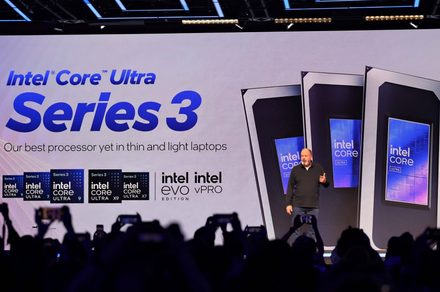

If all falls according to their CES 2026 plans, Intel is lining up a bigger push into gaming handhelds. This time it isn’t just about squeezing a laptop chip into a smaller shell. According to IGN, Intel is working on Intel Core G3 handheld chips built from Panther Lake silicon and tuned for portable gaming PCs.
If that happens, the payoff for you is consistency. Handhelds live and die on sustained performance, battery life, and heat, so a part designed for that envelope could mean fewer dips once a system warms up and more genuinely competitive options across brands.
Core G3 is built for handhelds
The key detail is that Intel seems to be shaping Panther Lake into different configurations that better fit handheld wattage and cooling limits. The usual boost behavior you see in laptops can fall apart fast in a tight chassis, so it’s not exactly one size fits all.
In a handheld, you’re juggling thermals, fan noise, and playtime at the same time you’re chasing frame rate. If Intel’s Core G3 variants focus on steady output instead of short spikes, it could make the difference between a device that feels great for 15 minutes and one you’ll actually want to keep playing on.
Arc B390 gains look huge
Intel also made graphics the headline at CES 2026, and it’s attaching some bold numbers to Panther Lake’s Arc B390 integrated GPU. In its own testing, Intel has said Arc B390 can be up to 77% faster in gaming than Lunar Lake’s Arc 140V, plus additional comparisons against AMD’s integrated graphics and even an RTX 4050 laptop GPU in select results.
That’s the kind of claim you should treat as a starting point. Handheld performance will still come down to power budgets, cooling, drivers, and the games used for testing. Still, if Arc B390 scales well at lower wattages, it could be the piece that finally makes an Intel based handheld feel like it belongs in the same conversation as the best known options.
What to watch next
Intel has tried this category before, and early Claw models didn’t do it any favors. The next checkpoint is simple, real devices from more than one partner, with pricing that makes sense and performance that holds up after a long session.
Keep an eye on the wider landscape too. Our ROG Ally vs Steam Deck comparison is a good reference for what buyers care about right now, and why efficiency often matters more than peak numbers. If Core G3 shows up broadly, it could push faster gains in efficiency and value across the whole category.