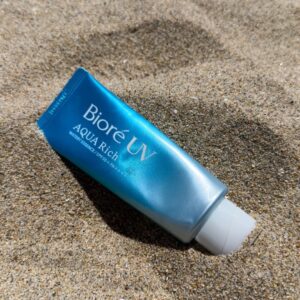
Some unexpected good news from the FDA: bemotrizinol, a sunscreen ingredient that has been used in Europe and Asia for decades, is finally being added to the allowable ingredients list for products sold in the U.S. Bemotrizinol is the active ingredient in sunscreens like Bioré Watery Essence, which has a cult following for being unlike anything we can get in the U.S.
I’ve tried Bioré UV Aqua Rich Watery Essence (that’s the full name of the product) in its original Japanese formulation. This sunscreen is a cult favorite on skincare and Asian beauty forums because of its non-greasy feel, and because it protects against both UVA and UVB rays without leaving a white cast. I got mine from a friend who had either picked it up while traveling or possibly ordered from overseas; you can’t buy it in U.S.-based stores.
I’ll explain why this is below, but first: it truly is nothing like anything we have locally. Even our most “non-greasy” sunscreens tend to feel a little goopy or sticky. This one really feels like nothing after you rub it in. I instantly understood why it’s so sought-after. Remembering that experience, I’m looking forward to what we might see in American sunscreens once manufacturers are allowed to include this ingredient.
What’s so special about bemotrizinol?
Bemotrizinol has a lot of things going for it. One is that it “plays well with other sunscreen ingredients,” as one dermatologist told Women’s Health. You can make lighter, nicer-feeling sunscreens with it, hence the popularity of the Bioré formulation I tried. To see what I mean, check out this video where a dermatologist shows off the differences between Bioré’s Japanese formulation and the version it sells in the U.S. The ingredients are different, and the texture just isn’t the same.
It’s also more effective at broad-spectrum protection. With our current sunscreen formulations, all active ingredients protect against UVB rays (the rays that cause sunburn) but only a few can also provide protection against UVA rays (which contribute to wrinkling and aging of skin). UVB is considered to be the bigger risk for skin cancer, but both probably contribute to cancer risk. Right now, most broad-spectrum U.S. sunscreens use mineral components like zinc oxide. Mineral sunscreens work pretty well, but can leave a white cast on your skin when applied as thickly as you’re supposed to.
Bemotrizinol is a chemical UV filter, so it doesn’t leave that white cast. But it protects well against UVA rays in addition to UVB, and it’s more photostable than a lot of our existing chemical sunscreen ingredients so it can last longer on the skin. In other words, it’s a chemical sunscreen, but combines some of the best features of both chemical and mineral sunscreens.
It’s also considered to be one of the safest sunscreens. All sunscreens on the market are much safer than going without sunscreen, but all of our chemical sunscreen ingredients are currently undergoing a safety evaluation because regulators determined they are probably fine but need more research to know for sure. Currently only our two mineral sunscreen ingredients (zinc oxide and titanium dioxide) are considered GRAS, or generally recognized as safe and effective. Bemotrizinol will be the third.
If you’re looking at ingredient lists on Asian or European sunscreens, be aware that it goes by several names. Tinosorb S is bemotrizinol; so is bis-ethylhexyloxyphenol methoxyphenyl triazine.
Why it’s taken so long
Ask anyone in the skincare world what they think about U.S. sunscreens, and for decades now you’d get complaints that we’re missing out on the best sunscreens that the rest of the world uses. (Our last new sunscreen ingredient was approved in 1996.) In most countries, sunscreens are regulated as cosmetics, but in the U.S. they are regulated as drugs. That means the U.S. requires more rigorous testing and approval.
The CARES act, passed in 2020 for pandemic relief, provided a way for over-the-counter drugs to be sold without going through the complete approval process, so long as the FDA was satisfied they were safe and effective. Bemotrizinol met the criteria, thanks in large part to the fact that it’s been used safely since 2000 in Europe, Asia, and Australia. The FDA’s rule on bemotrizinol still needs to be finalized, but it seems likely we’ll see new sunscreens on shelves before the end of 2026.