All the way back in 2021, Apple put a notch on its laptops. Five generations later, it’s still here. But what’s truly surprising is that Apple hasn’t played around with any meaningful utilities around it, unlike the Dynamic Island that gives a functional twist to the pill-shaped hole on your iPhone’s screen.
Thankfully, the developer community has built a handful of cool apps that turn the notch into an activity hub. From music playback and calendar control to a tiny viewfinder for the webcam, the notch can now do a lot.
In my most recent trip to the Mac community forums, I discovered another lovely app built around the boat-shaped notch, and this one solved a crucial problem for me. And if you’re someone whose work revolves around a multitude of websites and browser-based platforms, this one is going to come as a pleasant surprise.
A game of links and notches

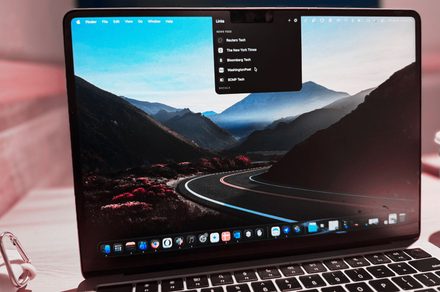
The app I’m talking about is called LinkNotch. The name speaks for itself — the app turns the notch into a hub for web links. Think of it as a container that hosts a handful of links, but hides in plain sight, and only appears when you take the cursor close (or to put it more accurately, behind) the notch area.
The idea behind that app is that you can park all your frequently visited web pages behind the notch area. So, instead of opening those tabs one by one after launching the browser on each workday. You can simply click your way through a scrolling list of links at the top of the screen.
With LinkNotch, all the tab clutter can safely be avoided, while simultaneously putting all your favorite websites within a mouse click’s reach. All you have to do is drag the cursor behind, and the notch extends down with a smooth animation and a scrolling list of all the links you’ve saved.

On a helpful note, you can organize all your links across different categories so that they appear neatly clustered. Now, you might think that there are chances the expanded notch will be triggered inadvertently, and it does happen. Quite frequently, and might get frustrating if you have a vertically multi-screen setup.
Thankfully, the app has a solution for that. Instead of using the cursor hover to trigger the notch bucket, you can set it to activate only when you perform a click gesture behind the notch area. This approach solves two problems in one go, while looking pretty elegant.
Sparing the browser hunt

As I mentioned earlier, manually entering a web URL every time you want to visit a website can be a drag. What about bookmarks? Well, I have way too many websites that I visit frequently, and the bookmarks bar at the top simply can’t accommodate them all.
But more importantly, I don’t want the bookmark bar at all. When you’re working on a 13-inch laptop, like the MacBook Air, each millimeter of vertical pixel space is precious. And let’s not forget, the bookmark bar with its bevy of icons and text is an eyesore. The other option?
Instead of digging through my bookmarks, I could use an automation to launch a select few websites in one go, or use a third-party tool like RayCast to do it. But these are neither easy to set up for a non-tech-savvy MacBook user, nor are they free. And even if you can digest it all, opening a bunch of tabs at once is going to look messy and slow things down.

In my case, an average day for me starts with scouring a select few websites for the latest global news. And as I settle into the work zone, I transition to my email and scheduling duties, followed by social media checks to find any crucial product updates, newsroom.
Next, the core apps that handle my work appear on the screen. The list includes Docs. Adobe Express and WordPress, followed by passion project platforms spanning across Google AI Studio, Opal, and GitHub. You see where this is going, right? And let’s not forget the websites that handle the fun and recreational side of things.

Now, I can create a tab group for all these sites, but opening one when a whole bunch of other sites are already running across browser windows visibly slows down the system — in addition to the tab clutter it instantly throws into my face.
LinkNotch handles the resource conundrum and the clutter woes simultaneously. You just have to hover and click to open a tab. And once the task at hand is over, you can close it, hover the cursor over the notch, and open the other site you want. It’s like a net-one-tab situation, where your work flows from one tab to another, without ever opening a second one.
A parting gift
The app’s premise is pretty straightforward, and one might even say that it’s barebones. And the criticism would be valid. But for users like me — journalists, researchers, students, digital marketers, visual designers, and social media managers — whose work is scattered across half a dozen (or more) websites, LinkNotch brings some needed zen to the workflow.

And that makes it worth the subscription. The price varies between $12-15 per year, depending on the country you’re living in, but it’s totally worth it. As the saying goes, sometimes, it’s the simplest tools that solve a profound problem that thousands of people run into on a daily basis. LinkNotch is one such fix for a MacBook papercut.
And if the concept of a notch-based productivity app is something you appreciate, and your total budget can go up to $20, I highly recommend NotchBox. This one adds a whole dimension of other controls to the notch area. It can handle music playback, doubles as a clipboard, can handle pomodoro timers, set a stopwatch, offers a peek into network stats, and even launch apps. It even has a browser functionality built into the notch container.
This one also serves as a hot center for storing and pulling frequently used files. All you have to do is perform a simple drag-and-drop with the fle package. And it’s pretty frugal on system resources, in case you’re wondering, so there’s that. Overall, these two apps can drastically ease your day-to-day Mac workflow, and I highly recommend them. I just wish Apple paid attention to the unrealized potential of the notch and did its own magic.