We may earn a commission from links on this page.
The greatest regret of my life is choosing to take French in high school. Don’t get me wrong, I find French beautiful, and I was a dedicated A+ student. But as an adult, I’m constantly embarrassed by how little Spanish I know.
But even in adulthood, I knew it wasn’t too late for me to learn Spanish, so I did what literally everyone does: I downloaded Duolingo. It’s free, popular, and has a mascot with deeply threatening energy. What’s not to love?
Eventually, I reached a 300-day streak—nearly a full year of daily practice!—but when I tried to have an actual conversation in Spanish, I could not hold my own, to put it gently. I realized that Duolingo had gamified me into feeling like I was making progress, rewarding streaks and unlocking owl animations while carefully avoiding the part where I learned, you know, to speak and understand Spanish.
Duolingo is a game, but Babbel is a learning tool
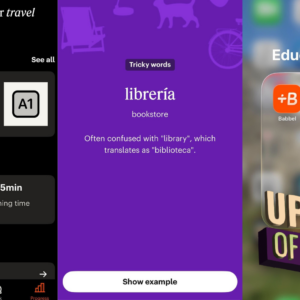
With a trip to Mexico City approaching, I signed up for Babbel. I didn’t expect to be fluent, but I wanted to avoid being the most helpless monolingual American on the trip. And now that I’m on the other side of that vacation, I can say with confidence that every basic phrase I successfully attempted to speak was thanks to two things: 1) Babbel’s grammar lessons, and 2) the generous patience of every local willing to communicate with me.
A few months of daily Babbel lessons genuinely helped me navigate asking how much something costs, whether I could pay by card, and ordering at a restaurant. Crucially, I felt I was doing all of this not from a place of pure regurgitation, but from a place of actual language understanding. That’s a different feeling entirely.
Duolingo’s genius is its dopamine loop, but that’s its limitation too—a sustained streak, and not language acquisition, is the real product. Where Duolingo’s scenarios include sentences like “My fathers are young and pretty,” (a real example!), Babbel teaches you “Could I please have the check?”
Babbel is more structured. The grammar explanations are woven directly into lessons rather than siloed in a separate section you’ll never visit. The scenarios are grounded in reality. The whole thing feels less like Candy Crush and more like…a class. Which, it turns out, might be why classrooms were never designed to feel like Candy Crush.
Babbel versus Duolingo: Point by point
Here’s my breakdown of how the most important ways these apps compare.
Duolingo:
-
Free (with ads for unhinged mobile games)
-
Great for building daily habits
-
Solid vocabulary exposure
-
Gamified streaks and rewards
-
Grammar depth is limited
-
Designed to feel like progress, no matter what
Babbel:
-
Paid subscription (around $15 per month, give or take)
-
Structured, grammar-forward lessons
-
Real-world conversational scenarios
-
Cultural context built in
-
Purposeful over playful
-
Designed to build actual skills
Questions to consider before you try any language learning app
Before you start using Babbel (or flirting with the Duolingo Owl), it’s important to consider your actual goals. Whether you’re prepping for a trip, want to keep your brain sharp, or actually become fluent, no app comparison means anything without first understanding what you’re trying to achieve.
If your goal is casual learning or building a daily habit, Duolingo is genuinely a fine place to start. It’s perfectly good for vocabulary exposure and using the psychology of habit formation to keep you coming back. There’s real value in that! Just don’t confuse a 300-day streak with 300 days of progress.
If your goal is to actually speak another language—to survive a vacation, hold a conversation, order food with confidence—Babbel is the more honest tool. And hey, both apps use streak mechanics to use habit formation psychology, but Babbel also integrates grammar explanations into lessons, offers far more practical and applicable conversation scenarios, and wraps everything in cultural context that makes the language feel alive rather than abstract.
Any language app will have limits, but Babbel is worth the cost
A major caveat here is that no app will make you fluent. Native speakers don’t speak with the crisp, patient enunciation of a language app. Real people speak quickly, use slang, have regional accents, and might not be willing to wait patiently while you search for the right vocabulary. You’ll eventually hit a wall with any app.
Duolingo’s perpetual free tier is likely the decision-maker for most people. You’ll never be locked out of educational content for lack of a credit card. The cost of “free,” though, is a parade of deeply unhinged ads for other addictive phone games. A fair trade, perhaps, depending on your tolerance for chaos.
But if you’re self-motivated and serious (or even just serious enough to want to survive a vacation!), then Babbel is the structured, purposeful, real-world-ready choice. It might feel less like a game, but I suppose that’s the point. When I signed up, I caught a 50% deal: $8.95/month for 12 months. Babbel also offers a one-time lifetime access payment of $299.99, though at that investment level, you might as well hire a tutor? All in all, standard month-to-month pricing hovers around $15/month.