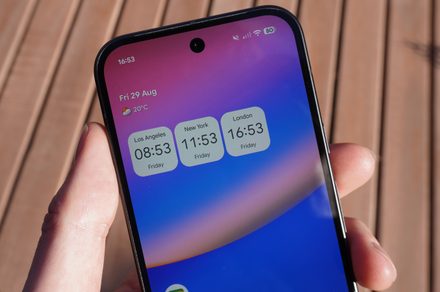
Folks over at Android Authority have learned about Google’s “Project Toscana,” which seesms to be a codeword or internal name for facial recognition technology. What’s interesting is that the company is working to integrate the technology on both Pixel phones and Chromebooks.
The publication’s source has used the advanced facial recognition technology on a Pixel phone with only a single punch-hole camera on the front, and two Chromebooks (with the help of external cameras), under varied lighting conditions.

Hardware mystery: How does it work?
So, unlike the current AI-based face unlock on Pixel phones, which isn’t quite useful in poorly lit environments, Project Toscana seems to work in both good and poor lighting conditions. In fact, the publication goes so far as to say that the experimental tech works as “quickly” as Apple’s Face ID.
What’s puzzling me, however, is the fact that the advanced face unlock system has been tested on a phone with a punch-hole cutout, likely housing a single camera sensor. The report doesn’t mention any specialized hardware that enhances the technology’s accuracy.
In comparison, Apple’s iPhones include a dedicated IR dot projector that projects more than 30,000 IR dots onto the user’s face and an IR camera that reads the dot pattern reflected from the face, and it is to hide all these sensors that the latest iPhones come with a Dynamic Island.

Could it be Tensor power and computational security?
From what I can read between the lines, Google’s Project Toscana could leverage hybrid camera sensors that may be able to capture both visible light and near-infrared (NIR) wavelengths.
Further, the mechanism could also include time-of-flight integration and computational liveness checks (via the advanced image signal processor on the proposed Tensor G6 chip).
Given that it isn’t clear whether the outlet’s source tested the feature on an existing Pixel or an upcoming model, I can’t comment on it with utmost surety.
If it’s an unreleased Pixel phone (likely the Pixel 11 due for a launch later this year), it might feature an invisible IR emitter tucked under the screen, something that has been rumored in the past as well.
Keeping the technical aspect of Project Toscana aside, it’s great to hear that Google is working to improve its facial recognition technology. We can expect the future Pixels, likely the Pixel 11, to feature the technology.