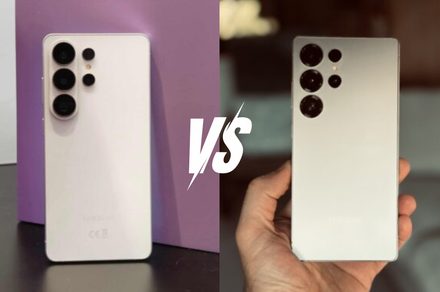
Samsung releases a new Ultra every year, and every year the same conversation happens. Is it worth it? What actually changed? The Galaxy S26 Ultra doesn’t reinvent anything — but it does come with a couple of upgrades that are harder to dismiss than usual. A world-first Privacy Display, a custom-tuned chipset, meaningfully wider camera apertures, and faster charging. Not a revolution, but enough of a shake-up that the comparison with the S25 Ultra is worth having properly.
Price and availability
The Galaxy S26 Ultra starts from $1,299.99 for the baseline 256GB variant. It is available to pre-order on the company’s website, Amazon, Best Buy, and Samsung Experience Stores; general availability commences from March 11, 2026.
The Galaxy S25 Ultra, on the other hand, is already available to purchase across retailers. If you’re lucky enough, you can find the phone listed at massive discounts of around $300 to $400, making it an excellent recommendation at an effective price.
Design

The S25 Ultra was never a subtle phone. Big, sharp-cornered, titanium everything — it had the energy of someone who irons their gym clothes. The S26 Ultra tones things down just enough to feel like a different phone in your hand — without losing the Ultra characteristics.
It’s 0.3mm thinner and 4g lighter than the S25 Ultra, numbers that won’t make any headlines. But throw in those noticeably rounder corners and something shifts. It stops feeling like you’re gripping a rectangular slab and starts feeling like, well, a phone.
Samsung did sacrifice a little screen dominance to get there, though, or at least that is what it looks like. The bezels are marginally thicker than on the S25 Ultra (resulting in a lower screen-to-body ratio), and the difference is quite noticeable, at least to me.

Water and dust resistance remain unchanged, as the Galaxy S26 Ultra features the same IP68 rating as before. Where things actually feel fresh is the color lineup — Cobalt Violet and Sky Blue alongside the usual White and Black, with Pink Gold and Silver Shadow as Samsung.com exclusives.
The finishes have got way more personality than last year’s range of “various shades of titanium.”
Display

The S26 Ultra has the same 6.9-inch QHD+ Dynamic AMOLED 2X panel as the S25 Ultra, same 1-120Hz adaptive refresh rate, same everything. Samsung basically looked at last year’s display, said “yeah that’s fine” and moved on. Honestly? Hard to argue with them on that one.
So where did the display team actually earn their salaries this year? Two words — Privacy Display. The S26 Ultra is the first phone in history to ship with a proper built-in Privacy Display, and before you roll your eyes thinking it’s just another gimmick — it isn’t the third-party privacy screen protectors that degrade the overall display quality.

The new feature works at the pixel level. The display literally controls how light scatters (using a directional OLED panel), so anyone peeking from the side just sees darkness. You can set it to kick in automatically when typing passwords or opening certain apps; it handles both portrait and landscape without any fuss, and your screen still looks completely normal straight on.
Revolutionary? Maybe that’s too strong. But genuinely useful in a way most “premium features” aren’t. Samsung also gave the color engine a proper workout, plus a new ProScaler feature that makes text and fine details look sharper. You won’t notice it immediately, but after a few days on the S25 Ultra, the difference starts nagging at you.
Performance

The S25 Ultra ran on the Snapdragon 8 Elite for Galaxy and nobody was really complaining. It handled everything without breaking a sweat. Then Samsung went and did it anyway — equipped its successor with an even faster and more efficient chip.
What powers the S26 Ultra is a Snapdragon 8 Elite Gen 5, but with an asterisk; a version exclusive to Galaxy, bumping the prime cores from 4.6 GHz all the way to 4.74 GHz. Samsung essentially took the same engine and quietly bolted on a bigger turbo before anyone was looking.
CPU is up 19%, GPU by 24%, and the NPU — the part of the chip responsible for all the AI heavy lifting — improved by 39% over the S25 Ultra. That last one is worth dwelling on.

Galaxy AI runs almost entirely through the NPU, which means that 39% gap is less about impressing reviewers and more about whether your phone’s AI features actually feel instant or make you stand there tapping your foot.
The CPU gains show up in the small moments — that extra snap when opening apps, smoother multitasking when you’ve got too much running at once. The GPU improvements mean better frame rates and richer visuals during gaming.
And a completely redesigned vapor chamber keeps everything running cooler under sustained pressure, which anyone who shoots long videos or games seriously will appreciate pretty quickly.
Software

The S26 Ultra ships with One UI 8.5 and Android 16 — and the gap between it and One UI 7 is bigger than a version number suggests.
Galaxy AI gets a serious personality transplant here. Now Nudge reads context across your apps and throws up suggestions before you’ve thought to ask — friend texts asking for trip photos, phone’s already pulling them. Calendar conflict hiding in your messages? Caught that too.
Now Brief works similarly, surfacing reservations and travel updates based on actual context rather than just burying you in notifications.
Bixby finally speaks like a normal person. Natural language, no rigid command structure, proper device control. Whether this is the version that makes people stop making Bixby jokes is another matter, but it’s the closest Samsung has come.

Gemini and Perplexity also sit alongside it now, handling multi-step background tasks with a single button press.
Elsewhere — Circle to Search now recognizes multiple objects at once, Creative Studio turns sketches and prompts into wallpapers and stickers without app switching, and an upgraded Photo Assist lets you edit images using plain conversational language.
AI Call Screening summarizes unknown callers before you pick up, and Privacy Alerts flag suspicious app behavior in real time. As for S25 Ultra owners — some of this will probably trickle down eventually. Some of it almost certainly won’t. Samsung hasn’t exactly handed out a roadmap, so all we can do is wait.
Cameras

On paper, the camera systems look like Samsung just hit copy-paste. 200MP main, 50MP ultrawide, 50MP periscope telephoto, 10MP 3x, 12MP front — the S26 Ultra has the exact same sensor lineup as the S25 Ultra. But quite a lot has happened between the lines.
Samsung widened the apertures across the board — the 200MP main goes from F1.7 on the S25 Ultra to F1.4 on the S26 Ultra, while the 50MP periscope telephoto opens up from F3.4 to F2.9.
Those aren’t just numbers moving around. Wider apertures mean more light hitting the sensor, and more light means your zoom shots in a dimly lit restaurant or a late evening outdoor concert actually come out looking like photographs rather than abstract impressionist paintings.

Samsung claims 47% more light on the main camera and 37% more on the telephoto compared to the S25 Ultra, and low light performance is genuinely where you feel that most.
Nightography Video got an upgrade too. Enhanced Super Steady adds a horizontal lock option, and the S26 Ultra becomes the first Galaxy to support the APV codec — professional-grade video compression that stays visually lossless even after repeated editing rounds.
Photo Assist and Creative Studio round out the AI editing side, letting you change outfits, fix lighting, restore missing objects, all through plain conversational prompts. The selfie camera also gets improved AI ISP processing for more natural skin tones in tricky mixed lighting — a small thing, genuinely noticeable, but the 12MP sensor remains the same.
Battery

Both phones pack a 5,000mAh battery, so Samsung didn’t touch the cell size, which, fair enough, was already competitive. What changed is everything around it.
The S25 Ultra topped out at 45W wired charging. Fine. Perfectly adequate. The kind of charging speed that gets the job done if you plug in before making breakfast and don’t have anywhere urgent to be.
The S26 Ultra bumps that to 60W with Super Fast Charging 3.0, hitting 75% in around 30 minutes. That’s a real-world difference — the kind where you plug in while getting ready in the morning and leave the house with enough battery to stop worrying about it until evening.

Wireless charging gets an upgrade too, moving to Super Fast Wireless Charging (25W) on the S26 Ultra. The S25 Ultra had wireless charging, but the S26 Ultra moves things along faster without the cable — useful for anyone who’s built their life around a charging pad on their desk.
One thing worth flagging — the 60W adapter doesn’t come in the box, which at this price point feels a little cheeky. But that’s the world we live in now, apparently.
Conclusion
The Galaxy S26 Ultra is the better phone, for sure. Faster chip, wider apertures, genuinely useful Privacy Display, better charging speeds, fresher software. On every measurable axis, it moves the needle forward. If you’re walking into a store today choosing between the two, the S26 Ultra is the one you want — full stop.
The more interesting question is whether S25 Ultra owners should care. And honestly? Probably not. Here’s the thing about owning last year’s Ultra — it was already excessive in the best possible way. It handled everything you threw at it without complaint, the camera was already outstanding, and nothing about daily life with it felt compromised.
You should only upgrade if having the best possible cameras matter to you above everything else, perhaps you’re a professional smartphone photographer or videographer. In that case, you might also benefit from the Snapdragon 8 Elite Gen 5’s improved processor power for editing on the go. Otherwise, sit this one out and save yourself for whatever Samsung does next year.