
The judgment most discovery practice leaves undeveloped

You can measure what happened after you released it. What most product discovery practice never examines, and has no frame for examining, is whether the human reasoning that produced it was sound.
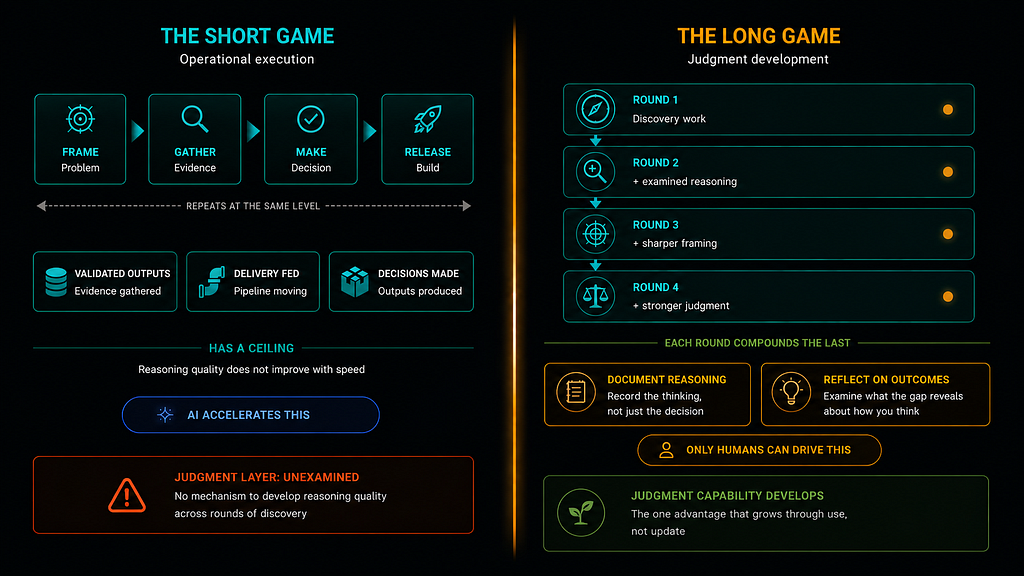
AI is compressing the distance between idea and delivery faster than ever. For many makers, that compression is bypassing deliberate discovery entirely. A prototype stands in for the problem framing, a rapid release substitutes for the evidence gathering. When discovery does happen within this compression, its purpose tends to be producing validated outputs that feed delivery.
That is the short game. Done well, it reduces the risk of building the wrong thing. AI has made it dramatically more efficient: synthesis that once took days now takes minutes, pattern recognition across dozens of customer conversations is near-instantaneous.
But the short game is limiting. The quality of reasoning at those critical moments (how the problem was framed, which assumptions were tested, what the evidence actually meant, whether to proceed or stop) does not improve simply because the work runs more efficiently.
The long game asks a different question: how does the quality of judgment at those moments improve over time? How do makers get better at discovery itself, not just faster at executing it? That requires a different frame.
What the Discovery Judgment Framework introduces
Most discovery practice is conceived as a set of activities: things to run, inputs to gather, outputs to produce, assumptions to validate. The Discovery Judgment Framework, introduced in The anatomy of product discovery judgment (Robins, 2025), reframes it as something more: a layered practice with a Human Foundation, a Structured Process, a Judgment layer woven through it, and an optional AI Partnership layer that accelerates the execution without touching the judgment.
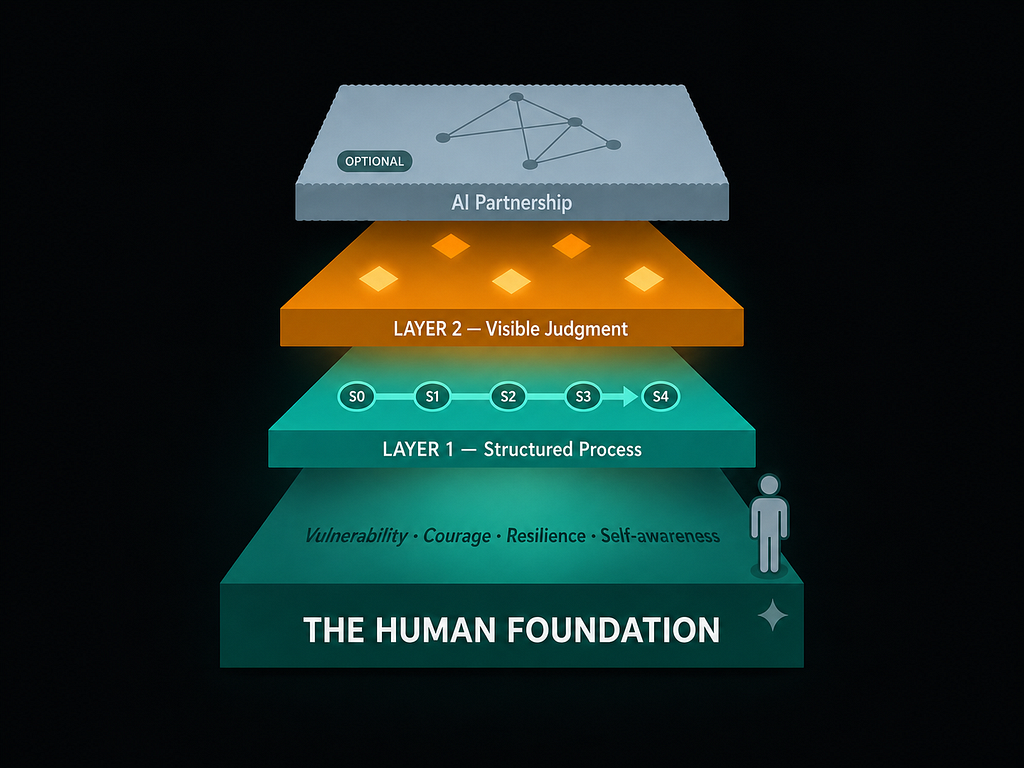
The one layer conventional practice does not name is the Judgment layer. It sits woven through the Structured Process at 19 specific moments where reasoning quality most directly determines outcomes: framing the problem, prioritizing opportunities, interpreting evidence, deciding whether to proceed, pivot, or stop. These are not process steps. They are moments of human reasoning. Every round of discovery passes through them. Most makers exercise judgment at these moments without realizing it, which means they have no way to examine it, no way to notice when it was weak, and no mechanism for improving it deliberately.
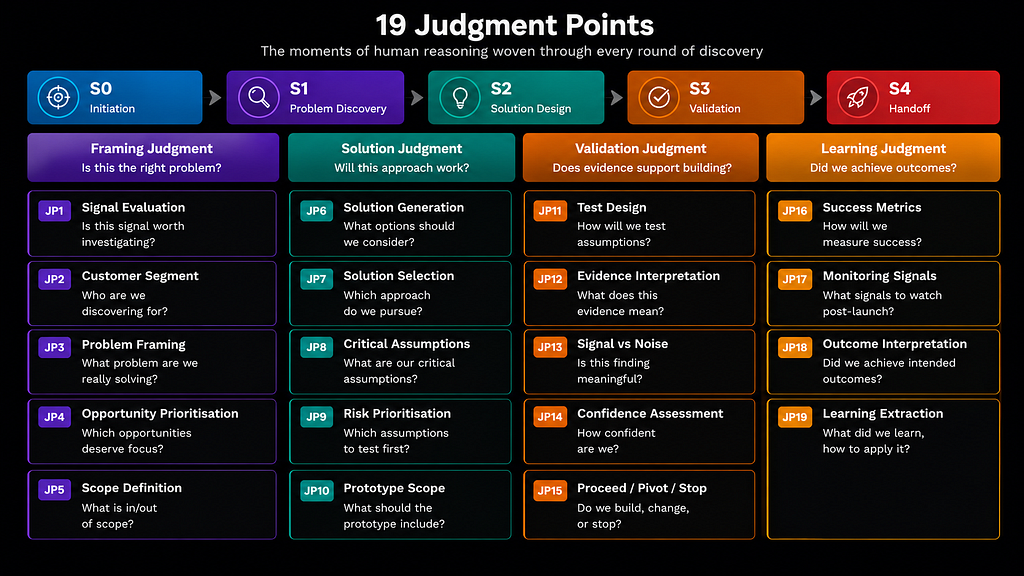
The Judgment layer goes unexamined not because makers are careless, but because conventional discovery practice has no frame for it. This is the layer AI cannot touch. AI synthesizes, generates, and predicts with increasing fluency, but it has nothing to offer the question of whether the judgment behind a decision was well-exercised. That question is irreducibly human. It only develops through deliberate practice and examined reflection, not through more rounds of work.
The double loop
In Teaching Smart People How to Learn (Argyris, 1991), Chris Argyris introduced the distinction between single-loop and double-loop learning. Single-loop learning fixes problems within existing patterns of behavior. Double-loop learning questions whether those patterns remain appropriate. In Revitalizing Double-Loop Learning (Westover, 2025), the paradox that makes it difficult in practice is identified precisely: the better practitioners become at their established ways of working, the more resistant they become to examining whether those ways still serve them.
That paradox is acutely visible in product discovery. A maker releases something, observes what happens, and adjusts the next decision accordingly. Single-loop learning closes that obvious gap. Necessary. Useful. It does not improve the reasoning that produced those decisions.
Double-loop learning asks what single-loop learning cannot. Not just did this work? but why did we frame the problem this way? Not just what did customers do? but what did we predict they would do, and where were we wrong? Not just what do we build next? but what did the gap between our prediction and our outcome reveal about how we reason?
Those questions are uncomfortable. They require makers to examine their own thinking rather than just their outputs. In an AI-accelerated environment, the temptation to skip them is greater than ever. When AI handles synthesis fluently, the absence of reflective practice is invisible. Everything looks like progress.
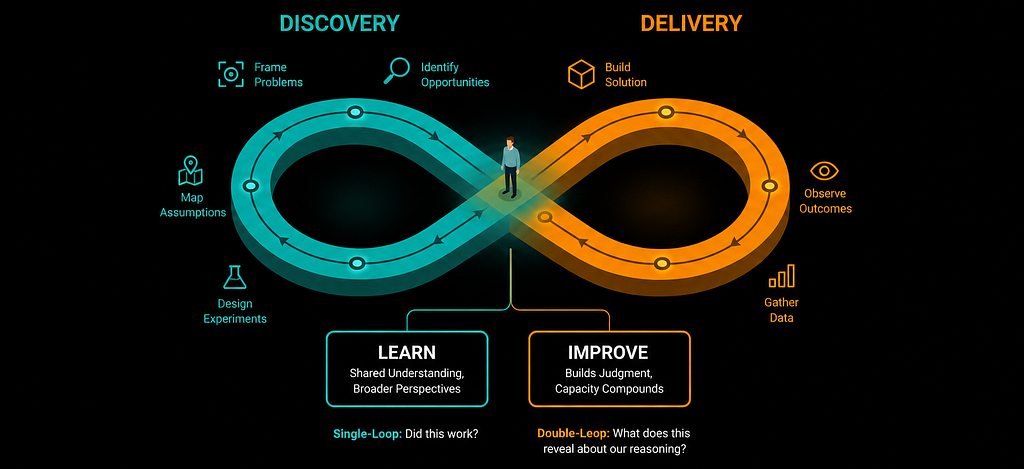
The double loop requires two disciplined habits woven into how a structured discovery process is run, not added on top of it, but practiced within it.
The first is documenting the reasoning behind significant decisions as they are made: not just what was decided, but the evidence considered, the assumptions carried forward, the alternatives rejected, the confidence level at the time. Without this discipline, memory reconstructs past decisions to fit outcomes. You end up examining a story, not the original reasoning.
The second is scheduled reflection after outcomes are known: not a retrospective on what was delivered, but an examination of how makers reasoned going in. Not “what went well?” but: what did we predict? Where were we wrong? What does that gap reveal about how we think? That examination, run deliberately after significant decisions and outcomes, is where documented reasoning becomes improved judgment.
Without both habits, experience builds. Judgment does not. With them, experience transforms into judgment that compounds across rounds of discovery.
In an AI-human partnership, effective decisions depend on AI’s prediction capability and human judgment working together. AI handles what is likely, humans decide what should be done. That decision-making capacity is what the double loop develops. Both habits are covered in depth in Building systems that strengthen discovery judgment (Robins, 2025) for makers ready to build them into their practice.
AI accelerates the short game. But humans drive the long game.
AI accelerates the execution layer of the partnership fluently, synthesizing, generating, producing outputs faster than any makers can manually match. What it cannot do is develop the judgment the human partner brings to it. That judgment only grows through deliberate, examined practice.
In Becoming an AI-native Designer (Lin, 2026), Sen Lin observed that most of what an experienced practitioner brings is tacit, accumulated through years of practice, a personal knowledge graph uniquely theirs. In The State of UX 2025 (Teixeira & Braga, 2025), Teixeira and Braga documented the outcome directly: operational progress accelerating, outcomes not keeping pace. Accumulation without examination produces experience. Only reflection converts it into judgment.
The makers who compound judgment across rounds of discovery are building something AI cannot replicate: not a process, not a methodology, but a genuinely sharper sense of what is worth building and why. That sharpness shows up in the questions they ask earlier, the assumptions they catch before committing, the decisions that are harder to make but more right when made. It is not visible in any single round. It is visible across them. That is the human’s contribution to the partnership.
The question worth asking
After your last significant release, did you examine not just what happened but whether your reasoning going in was sound? Did anyone document that examination in a form the next round of discovery could draw on?
If not, you completed the discovery work but the reasoning behind it went unexamined. Judgment capability did not develop. The long game was not played.
The shift does not require abandoning the short game. It requires adding the Judgment layer beneath it: the examined round, the documented reasoning, the deliberate reflection that converts experience into judgment.
That is what turns discovery from a phase, or a continuous operational loop, into a genuine capability. And in an AI-accelerated environment, it is the one advantage that grows through use rather than update, because it lives in the reasoning of the maker, not the capability of the tool.
Gale Robins is the founder of Unvera and the author of the Product Discovery Judgment Framework: Building Discovery Capability in the AI Era. She helps software makers develop discovery judgment: the ability to decide what is worth building when AI makes building faster and cheaper. Learn more at unvera.ai.
References
Argyris, C. (1991, May). Teaching smart people how to learn. Harvard Business Review. https://hbr.org/1991/05/teaching-smart-people-how-to-learn
Lin, S. (2026, April 19). Becoming an AI-native designer. UX Collective. https://uxdesign.cc/becoming-an-ai-native-designer-828365b71109
Robins, G. (2025, December 5). The anatomy of product discovery judgment. UX Collective. https://uxdesign.cc/the-anatomy-of-product-discovery-judgment
Robins, G. (2025, December 10). Building systems that strengthen discovery judgment. UX Collective. https://uxdesign.cc/building-systems-that-strengthen-product-discovery-judgment
Teixeira, F., & Braga, C. (2025). The state of UX in 2025. UX Collective. https://trends.uxdesign.cc
Westover, J. H. (2025, June 3). Revitalizing double-loop learning: From conceptual foundations to organizational transformation. Human Capital Lab Review. https://www.innovativehumancapital.com/article/revitalizing-double-loop-learning-from-conceptual-foundations-to-organizational-transformation
Discovery is a capability, not a phase was originally published in UX Collective on Medium, where people are continuing the conversation by highlighting and responding to this story.