The quote was fake, yet the outrage was real. While we argued about it, the water, the power and the public money slipped by unwatched.
The line was almost too neat, which should have been the first warning.
There was Jeff Bezos, on a stage in Paris, calmly suggesting that people might drink a little less so the machines could take a little more. “Biological limits are real, but digital potential is infinite,” he supposedly said, before explaining that cooling a data centre mattered more than keeping humans comfortable.
It had the exact blend of cold arithmetic and missing ear we have come to expect from a certain tier of billionaire. Within hours, it had travelled across Reddit, X and Facebook. An Indian news site, The Print, published it as fact.
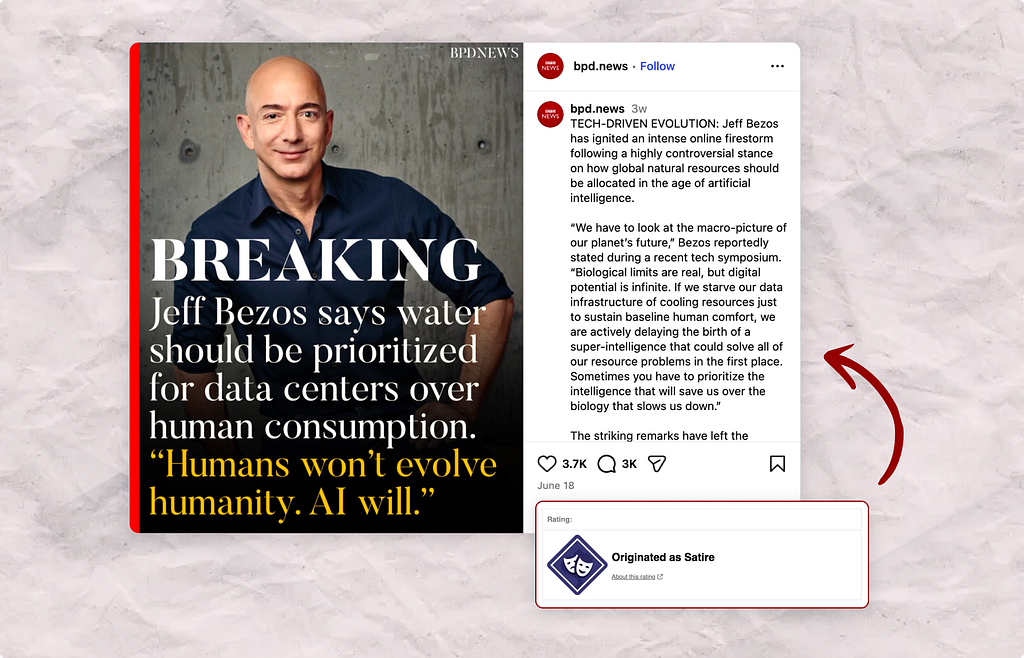
The problem is, he never said it.
Snopes traced the words to a parody account trading as BPD News, set up in March 2026 to imitate the BBC and flagged (for anyone who paused to look) as satire.
The fact-checking site Lead Stories read the full transcript of his session, all forty-nine minutes of it, and found no such line. The Associated Press had livestreamed the whole appearance. The sentence was simply not there.
And still it was believed, on sight, by a great many people, because the feeling of it rang true even though the words were invented. The fabrication, persuasive precisely because the shoe seemed to fit, tells us almost nothing about the man, and a good deal about how we now read the race to build AI. We treat it as a hushed reordering of whose needs come first, with most of us somewhere near the back.
For all that, nobody checked. Then again, we rarely do.
Not a checking species
We are not, on the whole, given to verifying things. Exploding Topics, a trend-analysis firm, found as much in its AI Trust Gap Report: only eight per cent of people always click through to the sources sitting behind an AI-generated answer. The rest read the summary and carry on.
This holds well beyond viral memes. Researchers at the University of Melbourne and KPMG asked more than 48,000 people how they felt about AI. Most said they used it regularly. Fewer than half said they trusted it. The survey reached dozens of countries, and when set beside an earlier round from before ChatGPT arrived, the mood had soured rather than warmed. Our wariness has climbed without our care keeping pace. Suspicion and scrutiny, it seems, are different muscles.
The machine always sounds sure
The reflex has a name, but the behaviour matters more than the label. Automation bias is the standing preference for the system’s answer over our own hesitation, first documented decades ago in cockpits, where pilots would follow a faulty instrument past the evidence of their own eyes. The same deference now greets the chatbot.
Part of it is effort. Reading a summary is easy, verifying it is work, and we are stingy with the kind of attention that cross-checking demands.
The rest is less flattering. We are softest on the claims that agree with us and hardest on the ones that do not, so a plausible reply pointing in the right direction sails through untouched.
The interface does its bit here too. A large language model delivers a wrong answer in the same tone it uses for a right one: fluent, composed, evenly confident. No furrowed brow, no dip in certainty, no visual tell that the ground has turned soft underfoot. That evenness is a design choice, and it makes the output easier to trust than it should be.
No one is too clever for this
The obvious assumption is that this catches the careless and spares the expert. It does not.
In a 2023 study in the journal Radiology, researchers at University Hospital Cologne showed radiologists a deliberately wrong AI reading of a mammogram.
Among the most experienced of them, accuracy fell from around 82 per cent to 45. Knowing more offered little cover. It mostly gave them further to fall.
It reaches past the lab, too. Late in 2025, Deloitte agreed to refund part of a A$440,000 fee to the Australian government after a report it delivered was found to contain non-existent academic references and a quote pinned to a Federal Court judgment that no judge had written. A Sydney University researcher, Christopher Rudge, caught it.
The thread he pulled was a professor credited with a book she had never authored, on a topic outside her field. Deloitte later disclosed it had used a generative AI tool to help produce the document. This was one of the largest professional-services firms on earth, not a student cutting corners, and the errors came to light only because a single reader went to the footnotes.
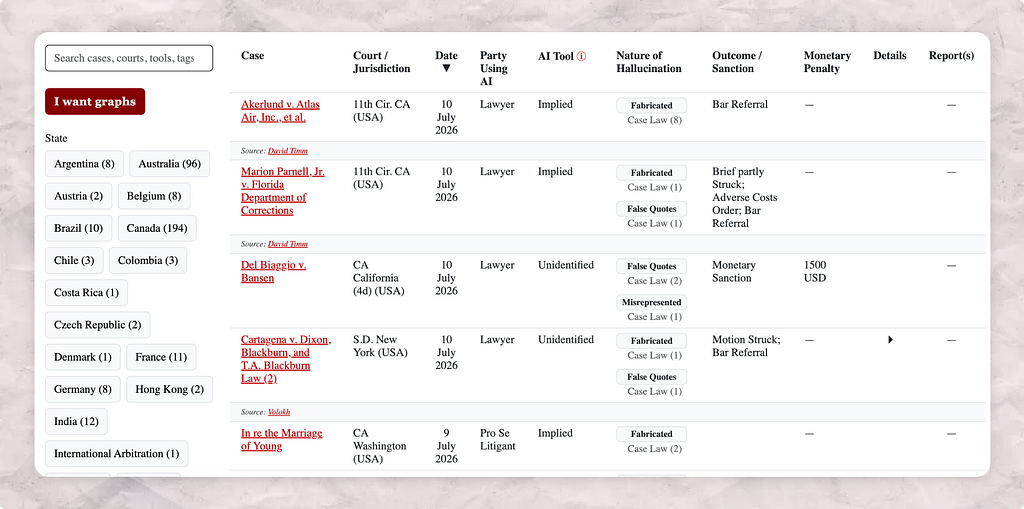
The courts have it worst. Damien Charlotin, a researcher at HEC Paris, keeps a running database of legal filings undone by AI-invented citations.
It has passed 1,700 cases and grows faster than he can log them.
The fakes are convincing at a glance: plausible case names and real-sounding judges, attached to rulings that never happened. In one much-quoted instance, a lawyer grew uneasy about his citations and asked the chatbot whether the cases existed. It assured him they did. The tool that produced the error also vouched for it. Remember that the next time someone proposes we simply use AI to check the AI. When researchers tested that very idea in PNAS in 2024, the fact-checks sometimes left people trusting true stories less and dubious ones more.
What Bezos actually said
Which returns us to Paris, and to the better question the fake quote buried. The danger of the invented sentence was not that it embarrassed Bezos. It is that a week of righteous argument burned itself out on words nobody had spoken, while the actual debate carried on, with far fewer people watching.
Bezos did talk about AI at VivaTech, and the true version is milder but says more than the hoax ever did. He argued that advanced AI will bring a labour shortage rather than mass unemployment, on the reasoning that better tools let people find more problems worth solving. Turning to his new venture, Prometheus, he described it as building an “artificial general engineer”. He raised the water question too, glancingly.
The number behind it needs no villain’s monologue: Amazon has disclosed that its data centres got through 2.5 billion gallons of water last year.
https://medium.com/media/13afe5426ef19e47bc6378fe934f2b23/href
Let them have data centres
Take the invented lines at their word for a moment, and audit the world they imagine. The satire proposed a swap: our water for their cooling, our power for their scale. What would it actually cost? Three questions, three numbers.
• How much water do they need, and where does it come from?
Amazon’s 2.5 billion gallons is one company in one year. A single average data centre requires something in the region of 300,000 gallons a day, a fair share of it drawn in places that were short of water to begin with.
• How much power is required, and who queues behind it?
In 2024 they used roughly 415 terawatt-hours of electricity, about 1.5 per cent of world supply. The International Energy Agency expects that to more than double by 2030, to something close to what all of Japan runs on in a year.
• Finally, who pays to build it?
Data centres sit among the most heavily subsidised businesses around. Virginia’s tax break alone costs the state some $1.6 billion a year. Whether those costs land on household bills is contested: consumer groups and several US senators say they do, while a study commissioned by Amazon argues the centres pay their own way and can even ease bills a little. Nobody yet knows for certain, and the argument is far from over.
The made-up sentence got its week of outrage. The planning hearings where these questions are actually settled tend to get a wet Tuesday and an empty public gallery.
What is AI really costing the planet?
The market has noticed
If the episode showed how little we check, the business world has drawn the obvious conclusion and started building on it. Analysts valued the market for AI-detection tools at somewhere around half a billion dollars in 2025, and expect it to multiply several times over by the early 2030s, with the sharpest growth in software that spots deepfakes and synthetic media.
The logic is neat: as machines flood the world with plausible text and images, other engineered solutions will sort the true from the invented. There is one snag.
These detectors tend to lose accuracy as the models they police improve, and they carry a stubborn rate of false alarms, so the thing being sold as a fix keeps needing fixing.
The people who did this work by hand, meanwhile, are being shown the door. Human fact-checking grew for a decade, from about 110 projects worldwide to more than 450, before the trend turned. Then, in early 2025, Meta ended its US fact-checking programme, which had funded a large share of them, and the field tipped into retreat.
For the first time, roughly three times as many projects closed as opened. The International Fact-Checking Network found three-quarters of those it surveyed financially vulnerable or in outright crisis. All the same, readers have not lost interest. Most of these organisations reached larger audiences than the year before, even as the money drained away.
The appetite for a settled answer keeps rising while the specialists trained to produce one lose their funding, and the budget flows instead to tools that struggle to keep pace with the problem they were built to solve.
The job that stays ours
The fake quote itself still did damage. It caught on because it told a broadly true story in false words, and a false story that feels true is a peculiarly modern trap. The real stuff, however, doesn’t spread like that. There is no shareable image for a terawatt-hour, a tax abatement or a 237-page report. That is homework, and it mostly goes undone.
The obvious candidate for that task is the same tool producing the claims, and yet it makes a poor judge of its own output. So, the checking stays with us. A better interface would help: one that wore its uncertainty as plainly as its confidence would be a harder thing to take on trust, and more often than not, that is exactly what we need.
If you enjoyed this, follow me on Medium for more on design, psychology and technology.
References
Amazon. (2025). Do data centers raise electricity bills? What an independent study found. https://www.aboutamazon.com/news/sustainability/data-centers-electricity-bills-grid-power-amazon
Amazon. (2026). Amazon’s data centers are 7x more water-efficient than the industry average. https://www.aboutamazon.com/news/sustainability/amazon-data-center-water-usage
Charlotin, D. (2026). AI Hallucination Cases [Database]. HEC Paris. https://www.damiencharlotin.com/hallucinations/
Consumer Reports. (2026). AI data centers: Big tech’s impact on electric bills, water, and more. https://www.consumerreports.org/data-centers/ai-data-centers-impact-on-electric-bills-water-and-more-a1040338678/
DeVerna, M. R., Yan, H. Y., Yang, K.-C., & Menczer, F. (2024). Fact-checking information from large language models can decrease headline discernment. Proceedings of the National Academy of Sciences, 121(50), e2322823121. https://doi.org/10.1073/pnas.2322823121
Dratsch, T., Chen, X., Rezazade Mehrizi, M., Lorenz, A., Kröger, J. R., Persigehl, T., Pinto dos Santos, D., & Baeßler, B. (2023). Automation bias in mammography: The impact of artificial intelligence BI-RADS suggestions on reader performance. Radiology, 307(4), e222176. https://doi.org/10.1148/radiol.222176
Duke Reporters’ Lab. (2026). 2026 census: Fact-checking losses continue amid funding pressure, but most projects persist. https://reporterslab.org/2026/06/12/2026-census-fact-checking-losses-continue-amid-funding-pressure-but-most-projects-persist/
Exploding Topics. (2025). AI Trust Gap Report. https://explodingtopics.com
Gillespie, N., Lockey, S., Ward, T., Macdade, A., & Hassed, G. (2025). Trust, attitudes and use of artificial intelligence: A global study 2025. The University of Melbourne and KPMG. https://doi.org/10.26188/28822919
Good Jobs First. (2026). Even cloudier with a greater loss of spending control: How data center tax abatements undermine public budgets. https://goodjobsfirst.org/even-cloudier-with-a-greater-loss-of-spending-control-how-data-center-tax-abatements-undermine-public-budgets/
Grand View Research. (2026). AI detector market size, share & trends report, 2026–2033. https://www.grandviewresearch.com/industry-analysis/ai-detector-market-report
International Energy Agency. (2025). Energy and AI. https://www.iea.org/reports/energy-and-ai/executive-summary
International Fact-Checking Network. (2026). State of the fact-checkers report 2025. Poynter Institute. https://www.poynter.org/wp-content/uploads/2026/03/2026-State-of-Fact-Checkers-4.pdf
Lead Stories. (2026). Fact check: Jeff Bezos did NOT say water should be used to fuel AI rather than for human consumption. https://leadstories.com/hoax-alert/2026/06/fact-check-jeff-bezos-did-not-say-water-should-be-used-to-fuel-ai-rather-than-for-human-consumption-in-public-remarks-at-2026-vivatech-conference-in-paris.html
The Register. (2025). Deloitte refunds Australian government over AI in report. https://www.theregister.com/2025/10/06/deloitte_ai_report_australia/
Snopes. (2026). Did Jeff Bezos say human water consumption is limiting AI’s potential? https://www.snopes.com/fact-check/bezos-water-consumption-ai-quote/
Stillman, J. (2025, July 18). Are you too trusting of AI answers? 92 percent of people don’t check it for accuracy. Inc. https://www.inc.com/jessica-stillman/are-you-too-trusting-of-ai-answers-92-percent-of-people-dont-check-it-for-accuracy/91209990
Waziri, I. J. (2026, June 19). Amazon founder Jeff Bezos says human water consumption is limiting AI’s potential. ThePrint. https://theprint.in/feature/jeff-bezos-water-consumption-amazon-ai-potential/2964266/
World Economic Forum. (2025). How data centres can avoid doubling their energy use by 2030. https://www.weforum.org/stories/2025/12/data-centres-and-energy-demand/
Did you verify that — or was it just too easy to believe? was originally published in UX Collective on Medium, where people are continuing the conversation by highlighting and responding to this story.