How business management killed craft apprenticeship
Victor Wooten is my all-time favorite bassist. But, it’s not only because of his amazing playing skills. It’s also his philosophy of teaching music.
He runs music camps where complete beginners are invited to come jam with him, the professional musician. His philosophy is simple: there are no wrong notes, no punishment or judgement for misfit notes. What matters…is what you do after you play them. Wooten points out that this is how babies learn language. They’re allowed to “jam” with professionals from day one. It would be absurd if we made children practice grammar alone until they were fluent enough to speak with adults. But, that’s typically how music is taught, and it takes too long.
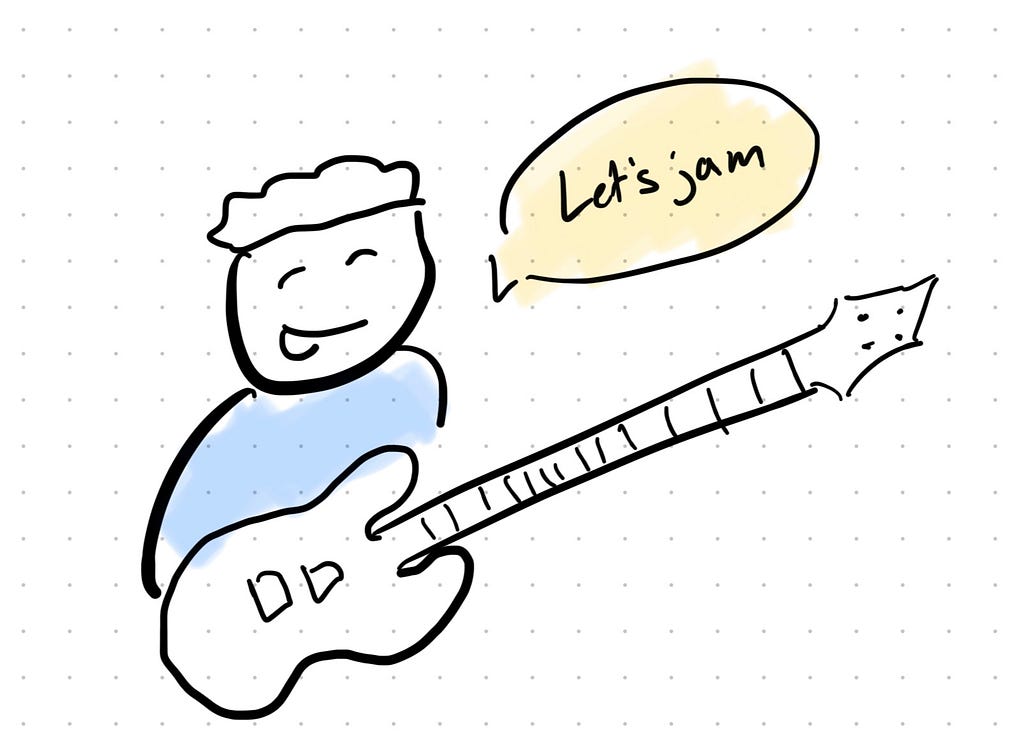
I’ve been playing bass for quite a few years and Wooten’s approach resonates with how I actually learned the most. Sure books and courses are helpful, but it’s jamming with other people (better than me), watching how they think in real time, deciding when to hold back, when to step forward, how to recover when something doesn’t land. That’s where a lot of the breakthroughs happen. And, that’s what Cal Newport calls career capital: the skills you build by working next to people who already have them. Reading about the skills are helpful, but you need to be “in the room jamming” with people to really get the full effect.
And that’s exactly what we’ve stopped doing in design.
The False Binary We’ve Created
When you move from individual contributor to design leader, the fear of micromanagement sets in. You’re told “don’t dictate pixels” and “don’t hover over your team’s shoulders”. You’re told to stay strategic. The message is clear: good managers stay out of the details. And for good reason: nobody wants a boss who controls every decision and undermines their team’s autonomy. So design leaders internalize this rule and step back from craft entirely.
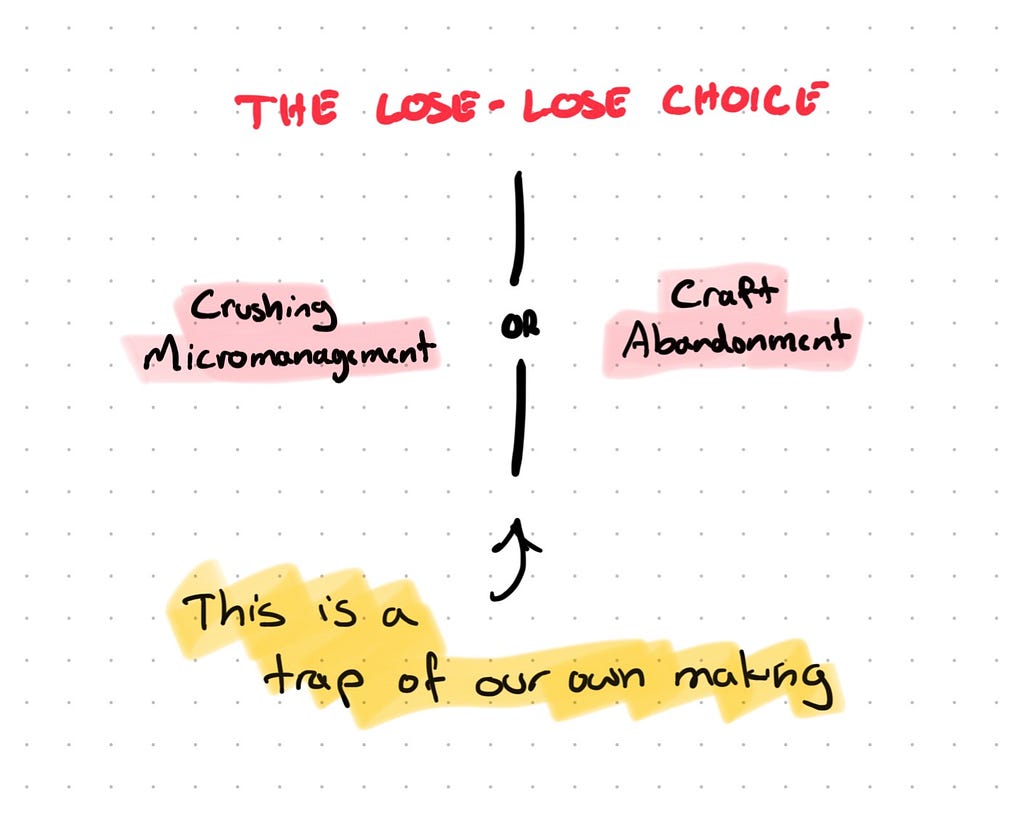
You’re faced with two choices:
- The “Wrong” One: Stay hands-on with craft, but risk micromanaging, dictating pixels, and undercutting team autonomy
- The “Right” One: Stay strategic and high-level, stay out of their work, leave craft to the individual contributors
Management in the design industry has overwhelmingly chosen to stay out of craft. Design leaders believe “Good managers don’t get sucked into the details” or “I empower my team by staying high level.” Sounds right. Sounds like good management.
If that’s the “right” decision, then why is our industry struggling so much? Why do junior designers fail to grow into fully-fledged seniors? Nobody’s taught these younger designers to think like designers. To reason through problems. To wrestle with complexity the way experienced designers do. We blame “outside” forces like automation, shrinking budgets, and organizational shifts that prioritize speed. But I think we’re missing a systemic cause: we’ve dismantled the apprenticeship model from both ends.
The Dismantling of Apprenticeship
To understand how we got here, we need to look at design’s journey of professionalization. Design schools have existed since the 1870s — RISD, Pratt, Parsons — but they operated on apprenticeship principles. You learned in studios under master teachers. When you graduated, you joined design agencies and continued learning the same way: working alongside senior designers, watching how they solved problems, gradually taking on more responsibility. Through the 60s, 70s, and 80s, this was just how you learned the craft.
Then came the web. In the 2000s, digital design was still craft-heavy — we were people who made things look nice, who skinned websites. We wanted a seat at the table, to weigh in on decisions that impacted our work. So we embraced design thinking, user-centered design, and strategic frameworks. This was necessary. Software was getting complex, and design needed a voice beyond aesthetics. But we over-corrected.
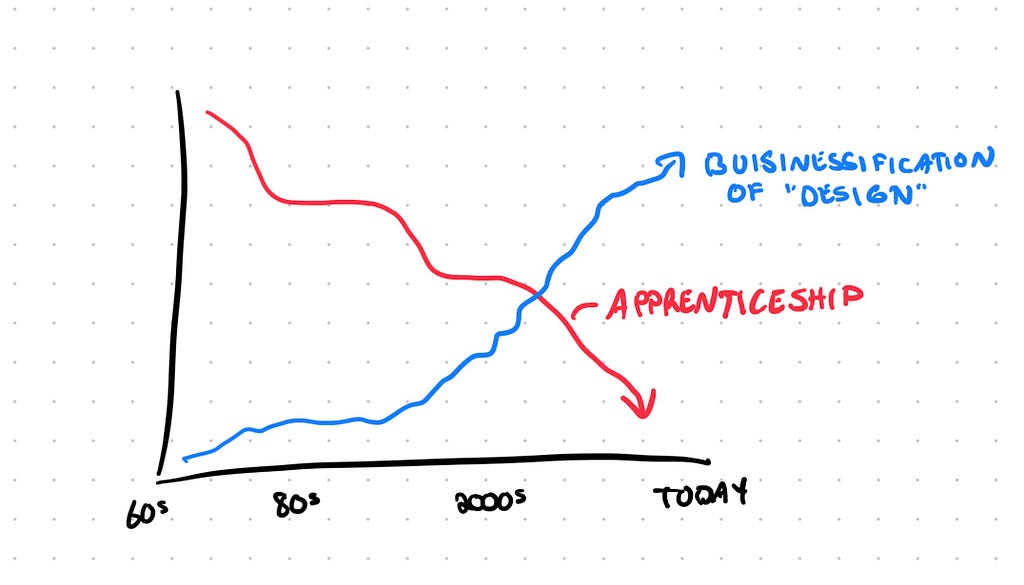
As Jenny Wen pointed out in her talk “Craft is Counter-Intuitive,” we tilted so far toward strategy that craft started to feel less important. Portfolios became filled with diagrams and journey maps, maybe one screen mockup. Design systems made our work modular and efficient, but also boring and predictable. We automated the artistry out of our own jobs. And when designers moved into leadership, they followed modern management principles — principles designed for business and tech, not craft-based disciplines. The advice was clear: stay strategic, don’t micromanage, empower through delegation. So design leaders withdrew from craft entirely. “Stay out of the work” became the hallmark of good management, even though design is a craft that requires apprenticeship.
At the same time, we industrialized design education. Bootcamps promised to turn people into designers in twelve weeks. They taught frameworks, processes, and deliverables — but they couldn’t teach the apprenticeship model because they didn’t have it themselves. Students went from bootcamp curricula to design systems, never experiencing what it’s like to jam with someone who’s been doing this for years.
What Juniors Actually Need
But we need to get back to a Victor Wooten approach. You don’t learn to speak by practicing alone until you’re fluent or reading in books. You don’t learn jazz by studying theory in isolation. You learn by doing it next to people who already know how. The “jamming” model creates a safe space to make mistakes. It puts you close to people who know what they’re doing, so you can watch how they think. You learn when to lead, when to follow, when to take risks. You see the quiet corners of practice, not just the outcome. You watch someone hit a dead end, figure out what’s not working, and iterate toward something better.
You learn by doing it next to people who already know how.
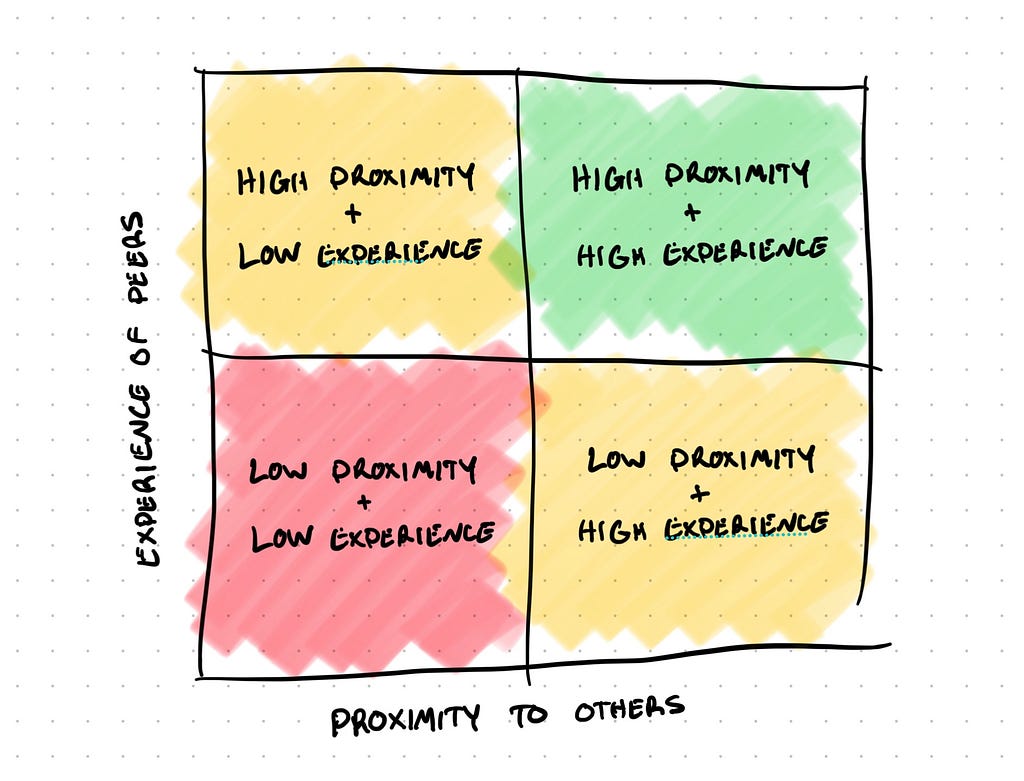
This is what our industry desperately needs. This is what junior designers need. They need to jam with people who’ve been doing this for years. They need to see how you think through design problems, watch you work through solutions in real time, and feel the difference between an acceptable solution and a great one. You can’t learn this from tutorials or design system documentation or other junior designers. That’s like babies only talking to other babies. Yet this is exactly where we’ve left them.
What Jamming Looks Like in Practice
Jenny Wen, Design Lead at Anthropic and former Director of Design at Figma, shows what the third way looks like. In her talk, she challenges the “stay out of the work” rule directly. She notes that craft-focused companies are increasingly looking for leaders who are hands-on, who can help teams do great work, who can get into the details and push their teams to be better. Her critical insight: “If your team is already really great at craft or already really senior, you believe that you can make them even better at it. I think that’s the most empowering thing you can give your team.”

What does she actually do?
- Pairs directly with designers on challenging work. When the Figma Slides product icon had too many stakeholders and too many opinions, she sat down with the designer and they pushed pixels together to arrive at the final design. Then she helped defend that decision.
- Gives detailed design feedback, not just about strategy and problems, but about border radius and hierarchy, because these details matter to support the overarching strategy.
- Riffs on designs, hopping into files and creating her own versions, making it clear to her team that these are explorations, not directives. They don’t have to choose her option.
- Concepts work herself to help drive direction and push teams to be more ambitious. When she’s managing, she’s rarely designing, but when it would help, she doesn’t hold back.
The foundation of all of this is trust. Everything she does comes from “a place of trust,” as she puts it. Decisions still belong to the designer. She’s helping as a teammate, not asserting authority. This is jamming: working together on craft, showing how you think instead of dictating what to do. You’re getting close without taking over. You’re hands-on without controlling. That’s the distinction we missed.
You’re getting close without taking over. You’re hands-on without controlling.
I’ve been doing exactly what Jenny describes for years. Pairing with designers, pushing pixels together, giving detailed craft feedback. But I did it quietly, almost like I was breaking the rules, because I knew as a manager “I wasn’t supposed to.” I’d tell myself I was just “helping out” rather than admitting what it really was — teaching. Jenny’s talk was freeing. It gave me permission to stop apologizing for being hands-on with craft.
This shift is already happening whether you choose it or not. Organizations are flattening, and managers are being asked to be more hands-on. The tools our teams use are more powerful than ever, and the software people love is increasingly defined by its craft. Design needs different leadership now.
What This Requires of You
This requires some nuance. Not all leaders need design backgrounds; team composition often needs other skills. And this isn’t about doing all the craft yourself or dictating solutions. It’s about being intentional and careful about when you jump in. Know when your presence helps and when it gets in the way. You need to recognize the difference between helping and controlling. Build trust so your team knows what you’re doing. Be vulnerable enough to show your dead ends, not just your successes. Wooten’s “no wrong notes” philosophy doesn’t mean there are no standards. You’re creating safety to learn and explore, not accepting mediocrity.
Empower people by working close to them, not by staying out. Treat craft like part of your job is teaching, not just something you personally like. Recognize that hands-on with trust is jamming, not micromanagement.

How to Start Jamming with Your Team
Practically, this looks different for every team:
- Protect time for pairing sessions: maybe Friday afternoons are sacred for working through hard problems together
- Give feedback on the details that matter: border radius, hierarchy, type scale, not just strategy and flows
- Riff on designs in shared files the way Jenny does: make it clear these are options to explore, not mandates to follow
- Model your thinking process, including the dead ends, not just the polished solutions
What ever you do, just remember: you’re creating opportunities to jam.
The Jam Session Is Waiting
If you’re a design leader, I want to encourage you to get back in the room. Your team needs to jam with you. If you’re hiring design leaders, look for people who can make the work better, not just manage the process. If you’re a junior designer, get close to people who know what they’re doing. Find your jam session. That’s where the learning happens.
Babies don’t wait until they’re fluent to speak with adults. Musicians don’t wait until they’re perfect to play with the band. Designers shouldn’t have to wait until they’re senior to work alongside masters. The jam session is where learning happens, and your team is waiting for you to show up.

Design leaders need to jam with their teams was originally published in UX Collective on Medium, where people are continuing the conversation by highlighting and responding to this story.