
Adam Smith on why 250 years of empathy still leaves us feeling unheard.

We talk about empathy more than ever. Listening sessions. Trainings designed to “meet people where they are.” Empathy maps meant to snapshot customer personas.
And still, the people who open up often walk away feeling drained.
Why?
It felt like a conversation. There was back-and-forth. No open disagreement. Nothing hostile.
So what was it?
Why is it that everything you said (some of it personal) was met with complete, instant understanding? Before you even finished your thought, they were nodding. How did they get to the finish line before you did?
If empathy was supposed to solve this, it hasn’t.
I’m Nate Sowder (fresh off parental leave), and this is unquoted, installment 16. It’s on Adam Smith — and the uncomfortable possibility that we’ve misunderstood what it means to understand each other in the first place.
Adam Smith (not the Econ 101 mascot)
When we hear “Adam Smith,” we think capitalism, free markets… the invisible hand. All of this comes from The Wealth of Nations, published in 1776.
Seventeen years earlier, Smith wrote a different book: The Theory of Moral Sentiments. It’s writing this book that shaped his thinking about human behavior, and it’s where we’ll be spending our time today. In fact, unlike his other works, Smith revised this piece 6 times, the last time on his death bed. If you want to know where someone’s head is at… 6 revisions.
In this book, Smith wrestled with a basic question:
How do we decide whether someone’s reaction makes sense?
When someone is furious, do we think they’re overreacting? When someone is hurt, do we think they’re justified? When someone celebrates, does the celebration fit the act?
We feel all of this constantly, but Smith was looking to uncover the process by which we rationalize it.
Sympathy and empathy
To understand Smith’s thought process, you need to understand how he used the word sympathy, because it wasn’t reserved for greeting cards and florists like we use it today.
For him, sympathy was the act of imagining yourself in another person’s situation in order to judge it proportionately. You don’t need to feel their experience directly, but you try to build a version of it using your own memories and perspective.
To qualify as ‘sympathy’, the version you build in your mind is supposed to be partial and always incomplete. This means that the level in which you’re able to understand can change and you have to acknowledge that.
Sympathy in Smith’s terms can be defined as: disciplined approximation.
The word we tend to use now is empathy.
Empathy is more concrete. It implies a level of understanding. “I get it.” “I know exactly how you feel.” That language suggests that the gap between two people can be understood.
Adam Smith never believed that two people could fully understand each other. Therefore, empathy, the way we use it today, wouldn’t work for Smith.
What sympathy requires
In 1759, Smith identified that genuine understanding requires time, humility and proximity.
Let’s look at each one.
Time.
Smith thought it took time to understand. Our first reaction to someone’s situation is often incomplete and biased. It takes time to sit with what we heard and let the initial judgement pass. Time to reconsider whether our response actually resonates.
Sometimes that means repeated exposure and other times it just means not reacting immediately.
Humility.
Humility, in Smith’s framework, meant recognizing the limits of your first judgment.
This meant not rushing to explain your own interpretation, and not immediately taking your turn to clarify, defend, or relate it back to yourself.
In practice, that often means letting the other person’s statement be enough without having to make it about you. This would allow you to suspend your need to respond long enough to examine whether your internal picture of the situation is accurate.
Without humility, the conversation becomes a rotation of perspectives. In other words, it’s no longer listening… you’ve entered a debate.
Proximity.
Smith opens The Theory of Moral Sentiments by noting that we are more affected by the misfortune of someone close to us than someone at a notable distance. Distance can tend to distort our reaction.
According to Smith, that distortion shows up as judgement.
The further we are from someone’s lived experience, the more our imagination fills gaps with our own memories and experiences. The answer to someone else’s problem might feel obvious, but under closer inspection starts to get more complicated the more effort we put toward trying to understand.
Proximity forces us to account for details we couldn’t see from a distance.
Sympathy is intentional
Let’s take a moment to explain this, because not only was it an important distinction to Smith, it’s what the rest of this essay is based on.
Sympathy (as is laid out by Adam Smith) requires you to set aside the instinct to orient the situation around yourself. You build a picture of the other person’s experience and examine whether your judgement makes sense.
Empathy, as we commonly use it in conversation (and research), often works differently. It looks inward, searching your own memories and experiences for something similar so you can translate that experience into terms you already know. Empathy feels pretty immediate, which can feel good for the person showing it, and can create connection.
A big distinction is that empathy stops growing the moment inward connection is made. Sympathy, on the other hand, asks if you understand rather than if you can relate. Big difference.
Neither of these make for better or worse people. But I think it’s important that only one of them encourages revision.
Spectator Model
Smith described how our first judgments form, and how hard it is to revise them. The “Impartial Spectator” was his name for the internal witness that can interrupt that process, but we have to do that intentionally.
What helped me while reading him was laying out his observations side by side. When I did this, I saw that deeper understanding develops if you’re willing to invest effort.
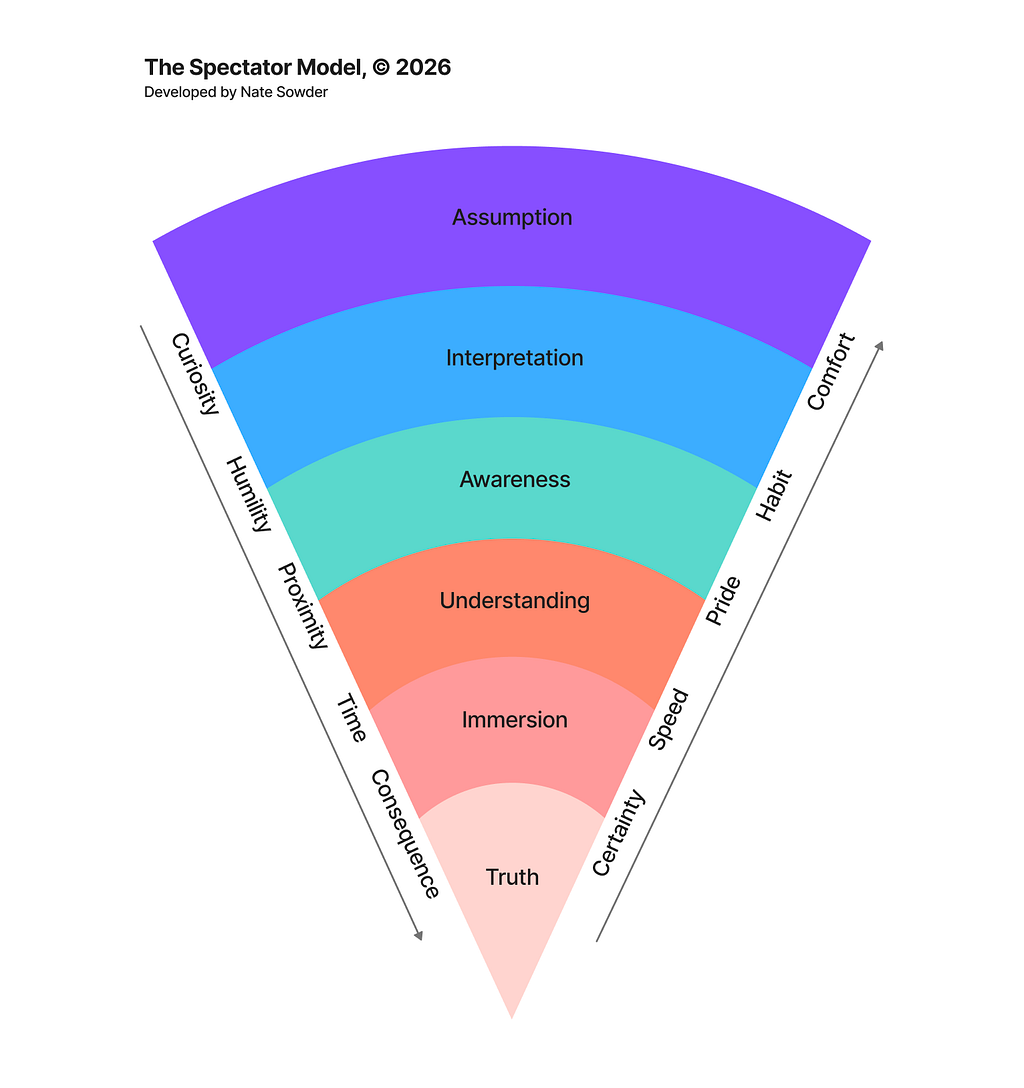
The point of the Spectator Model is to help you abstract your level of understanding. From there, you’re left with two decisions. 1. Are you sufficed with your current level of understanding? and 2. What would it take to go further in that understanding.
And it’s worth saying: You don’t always need to push all the way to truth. Sometimes ‘Awareness’ is the right level. The model is designed to make intent possible. This way, you can decide whether an additional conversation, meeting or investment in research is worth it, given your current level of understanding.
Here’s what the model looks like.
How to use it
Any time you form a judgment about someone, you are somewhere in this model.
That judgment happens a lot in personal conversation. We’re going to think about it here in terms of a product reviews, or more specifically, what might happen during research when you determine what a user “meant.”
In that moment, Smith would argue that you should be able to abstract your current level of understanding (or sympathy). Again, we’re not trying to be dramatic. Sympathy just means an acknowledgement that we cannot fully understand another person’s situation (no matter how much we may want to).
Ask yourself:
Are you operating mostly from what you already believed?
Have you filtered what you heard through your existing lens?
Has anything caused you to reconsider your first interpretation?
That act of locating yourself is the beginning of sympathy. From there, you’re left with decisions that empathy doesn’t afford because empathy assumes completion.
Decide:
Does the situation require deeper understanding? If no, you can stop. Not every moment deserves immersion. Sometimes awareness is enough.
If yes, look to the left of the model. If stakes matter, and moving inward is important, it requires investment. The labels to the left show the act required to move between bands.
If Yes:
From Assumption → Interpretation requires Curiosity
From Interpretation → Awareness requires Humility
From Awareness → Understanding requires Proximity
From Understanding → Immersion requires Time
From Immersion → Truth requires Consequence
Again, motion is what makes this model powerful. Because you can move inward in your level of understanding, you can also move outward. That outward movement is often when people begin to feel unheard… not only in personal conversations, but in research, strategy and leadership decisions.
This model is meant to be an abstraction to help you locate your current level of understanding. If you decide not to invest further, nothing crazy happens, but the next time you’re faced with that topic, your response will come from wherever you stopped.
Working toward sympathy keeps you oriented inward toward revision, and greater accuracy. Deciding that your level of understanding is “good enough” carries risk. By risk, I don’t mean moral failure or bad intent, just this: your response will be guided by the forces on the right side of the model, based on the level where you left off.
If No:
Certainty, Speed, Pride, Habit, Comfort
We’ve talked a lot about Empathy and Sympathy. As we tend to use it, empathy often feels like understanding. Sympathy assumes you have to continuously invest effort.
When you feel like you “get it,” you stop trying. And whatever shaped your interpretation up to that point (including your own stories and experiences) will also shape your response.
Adam Smith
For 250 years, Adam Smith’s Theory of Moral Sentiments has been read for its moral philosophy and largely overshadowed by his economics. What it offers, though, is a disciplined way to think about how we judge one another, and how bad we are at it.
The Spectator Model is my attempt to make that discipline visible and extend Smith into contexts he never had to imagine.
I don’t believe sympathy was ever supposed to be sentimental. In Smith’s hands, it was procedural. What I’ve tried to do here is make that procedure mappable.
Dear diary, you’re the last good listener was originally published in UX Collective on Medium, where people are continuing the conversation by highlighting and responding to this story.