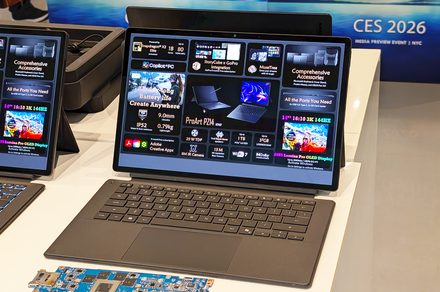

CES 2026 is popping off and Asus is here delivering a truly ridiculous number of laptop announcements, but the coolest new feature in these laptops isn’t the chips (sacrilege, I know). What I really care about is what I’ve cared about ever since I bought my first TV, and that’s OLED.
Asus revamped its OLED game in all of its laptops, improving some and even doubling the brightness in others. My biggest problem with OLED displays happens to be the brightness. With a glossy screen, you’re catching glare almost everywhere you go, so how are you supposed to enjoy the vivid imagery if your child keeps opening the sun-blasted window behind you? (It can’t just be me.)
Of course, there are a few new laptops I am eyeing in particular, all of which I got some hands-on time with, so let’s talk about it.
A new suite of OLED
Asus came up with a fancy name for its OLED technology, called Asus Lumina OLED and Asus Lumina Pro OLED. You’ll find the Asus Lumina Pro OLED on premium machines like the Asus ProArt P16, which is a beast that knocks the MacBook Pro off its pedestal. This isn’t anything new, though, as the ProArt P16 launched in October 2025, but the Pro panels are coming to new ProArt laptops this year.
The brightness on Asus’ panels can vary, but for the ProArt P16 in particular, Asus rates its 16-inch, 4K OLED display for up to 1600 nits of brightness in HDR. I’m not a fan of Windows 11’s HDR, but Asus improved the brightness in SDR as well. The laptop was tested at Ultrabookreview.com, and it scored roughly 700 nits in SDR. That alone outshines the MacBook Pro.
Asus lived up to its promise when it came to the ProArt P16’s display, so what’s next? That brings me to the brand new ProArt PZ14, a 2-in-1 detachable laptop comboed with a stylus pen that connects to the case. Its display dials down to 3K with up to 1000 nits of brightness. Still, this is a dream for artists. Well, kind of. Between its shiny display and the brand-new Snapdragon X2 Elite chipset, it’s bound to cost a pretty penny. We don’t know the price just yet, but I imagine the device will cultivate a more niche and deep-pocketed audience.

In terms of color, however, both versions of Asus’ Lumina OLED panels will support full 100% coverage of the DCI-P3 color gamut and 133% coverage of the sRGB color gamut. That also crushes the MacBook Pro’s display, which hovers around 82% DCI-P3 at most. Even the average viewer might be able to clock the difference when watching or playing their favorite show or game. However, the color gamut coverage is most impactful to artists and creators, so those working within that space will be pleased. The panels are also individually calibrated to meet a Delta E of less than 1. That just means the colors will be accurate.
That star brightness and color aren’t just in your standard Asus laptops, they’re in the gaming laptops, too. Asus calls it the ROG Nebula HDR OLED panel. Again, it’s not new, but this year’s model is supposed to reach up to 1000 nits of brightness in HDR, and they’ll have the same 100% DCI-P3 coverage as the standard Asus units.
One of my favorite gaming laptops of all time is the Asus ROG Zephyrus G14, and this year’s model is receiving a 14-inch, 3K, 120Hz display with that new panel treatment. Now, you can’t get me to use HDR on Windows 11 (sorry not sorry), but again, Asus promised that it improved the brightness in SDR as well. I reviewed the 2024 Zephyrus G14, and it hit close to 400 nits of brightness, so getting even 600 nits would be an awesome upgrade.

Between the Asus ProArt PZ14 and the Asus ROG Zephyrus G14, there’s a lot of shiny OLED to go around. I got hands-on with both of these laptops, and while it’s tough to eyeball nits of brightness when you’re in a crowded space with overhead lights, they were pleasantly vibrant.
We won’t be able to tell you what you’re getting until we can test these bad boys. But at the end of the day, the numbers won’t matter. The real determining factor is this: Will I still be able to see the final cutscene of my favorite game when my child decides to undo the blinds behind me? If Asus can manage that, then I’m happy.
We will likely hear more about prices and release dates for all of Asus’ laptops the deeper we get into Q1. You can catch me waiting patiently for those test results on the Zephyrus G14’s display (and battery). Stay tuned for more CES 2026 coverage as it comes through.