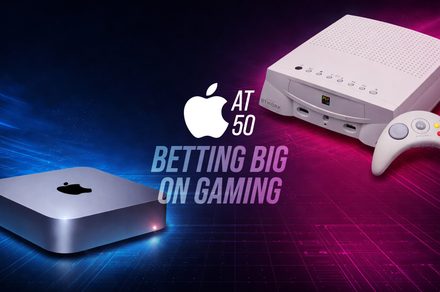
On April 1, 2026, Apple turns 50. And while most celebrations will focus on the iPhone and Mac, there’s one chapter that’s hard to ignore: gaming. Not today’s polished, AAA-on-your-phone moment, but a far messier experiment from 30 years ago.
Back in 1996, Apple wasn’t the giant it is now. Instead, it was struggling, experimenting, and occasionally missing the mark. Enter the Pippin. A console so badly misjudged that it became a lesson in how not to do gaming. And yet, in 2026, it feels less like a mistake and more like an idea that simply showed up too early.
Remembering the Pippin
You see, the Apple Pippin wasn’t just a failed console. It was a snapshot of a very different Apple, one that didn’t quite know what it wanted to be. Launched in partnership with Bandai as the “Pippin @WORLD,” it tried to position itself as a multimedia machine for the living room. Part console, part computer, part internet device. And somehow, none of those things was convincing.
In fact, that identity crisis was its biggest flaw. Gamers didn’t see it as a serious console. PC users didn’t see it as a real computer. And at $599 (roughly $1,100 today), it was priced like a premium product without offering a premium experience. Worse still, it launched into a market already dominated by the Sony PlayStation and Nintendo 64. These were platforms that were cheaper, but also had the one thing the Pippin didn’t: games people actually wanted to play.
Even the hardware quirks didn’t help its case. The infamous “Apple Jack” controller, with its awkward boomerang-like shape and trackball, felt more like a design experiment than something built for actual gameplay. In the end, the Pippin sold around 40,000 units globally. It faded out quickly, and when Steve Jobs returned to Apple in 1997, it was quietly buried. For decades after, Apple and gaming barely shared the same sentence.
But here’s the interesting part. The Pippin didn’t fail because Apple lacked ambition. It failed because Apple lacked alignment. There was no ecosystem, no developer momentum, no clear vision tying hardware and software together. Apple even outsourced much of the experience to Bandai, something that feels almost unthinkable today.
2026: The Year of Unified Silicon
Fast forward to 2026, and the contrast couldn’t be sharper. Today’s Apple, under Tim Cook, isn’t trying to brute-force its way into gaming with a single device. Instead, it’s doing something far more Apple: building a tightly integrated ecosystem where gaming isn’t a category but a capability. And that shift, from product-first confusion to ecosystem-first clarity, is what makes this moment feel different. If the Pippin represented confusion, Apple’s current gaming strategy represents quiet confidence.
It arguably began with Apple Arcade in 2019: a safe, curated play with polished indie titles, no ads, and no microtransactions. It wasn’t chasing PlayStation or Xbox, just redefining mobile gaming. The real shift, though, came with Apple Silicon. Moving Macs, iPhones, and iPads to in-house chips wasn’t just about efficiency. Instead, it gave Apple control. For the first time, the company had a unified architecture with GPUs capable of console-grade gaming.
More importantly, developers no longer treat Apple devices as outliers. With tools like the Game Porting Toolkit, bringing games over from Windows is far easier. That’s a huge shift from the Pippin days, when devs were building for a tiny, fragmented audience. Now, it’s a billion-device ecosystem, and it’s paying off. Titles like Assassin’s Creed, Resident Evil, and Death Stranding now run natively across Apple devices. Not cloud versions or cut-down ports, but full experiences that scale from iPhone to Mac and beyond.

And that scalability might be Apple’s biggest advantage. Buy a game once, and it doesn’t live in a single box under the TV. It travels with you. Start a mission on an iPhone during a commute, pick it up later on a MacBook, and continue in a more immersive setup at home. This isn’t just cross-play, but it’s ecosystem-native gaming. It’s also the exact opposite of what Pippin tried (and failed) to do. Back then, Apple had a device without a platform. Today, it has a platform that doesn’t need a single defining device.
The Vision Pro Factor
Which brings us to the most futuristic part of this puzzle: the Apple Vision Pro. If Apple Silicon is the engine, Vision Pro is the new playground. Spatial gaming is no longer a gimmick. Instead, it’s becoming a legitimate extension of Apple’s ecosystem. Games aren’t just played on a screen anymore; they exist around you. With spatial audio, low-latency input, and immersive environments, the experience shifts from passive to physical.

It’s the “multimedia dream” of the Pippin, finally realized with technology that can actually support it. And this is where the idea of “Silicon Integration” truly clicks. Apple now owns the chip, the software, the storefront, and increasingly, the developer pipeline. That level of control allows games to scale seamlessly across devices and form factors in a way no traditional console ecosystem really does.
The Reality Check: Can Apple Win the Living Room?
Despite the technical leap, AAA gaming on Apple hasn’t exploded overnight. Adoption for some major titles has been slower than expected, raising familiar questions around pricing and audience behavior. Mainly because mobile-first users are used to free-to-play models, not $60 premium games.
There are also practical challenges. Modern AAA titles can easily cross 100GB, and Apple’s storage tiers still feel like a premium tax. The lack of a first-party controller means Apple is relying on third-party options, which work, but don’t quite complete the ecosystem in a way you’d expect from Apple. And culturally, Apple is still shaking off the perception that it’s not a “real gaming company.”
It’s a neat full-circle moment. Back in the Pippin days, Apple had the hardware but no games. Today, it has the games, the hardware, and the tools, and is just waiting for the audience to fully catch up. The difference is patience. Instead of rushing, Apple is quietly building its ecosystem, reshaping what gaming even looks like. The “console” is no longer a box; it’s the iPhone, the Mac, and even the headset. The Pippin may have flopped, but it wasn’t wrong, just early. In 2026, that same idea finally has the power, polish, and cohesion to work. And for once, it actually feels like Apple might land it.