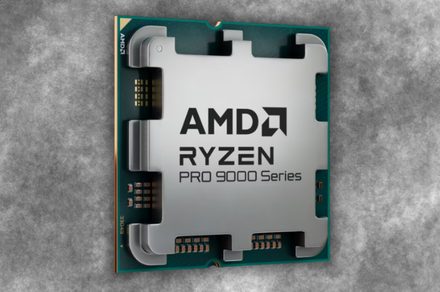
AMD just did something that should excite anyone running a professional workstation, and probably annoy anyone who believed 3D V-Cache was exclusively for gamers.
The chip maker has announced six new Ryzen Pro 9000 Series desktop processors built on Zen 5 architecture. And, for the very first time, these processors bring 3D V-Cache technology to the commercial desktop market.

What makes the X3D models special?
Among the six, the headline chip is the Ryzen 9 Pro 9965X3D, which comprises 16 cores, 32 threads, up to 5.5 GHz peak clock speed (with boost), and 128 MB of total L3 cache. While everything else might sound normal, the 128MB of cache is significantly larger than the standard 64MB.
The extra 64MB comes from AMD’s 3D V-Cache technology, which physically stacks additional last-level cache directly on the processor die and drastically reduces data latency under heavy workloads.
Below the Ryzen 9 Pro sits the Ryzen 7 Pro 9755X3D. It features eight cores, up to 5.2 GHz clock speed (with boost), and 104 MB of L3 cache. Both the chips do something that no other Ryzen Pro CPU has done before: break the 65W power limit.
While the 9965X3D runs at 170W TDP, the 9755X3D peaks at 120W. All the other CPUs, including the Ryzen 9 PRO 9965, Ryzen 9 PRO 9955, Ryzen 7 PRO 9755, and Ryzen 5 PRO 9655, are non-X3D models ranging from six to 16 cores and 65W to 170W, allowing OEMs to develop a full range of products on them.

When can you get the new AMD chips?
All six chips support up to 256GB of ECC DDR5 RAM, PCIe 5.0 connectivity, and AMD’s Pro Technologies suite, including enterprise security, remote manageability, and a long-term platform stability stack.
The company is positioning its new Ryzen chips for media and entertainment. Think 4K/8K video editing machines, architecture, or engineering workflows that often include 3D modelling/rendering, and local AI inference workloads.
Systems powered by the new Ryzen PRO 9000 Series processors are expected to roll out in the second half of 2026. The first confirmed OEM system, based on the new chips, will come from Lenovo in the third quarter of this year (it’s called the ThinkStation P4).
Unfortunately, these chips won’t appear in the retail market, as they’re OEM-only. The pricing will also follow the standard Pro series practice: it won’t be disclosed publicly.