The call for problem discovery, the freedom and wander, and craft in the age of AI
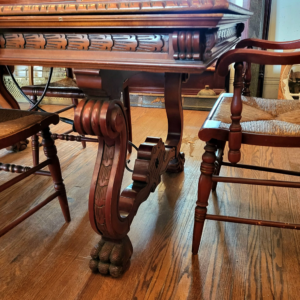
I grew up surrounded by 17th- and 18th-century architecture my stepfather salvaged from around the world. My mother had a knack for convincing him to put some of his salvaged pieces in our house, which meant I got to enjoy them before they went up for sale.
The awe of the well-built antique craft inspired me even as a child with no sense of money or quality. Craftsmanship from this era is something noticeable and tactile. It is in stark contrast to grabbing a handful of sand and it slipping through your fingers — a good craftsman using good materials withstands the test of time. Even today, I miss running my hands over the hand-carved intricacies in our buffet tables and marveling at the the faces expertly carved into each piece. When my friends came over, I’d show them how our side tables had animal feet. We’d giggle under the table as our imaginations ran wild, thinking the table would come alive and start running amok.

Today, my house and life are painfully void of craft. I live in a new build with pumped out, builder-grade (aka cheap) materials. I have plastic wood lookalikes rather than hand-carved wood. None of my furniture causes that moment of awe where you stop to marvel at it. My dining room table is a constant reminder of how far we’ve departed from the craft and moments of splendor when creating fast furniture.
I bang my knees on a weird jut at the head of the table. My kids constantly bonk their heads on other inconveniently designed juts as they try to play under the table. What appeared as nice ridges on the online photos turned out to be uneven plastic pieces put at different heights, resulting in the table itself not being flat. Every dish placed on the table becomes wobbly. I am embarrassed every time I host a dinner party. Come enjoy delicious food on an uneven surface and try to avoid hitting your knees on the poorly designed table.
https://medium.com/media/23cdc6762eea6c20c0c4dd191ab1f9a6/href
The craft has slipped through our fingers. What we are left holding is a painful reminder of how we’ve removed the awe and the craftsmanship. The dilution of craft is not just in my house either. It’s everywhere. According to the Washington Post’s article Why Furniture Got So Bad,
In the mid-20th century, the more affordable stuff was typically made domestically of American plywood — i.e., thin layers of wood glued together — while fancier pieces might be solid cherry or oak, and could be made in the United States or come from Italy or Denmark. Today, most of what’s on the market consists of Chinese-made press board and plywood, while pieces marketed as “solid wood” might be rubber wood with glued-on veneer.
Good craft starts with good materials. For the furniture industry, their departure from wood into plywood and plastic enabled companies to take advantage of cheap labor in China and India. The flatter they could make an item, the more of it they could ship — which to no surprise resulted in a higher margin. Without good materials to carve, the craftsmanship was distilled down into its barest form. Fast furniture was being pumped out at pace akin to the pace we are seeing with AI today. But fast meant trash.
Once a minor ding or imperfection happened, that piece of furniture ended up in the trash to be replaced by another “affordable” piece. The Environmental Protection Agency cited there were 12.1M tons of furniture that ended up in the landfill. This is a 450% increase in furniture that ends up in the landfill since the 1960s (as measured by 2.2M tons). We created the cheapest throwaway version possible. We created decorative garbage.
I don’t want to create garbage. I want to create experiences that people want to have like what my stepfather does in his shop. Customers drive U-Hauls to solve the shipping cost and rid themselves of the need for plywood and plastics. They travel from across the country to wander through his two buildings of antiques, spending hours marveling at the functional and decorative curiosities that have withstood centuries. They stand juxtaposed to an age where everything else is purchased online. They only buy in person because there’s something magical about seeing and feeling the intricate details of the craftsmanship before buying. They want to talk to a human with stories who can enlighten them to where the piece was salvaged, its history, and little delightful facts such as why people used to put out gargoyles to protect their homes.
Amongst experiencing this, I had to ask myself: Why are companies so persistent in creating fast and ultra-fast furniture? Do they not see the counterculture and want to reap some of those financial rewards? My first inclination was to look at the customer’s demands. With inflation, the increase in the price of groceries, and so many other cost factors, my thought was that the typical American customer couldn’t afford the price point for the beautiful antique. Then, I looked online and laughed at how quickly I was debunked. Crate and Barrel and Pottery Barn are more expensive than my stepfather’s antiques. My same cost theory can be debunked with Patagonia as it relates to fast fashion. Patagonia’s Worn Wear site allows you to buy used, quality gear and then sell it back. I use this for my kid’s clothing, and every season for quality gear that keeps them warm, I pay about $50 after I sell last season’s gear. It’s not cost but perception of cost/ branding that is allowing junk to prevail.
I was caught up in this myself. I hate my table so much because I thought I couldn’t afford the nice table. After doing my research, it turns out, shamefully so, that I could have used that money to buy a nice piece that would have solved my problem.
It is not the customer that is holding craftsmanship back. Rather, it is the false assumption that the craftsman’s process doesn’t matter. Moreover, I believe it is acting under the false assumption that we can completely cut some manufacturing partners (including ourselves) and end up with a product that people still want.
In fast fashion, we learned that one size fits no one and these cheap materials ripped within one wear. Patagonia stands in stark contrast to the Temus and Sheins of the world by making gear that lasts. Their Worn Wear line brings in $13M, retains customers by building trust, and keeps customers in a closed loop — you buy from us, we buy from you, you buy again from us, we buy again from you. Their insistence on craftsmanship, its materials, and the earth has led to new revenue generation streams and durable customers.
But like in fast furniture, companies want speed, and wandering feels like the antithesis of speed. Results now. They believe AI is the answer, everywhere for every problem. AI itself is a great invention that democratizes the discoverability of information. However, AI cannot replace human thinking. Humans need the freedom to wander, to question, to rewrite, and, importantly, the time to fail. As Giorgia Lupi notes in her New York Times article In Defense of the Detour, “The impulse to optimize for the obvious and to stop at the simplest answer is what I believe we have to resist.” Like a disease, the fast culture has hit every industry from plastics to fast fashion. These items don’t hold up just like AI-generated UI designs in a UX design critique. The prompt first, think never mindset is producing decorative garbage.
To truly hold onto the craft, we need to rediscover the sense of wandering until we find the problem and hold onto the ah-ha discovery moments. AI is a new tool to be used in a designer’s arsenal to move faster just like the spinning wheel for the weaver or the steam engine for the carpenter. For the weaver, they could move significantly faster, but core parts of their craft remained the same. You cannot create clothing without understanding: When will this piece be worn? By whom? What are their needs and wants?
But we’re in an age too where companies are testing if one size can fit all. AI spits out the same way to solve a problem in what’s called fast design. Fast design is different from fast furniture. Our materials aren’t a big part of the problem. Our biggest problem is that companies are acting under the guise that AI can figure out the problem, design, code, and ship. It can’t for the record.
This guise that AI can solve the problem and why that problem matters to humans is where we’ve gone awry and generated what’s called AI slop.
Let’s rewind for a moment. The reason I hate my table so much is that it doesn’t solve the problems I bought it to solve. I want a place where my loved ones can come together and enjoy a meal. I don’t want a dining room table that is decorative but not functional (screams — do the research into a pillow).
AI takes what is available and spits it back out, enabling companies to create UI designs at a pace never seen before. There is an unnerving acceptance that we no longer need the design process or to fail fast through problem ideation. We can type in 1–5ish prompts and then ship. In extreme examples, I’ve seen “we don’t even know what the problem is, but hey, here’s a pretty design.” This is what I call AI slop — something created without review that may or may not look nice and is not functional. AI slop doesn’t solve problems. It creates them.
We’re in a devil’s bargain. We sacrificed the art form of the design process to AI-generated designs. (shakes fist)
https://medium.com/media/171ef31a1effaa92d1b149f5f56cdeeb/href
And just like with any Devil’s Bargain, there is a hidden, negative cost. For instance, there is a misconception that a chatbot will solve every possible problem and AirCanada learned the hard way that isn’t true. What happened? Forbes in its article What Air Canada Lost in ‘Remarkable’ Lying Chatbot Case noted, “The passenger claimed to have been misled on the airline’s rules for bereavement fares when the chatbot hallucinated an answer inconsistent with airline policy. The Tribunal in Canada’s small claims court found the passenger was right and awarded them $812.02 in damages and court fees.” This was because Air Canada didn’t take “reasonable care” to conduct evals on the chatbot. Fast design and vibe coding meant a fast lawsuit.
(One caveat is: Certain problems have been solved and don’t need a new way to solve them. For instance, I send a lot of potential freelance clients to Squarespace. Instead of racking up your costs with a custom designer and custom engineer, Squarespace has pre-built templates that are mobile and desktop-friendly. They are great for restaurants where people need to see your location, menu, make a reservation, and order online. You don’t need to innovatively resolve that problem. And no, I am not a paid ad for Squarespace.)
Lawsuits aren’t the only negative outcome of bargain for fast design. Designers are turning into the janitors of the industry, cleaning up the AI slop rather than being the innovation problem solvers. As Nielsen Norman puts it: We are in the “custodial era of UX” (and I didn’t sign up to be here).

The Nielsen Norman Group notes,
The word “custodian” has another meaning: someone entrusted with the care of something valuable. In that sense, UX will remain a custodian: not of the mess created by AI slop, but of the real users’ needs.
I understand why my stepfather fervently wanted to hold on to the craftsmanship in his industry; he saw the craft that needed to be cared for when most people didn’t. I’m trying to do that too with my craft of finding the problem to solve. How he wanders through antique shops in France trying to find the best pieces, I wander through the human experience. What do you need? What do you want? What didn’t you say but is critical to your experience? How can I inspire delight? What can I do to make you pause and smile? How can I move you through the flow the fastest to get you off your screen?
Nevertheless, I can’t help but scream when I see designers continue to sign away their design principles to AI and act under the false premise that the experience doesn’t matter. As a designer, I don’t think we need to make this bargain. Designers have always operated under the premise to fail as fast we can. My entire career, I’ve always operated under tight budgets, rapidly looming deadlines, shareholder cost reduction pressures, and most importantly, I’ve always leaned into “yes, and” theory. “Yes, I can deliver that tomorrow and it won’t solve your problem.” “Yes, we can exclude this part of the experience and you may see decreased revenue.” So…why do I feel alone when pushing back on AI when my entire career the design industry has taught me to always push back on behalf of the end user?
It may look like this. Your company tells your product team to cut corners and skip over failing fast to prompt once, then ship. But you don’t know the problem to solve. Grab your superhero cape of quality and craftsmanship and advocate that you must understand the problem first before you can prompt. (Need some inspiration? “…Explore 4 key craft improvements for your team” or “The Golden Rules of UX”.) Then, leverage AI as a tool in your design toolbox once you’ve done the heavy thinking and understand the problem.
https://medium.com/media/0df2d210d31f10787634f0e306b336c5/href
A word of caution: We can’t achieve this if we continue acting under the false assumption that AI is the heavy thinker. It’s not (Why AI Won’t Replace Your Thinking…Unless You Let It and AI Can’t Think Critically, But People Must). At the end of the day, progress and speed must be embraced while also being mindful of our impact and trade-offs; if we start using AI to solve the problem (oftentimes unknown), then we will lose the ability to progress, to play, to wander. We will continue to bonk our knees on the sloppy solutions we’ve cheaply created with AI. Fast is trash when speed becomes the most important factor and we sacrifice the artisty of problem discovery.
Our craft is not sand slipping through our fingertips despite the fact we are treating it as so. We must be willing to wander, to be the antique dealer in the modern age, to hold on fervently to our craft and inspire others. We are seeing a resurgence for craftsmanship and problem discovery. We are in the age of AI AND we can be in the age of craft too.
AI-generated UI is fast design, not UX was originally published in UX Collective on Medium, where people are continuing the conversation by highlighting and responding to this story.