A UX carol
It was Christmas Eve, 2025, and like any other day, Ulysses Xavier was doom-scrolling LinkedIn.

It was Christmas Eve, 2025, and like any other day, Ulysses Xavier was doom-scrolling LinkedIn.
Ulysses was a UX designer — or a “Product Designer,” or maybe a “Digital Experience Architect,” or a “Product Experience Manager,” depending on which day you asked him. Currently, however, he felt more like a Figma monkey. He sat in his Scandinavian designer chair, bathed in the orangey light of a dual-monitor setup (because you gotta filter out that blue light), reading yet another hot take about how AI had rendered his so-called career — which was kind of a joke, anyway — obsolete.
“Bah,” Ulysses muttered, quickly archiving yet another generic rejection email from a job application. “Humbug.”
He closed his eyes, wishing for the good old times when designers did all the user research and customer journeys by themselves. When he opened them, his MacBook and monitors were gone and his Spotify playlist “Coffee Shop Background Noises” replaced by the screeching, static-filled sound of a 28.8k modem connecting to the internet.
The First of the Three Spirits
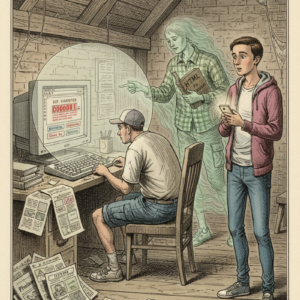
Standing before him was an ethereal, slightly translucent figure dressed in flannel and holding a copy of HTML for Dummies.
“I am the Ghost of UX Past,” the figure said, its voice crackling like a 32-kbps RealAudio. “Come with me.”
Suddenly, Ulysses was back in 1995. He saw an attic. A solitary figure sat hunched over a CRT monitor, coding in what looked like a very old-school Apple Notes, typing on a keyboard that seemed way too clunky and loud.
“Is that … a developer?” Ulysses asked.
“No,” the Ghost corrected. “That is Max. He’s what’s called a webmaster. In this era, there are no silos. He designs the page, writes the HTML, configures the server, and crops the JPEGs in Photoshop. He’s like a general contractor of the web.”¹
Ulysses watched Max struggle. He was using invisible tables for layout because CSS didn’t really exist yet.² He was embedding headers as images because there were only a handful of fonts like Times New Roman and Courier available.³ It looked like a horrible mess … and painful.
“It looks terrible,” Ulysses whispered, eyeing a blinking hit counter.
“It’s foundational,” the Ghost retorted. “There is nothing like ‘user experience’ yet — Don Norman has only started coining the term at Apple recently.⁴ But look at the ownership. Look at the freedom. There are no stakeholders blocking tickets. There’s just the creator and the user. It’s chaotic, yes. But it’s pure creative problem solving … well, maybe more creative than solving, to be fair.”
“What is he using?” Ulysses asked. The ghost put a hand on his shoulder: “It’s called Notepad.”
Ulysses realized something. The constraints of the past — the technical limits, the lack of tools — forced immense creativity, even if the pages often seemed ugly. But these people weren’t just pushing (ugly) pixels; they were actually wrestling a giant squid.
The Second of the Three Spirits
The scene dissolved into a sterile, open-plan office. Ulysses was sitting at a desk that looked like it rather belonged in a hospital. He noticed that on his monitor, there was a Zoom call with 45 participants.
“Am I … in a Zoom call … in an office? Why?”
“That’s the exact question I ask myself everyday … I’m the Ghost of UX Present, by the way,” sighed a weary figure who had appeared at his side, wearing a hoodie and looking noticeably burned out.
Ulysses looked around in confusion. He saw hundreds of designers churning out high-fidelity mockups in Figma, moving pixels by 4px increments. He saw their anxiety as Slack channels quickly filled with requests from stakeholders and management.
A couple of desks down, one of the designers was just laid off by his manager, “because revenue is bad and we have AI now to save costs.”
“Look at them,” the Ghost gestured. “They are terrified.”
Where the Ghost had gestured, Ulysses now saw analytics dashboards floating in the air like holographic projections. He couldn’t identify all the numbers, because they seemed to be using Liquid Glass, but he saw the more than 250,000 tech layoffs from 2023.⁵ He saw the job market flooded with bootcamp graduates who had been promised secure and high-paying UX jobs.⁶
“They feel like assembly line workers,” Ulysses said, recognizing the feeling. “Figma monkeys.”⁷
“Precisely,” the Ghost nodded. “They see product managers doing user research and creating wireframes. They see AI generating layouts faster than they can think. They are fighting for a seat at the table, but once they get there, they just take orders.”⁸
The Ghost showed him a designer arguing with a stakeholder. The designer wanted to do discovery research; the stakeholder just wanted the screens done by Friday.
“We have become obsessed with the artifacts of design,” the Ghost said sadly. “Screens. Flows. Wireframes. We forgot that our job isn’t to make files. It’s to ensure the product works for the user. And because we act like factory workers, we are surprised when business treats us like a cost center to be optimized.”
Ulysses felt a pit in his stomach. “Is this it? Is this how it ends? Replaced by AI, apathy, and alienation?”
The Last of the Spirits
The Zoom call and the office around it faded. Ulysses found himself in a quiet, sunlit room. There were no screens. No keyboards. Just people talking, gesturing, and collaborating. All of them were wearing tags: Human-Centered Product Manager, Interaction Systems Architect, Behavioral Product Strategist, Experience Integration Lead, and Cognitive Systems Engineer.
A tall, calm figure stood there. This Ghost didn’t look scary. It looked … Ulysses didn’t know how exactly, but maybe something like empowered?!
“I know what you think. You’ve looked at the job titles and now you think UX is dead,” the Ghost said. “But you are confusing the title with the discipline. We are all designers in one way or the other. I used to be called a ‘UX designer,’ but that was a long time ago.”
“Where are the screens?” Ulysses asked, looking for a laptop.
“Gone,” the Ghost smiled. “Or rather, the ideas of ‘screens’ and ‘average users’ are gone. Why would we design one interface on just 5 different screens, but for millions of users? The ‘average’ user never existed anyway.”
The Ghost waved a hand, and Ulysses saw a vision of the future:
1. The End of the Screen (as we know it)
“People here don’t draw pages,” the Ghost explained. “They define systems and constraints. They design components and the rules that govern them — ‘The header is always top,’ ‘Component A prioritizes over Component B,’ and so on. An AI takes those components and rules and generates hyper-personalized interfaces for every single user, adapted to their specific device and context.”
2. The Designer as Educator
Ulysses saw a Human-Centered Product Manager sitting with a Behavioral Product Strategist and a Cognitive Systems Engineer in what seemed to be a very intensive coaching session. “We stopped fighting the inevitable,” the Ghost said. “We embraced the fact that stakeholders, engineers, and product managers want — and need — to be involved in design. So we became force multipliers. We realized that — just like with research—you can’t prevent ‘non-designers’ from designing. But they need support and guidance to ensure the best outcome for the user. Now, our job is to empower everyone to solve their problems with the right design methods, so we can focus on the really wicked stuff and strategy. Oh, and you of course noticed already, but we all got new titles and merged with other disciplines, because in the end, everything is design and nobody understood UX correctly, anyway.”
3. The Death of the “Monkey Worker”
“But what about AI?” Ulysses asked. “Did it replace us?”
“Obviously not. It replaced the monkey workers,” the Ghost answered firmly. “It replaced the rote production of UI assets. But it couldn’t replace the creative problem solving. Real designers aren’t monkey workers. They are strategic partners. The term ‘UX Designer’ might have vanished from job descriptions, merged into Product or Engineering, but the practice of UX is more vital than ever. Because one thing is for sure: there’ll always be users, and there’ll always be experiences.”
The End of It
Ulysses Xavier woke up with a start. The orangey light of his monitors seemed to hum softly.
He looked at his LinkedIn feed again. The doom-mongering articles were still there. The job market was still tough. But for the first time in months — maybe years — he didn’t feel cynical.
He realized that if he kept clinging to some kind of nostalgic understanding of UX from 1995, 2005, or 2015, he would indeed become a fossil. But if he embraced the shift? If he stopped designing screens for made-up personas that didn’t exist and started designing systems and strategy for an AI to build upon?
“UX isn’t dying,” Ulysses whispered to his empty room. “It’s merely growing up and finding a new identity.”
He sat up, opened LinkedIn Learning and typed: “How to build AI systems.” Then, he created a new document and began to jot down the concept for a proper design system for his websites.
Hi! 👋🏻 I’m Max, a Product Design Director and Freelance Product Consultant with a Ph.D. in computer science. If you’ve enjoyed this article, you can buy me a coffee, which is always highly appreciated, or subscribe to my newsletter. You’ll stay up to date on all my latest writing, and I’ll be sure to keep you entertained with new and interesting insights.
Endnotes
¹ See “What Happened to the Webmaster.”
² See “A Brief History of CSS.”
³ See “The problems of designing for the web in the ’90s.”
⁴ Cf. “The Fascinating History of UX Design: A Definitive Timeline” and “Where did the term User Experience come from?”
⁵ See “A comprehensive archive of 2023 tech layoffs.”
⁶ See “Trends in UX Design Hiring: Current Statistics and Data on Bootcamp Impact” and “Best UX Design Bootcamps 2025.”
⁷ Cf. “Tech Workers Versus Enshittification.”
⁸ See “How to use a wireframe in product management,” “How Should Product Managers Use Wireframes?” “AI UI generator in Figma Make,” and “The Biggest Challenges Practitioners Encounter Working in UX.”
Copyright © 2025 by Maximilian Speicher ● Originally published by The UX Collective
A UX Carol was originally published in UX Collective on Medium, where people are continuing the conversation by highlighting and responding to this story.