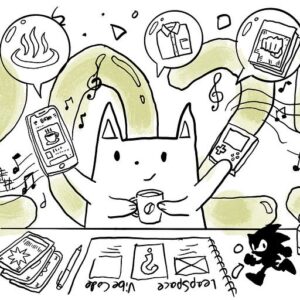
and why I’ve been making Bob Dylan songs about Sonic the Hedgehog

In 2025, AI stopped feeling like just a tool to me and started to feel more like a mirror.
This thought really struck me while generating music with Suno AI. Through the process of creating, I was channelling my raw emotion, emotions I hadn’t realised I was even dealing with at the time. Is this how musicians feel when writing songs?
This AI tool, like so many I’ve used this year, did not help reflect just my productivity, but also showed me my intentions, my taste, and sometimes even my nostalgia. In a way, the songs I was generating were more truthful about what was happening in my life than I was willing to admit.
Hell, I was producing so many songs at one point that they started subtly referencing one another with a lyric here and there, creating my own mini music universe. I made a Bob Dylan-style narrative about Sonic from the comic, weaving in philosophical concepts. I remixed If You’re Strong You Can Fly from Sonic CD. I turned classic poems into music: The Tyger and The Raven.
I appreciate these experiments because they prompt me to critically examine whether AI-generated artefacts are inherently more detached from us as creators. Because this raises important questions about the nature of ownership in collaborative creation with AI. While it is possible to use AI while still maintaining ownership of the resulting ideas, this requires one’s ability to articulate, defend, and integrate them into one’s own conceptual framework. Ultimately, if we fail to maintain active engagement with the creative process and merely delegate tasks to AI without reflection, there is a risk that delegation becomes abdication of responsibility and authorship.
Where we’re heading
I think we’re at an inflexion point for product management and knowledge work more broadly. The tools we have now enable us to operate at a scale and speed that was unimaginable even two years ago. But that acceleration comes with a cost: we’re less practised at the slow, deliberate thinking that leads to insight.
In the field of product management, I have long suspected that the future belongs to generalists, and I’ve never been more sure of that. Those who can think and do, who understand engineering, data science, UX, marketing, and sales deeply enough to prototype, test models, run discovery, and build strategies that excite teams will be the most successful. The single-domain specialist is increasingly a relic.
The most important thing we can do is maintain our attention, take accountability for our actions and deliverables, and resist the weaponisation of our curiosity. That’s the work ahead.
From tarot to moon ceremonies
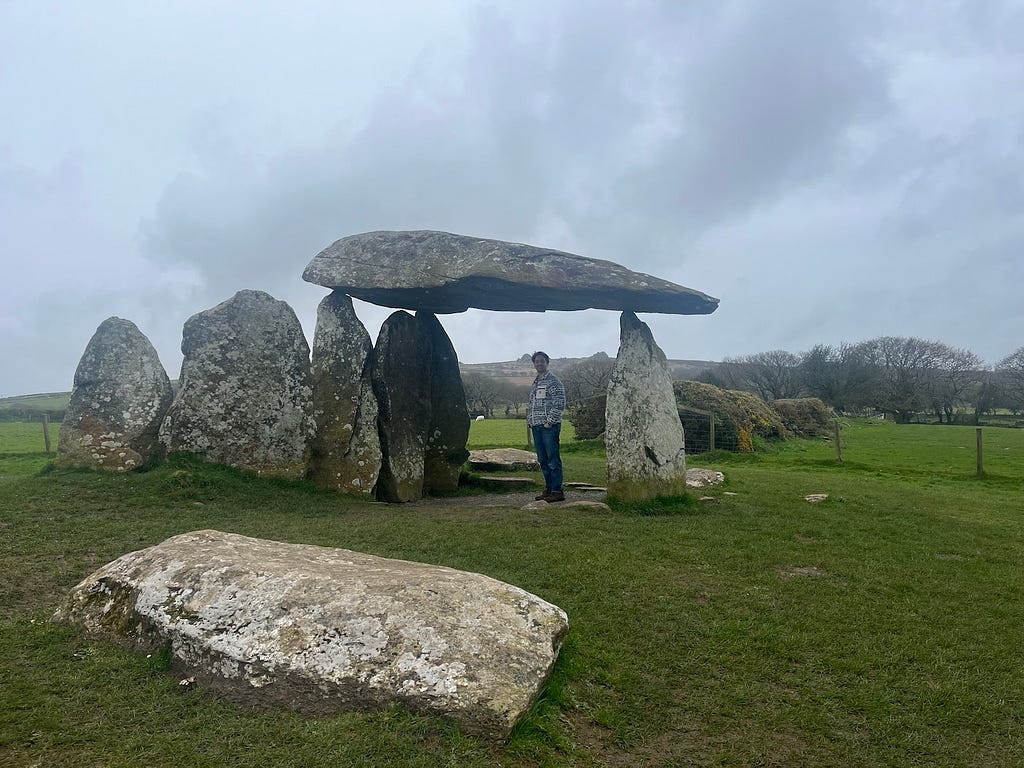
Last year, I joked about using tarot cards for sprint planning. This year, I’ve built on that theme. 2025 was the year I got introduced to moon ceremonies and magic stones. I understand many will read that and think I’ve gone potty, but hear me out.
Like tarot, I don’t really believe these things have any inherent power, but they are useful for reflection by forcing you to recognise where you are right now and set an intention. But what’s surprised me: these silly ceremonies are very engaging. Friends, family, even colleagues: people WANT to be involved in the silly gathering. Curiosity, novelty, disgust, whatever it is, it’s just fun. There is something about putting people in a scenario where we can all share in the collective chaos of the universe and support each other through whatever insights we find. Friendship is not natural. It needs work because to be human is to be an animal that needs witnesses.
Anyway, those are just the highlights. Below are more reflections that gave me pause this year. Dive in, and I hope they inspire and invoke thoughts that set you up for a great 2026.
The Reflections
On debate and changing minds:
- The best way to resolve a conflict or debate is to make the argument of your opponent better than they could. You literally have to make a better version of their argument, state it back to them, then ask, “Did I miss anything?” That clarity of understanding is the foundation for any possible change of mind for all parties involved, including ourselves.
- Changing somebody’s mind is one of the hardest things to achieve, and aggressive approaches tend to backfire. There is one thing that works, though: show curiosity. Be interested in what they are saying and try to understand why they think that way. This will provoke a considerably more open-minded response from others. Curiosity: the same thing social media weaponises against us, but when genuinely deployed in conversation, becomes one of our most powerful tools for connection.
- When debating, people tend to prefer the position of those who don’t really hold one of their own. LLMs are perfect for this and thus a great tool for finding common ground.
On AI and tools:
- The most important thing, I think, that most people in knowledge work should be doing is learning to vibe code. Vibe code anything: a diary, a picture book for your mum, a fan page for your local farm. Anything. It’s not about learning to code, but rather appreciating how much more we could do with machines than before. This is what I mean about the generalist product manager: being able to prototype, test, and build without being held back by technical constraints. I was able to relaunch my website in a fraction of the time it took me years ago, adding interactive effects and custom graphics that would have taken weeks before. I could finally create a website that feels like me: not only a record of things I’ve done, but also a place for experiments like a mini social media feed, all without the long nights solving silly problems like deploy configs.
- Learn to work creatively with LLMs in this order of importance: combinational, exploratory, and novel.
- If you let AI do all the writing and planning without understanding the thinking behind it, you’ll lose connection to the outcome. The key is maintaining ownership: can you defend the ideas, explain the reasoning, and adapt the direction mid-process? If yes, you’re using the tool. If not, the tool is using you. Like I said at the start: the danger is delegation turning into abdication.
- When working without AI, teams outperformed individuals by a significant amount, and teams working with AI outperformed everything else. (Research source)
On leadership and politics:
- Aligning the goals of many people begins with understanding what a good outcome looks like for each of them. This was my biggest learning from bringing together groups with very different approaches to product development.
- Paranoia grows with success. I suspect that’s natural, as you have more to lose, and now you are exposed to far more signals. Keep an eye on it and always be prepared to lose something with the hope of gaining more in return.
- You need to learn to love politics, and you also need to understand that politics gets more childish the higher you go up in the organisation.
- Sometimes you need to just call out the mood in the room. That we have gone off track, that there is tension, that we need to take a moment to step back. To do this well, ask a question rather than declare it: “Are we still aligned on our goals here?” invites reflection better than “We’ve lost sight of our goals.”
On building and creating:
- Don’t build a prototype with the goal of making a solution. Prototypes are best used as questions, not answers.
- Thoughtless thinking is a state we should all strive for. Henrik Karlsson’s “When Is It Better to Think Without Words?” explores this beautifully: how our most profound thinking often happens in a pre-verbal state, before we’ve forced our thoughts into the constraints of language. This is the slow, deliberate thinking I mentioned earlier: the kind that gets harder to access as our tools get faster.
- Three intelligences: human, artificial, and community.
- To do the most important things, you have to say no a lot and disappoint many people, even without a complete plan, even without fully understanding why, in the hope that the space created will be filled with something more valuable.
- So much of what is worth doing requires an almost irrational commitment to pushing through pain that would break most people.
- You win either by climbing the mountain ahead of you or building one beneath you.
- A great work emerges from an invisible ecology of lesser works.
- Sometimes you just need to build a faster horse. There ain’t no shame in admitting that. Spotify was just the faster horse in a world of iTunes.
On life and perspective:
- Experience is what you get when you don’t get what you want.
- Strengths and weaknesses are often two sides of the same coin.
- The older I get, the more I realise there aren’t a lot of people who are stupid, but there are allot of people who are incurious. In many ways, I can’t blame them. Social media continually weaponises our curiosity against us.
On friendship:
- When having a party, invite a few close friends to come 30–60 minutes early to set up and hang out with you. Those moments before everyone arrives, when you’re just arranging chairs and testing the speaker system, are often more valuable than the party itself. Uri’s “21 Facts About Throwing Good Parties” captures this wisdom: parties succeed not through perfect execution but through creating the conditions for genuine connection. Like the moon ceremonies and tarot, it’s about creating space for people to witness each other.
- We are biologically wired to return favours, even unearned ones. This works both ways: be mindful of what you accept and what you give.
In the future:
- Image generation models have reached a tipping point this year. The most recent models can perform amazing style transfer and contextual image transformations, and they can now reliably produce text with context. I foresee an explosion in visual learning aids and exploration next year. When designing Christmas cards this year or a t-shirt design for LeapSpace, I could layer so much more information: aggregating all my experiences from the year into a symbol-rich card, or blending the most important scientific discoveries with my love of 2001: A Space Odyssey and our product logo. It’s not just about generating images anymore; it’s about encoding meaning and narrative visually. The same way I encoded narrative into those Sonic songs: remixing what you love through your own lens.
- I’ve started getting more sophisticated with using AI in different work environments. Using IDEs like Cursor, I’ve set up folders of documents with custom instructions on how to interact with and retrieve them to help make informed decisions, answer questions, or continue building my knowledge base. It’s still early, but I really like this idea of the working directory knowledge base that grows with you and is managed by AI.
- World models look super interesting. For those unfamiliar, world models are AI systems that build internal representations of their environment, allowing them to predict outcomes and reason about their surroundings. Recent research argues they should develop structured, adaptive representations similar to how young children intuitively learn about the world. Google DeepMind’s Genie 3 even has this awesome visual and interactive version, generating dynamic, navigable worlds at 24 fps with real-time interaction. I can imagine that when they get more consistent, do text really well, are easily promptable and can do style transfer and brand consistency, they’ll be incredible for games and entertainment.
- What hits me is this idea of having simulated environments for our best ideas. It doesn’t have to be a high-fidelity environment necessarily, but one with a set of parameters that can be controlled, understood, and evolve. I often think of the Creature pets from Lionhead’s Black and White game from the 2000s: this was, at the time, state-of-the-art AI in a game of all things! Your behaviour towards the creature, if you treated it nicely or poorly, would directly impact its behaviour and personality towards itself, your villagers and the world around it. This was all part of a more complex system for the creatures, which was also influenced by other factors, such as the skills they were taught, the food they ate, and the events that shaped their lives. All of it, effectively, a bunch of parameters that the game would adjust based on your actions. Treat your creature poorly, punish it in confusing ways and not feed it, over time it will become sickly and cowardly. I often think about this and how modelling a system like that could be a template for working with increasingly complex AIs. That, rather than prompting with instructions and context, we were to give it personality traits and, in addition to collecting memories, adjust those parameters to provide context over time. It’s a different way of thinking about AI interaction: not as tool use, but as relationship building.
Travel and discoveries:

- After seeing one of my favourite shirts ruined on a sweaty 12-hour flight to Tokyo, I discovered Muji’s undershirts. Now essential for both comfort and confidence (no under arm stains for me), and keeping my nicest shirts safe! Means slightly less washing too: top tip.
- The two-phone travel strategy for China: carry one phone for all the Chinese apps and a second to translate the screen of your primary phone. Chinese apps are built with a completely opposite philosophy to the West’s simplicity, dense with options and configurations. But what struck me most was the gamification of everything. From the potential to win a free Luckin Coffee to getting a random discount on your subway fare. It’s so alien and different, as if you’re encouraged to participate in the economy with the hope of winning. Every transaction becomes a tiny lottery. Fascinating from a design perspective, maddening from a user one.
- If you love hot springs, you need to visit Beitou in Taipei. Most people never visit Taiwan, but if you’re a hot spring lover, this place is absolutely worth the trip.
- A country can be in economic decline, but that doesn’t necessarily mean it can’t be graceful. Japan is a master at this.
- Comics over anime. I got really tired of watching most things and found myself returning to source material: One Punch Man, Dragon Ball, Death Note, BLAME!, and The Invincible. The Sonic the Comic podcast was a surprisingly detailed hit of nostalgia. Same Sonic that inspired those AI-generated songs I mentioned: everything connects back to what we loved first.
- The Trimui Brick Hammer became my new favourite toy this year. A retro gaming handheld that plays SNES, GBA, PS1, even some Dreamcast and N64 games, all in a compact metal body that feels far more premium than its cost. Perfect for train commutes, flights, and, more importantly, for disconnecting from my phone for all my entertainment. I even installed a custom OS on it, so it’s also now my iPod.
- The Bellroy Venture Ready Pack 26L has become the greatest bag I’ve ever had. Sometimes you just find that perfect piece of gear that fits exactly how you move through the world.
- The new iPhone earned its place for two reasons: the orange colour (finally, some personality in tech) and insane all-day battery life.
On health and awareness:
- At the start of the year, I was plagued by sickness until February. It was just a really bad cold/virus, but it encouraged me to finally get some blood tests done as a checklist. I saw a few things I didn’t like, but especially concerning low vitamin D and calcium levels. That event finally encouraged me to optimise my nutrition. Ten months later, an updated blood test shows me things are going in the right direction, and I feel really good.
- The Oura ring helped me get a handle on how stressed I am at any given time. I started strong with silent retreats and meditation, but didn’t keep that up. However, just recognising the stress has been useful. Attention to what’s happening in your own body is as important as attention to your work.
- Using foam rollers has brought me so much back relief after months of desk work.
- The Ordinary’s balancing and clarifying serum completely transformed my skincare routine. Simple discoveries made a huge difference.
Borrowed wisdom that stuck:
- “If nothing interrupts you, you are not living; you are a screensaver.”
- “Fear is the greatest trick your enemies can play on you. Respect fear, but never give into it.” Timothy Snyder’s “On Tyranny: Twenty Lessons from the Twentieth Century” remains essential reading on how fear becomes the primary tool of manipulation, and why refusing to submit to it is an act of resistance.
- “Big tech like to see themselves invested in spreading knowledge and curiosity, but most of them prosper when spreading fear and stupidity.” The weaponisation of curiosity I keep coming back to.
- “Collecting is our desire to create a system that competes with the destructiveness of time itself.”
- “You craft your most authentic self by encountering the ways others have done so themselves.”
- “A dark infinity swallowed up our lights.”: David Rose (source)
- “People like you more when you are working towards something, not when you have it.”: Drake
- Glamour offers a promise of escape and transformation.
- After water, sand is the second-most-used material in the world.
Reading that shaped my thinking:
Edward Packard’s “Nine Things I Learned in Ninety Years” offers the kind of wisdom that only comes from a life fully lived. And “The Populist Phantom” helped me understand why so many people now describe themselves as disconnected from traditional institutions: sometimes what looks like populism is just people responding rationally to systems that have stopped serving them.
Have a brilliant 2026, everyone.
A product manager’s 48 reflections on 2025 was originally published in UX Collective on Medium, where people are continuing the conversation by highlighting and responding to this story.