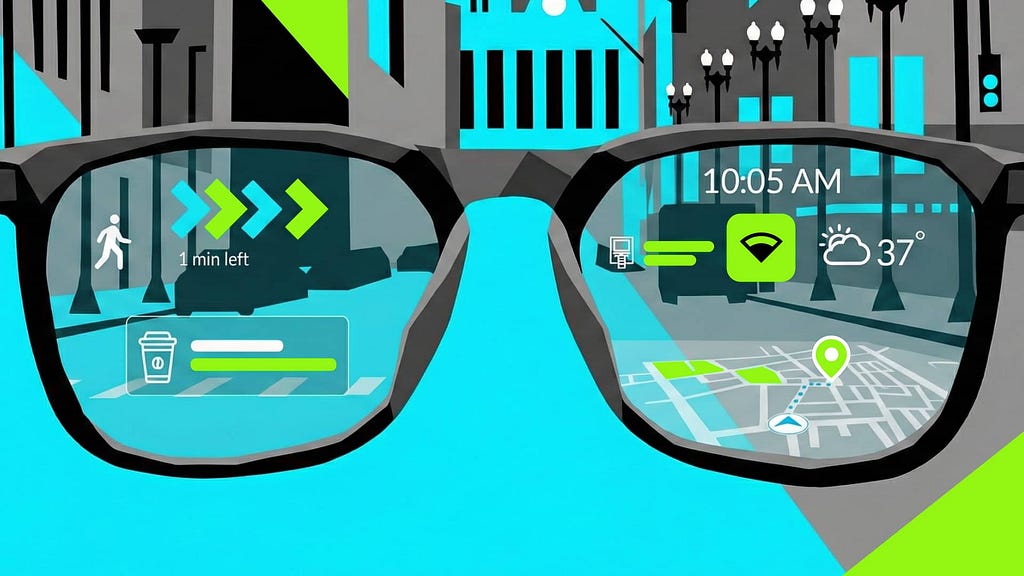
When I talk about AR glasses, I don’t mean bulky headsets. I mean devices that look like regular eyewear capable of whispering information into your ear and displaying 3D content or flat panels overlaid on the real world.
This article is neither a validation of the technology nor a criticism, it is an objective personal look at what I see coming. Here are five reasons why I believe AR glasses will succeed and become mainstream, along with the consequences designers and users must face.
1. Solving the “Kidnapped Body” problem

Mobile devices demand a high physical price. They force us to look down, occupy our hands, and monopolize our attention. I call this the “kidnapped body” problem. We pay this price without thinking, but the implications are profound. It severs us from the physical world, blocking out views, people, and genuine connection.
We have even developed medical terms for this. “Tech Neck” describes the repetitive stress injury caused by constantly looking down at a screen. AR glasses may succeed because they liberate the body. They return our hands to us and, more importantly, they lift our chins. By allowing us to look up and ahead, they reintegrate us into the world. While they will for sure introduce new distractions, the shift from “head-down” to “heads-up” computing is a fundamental ergonomic correction that users will gravitate toward.
2. The new, no-new device

In a gadget-saturated world, introducing a completely new device is risky. However, AR glasses have a secret weapon. They aren’t “new.” They are just glasses.
Global estimates suggest around 4 billion people already wear glasses for various reasons, with over 2.2 billion people having a near or distance vision impairment according to the World Health Organization. The form factor is familiar, socially accepted, and worn daily. The friction to adoption is incredibly low compared to a VR headset. Much like the Apple Watch which sold 12 million units in its breakout year by leveraging the centuries-old habit of wearing wristwatches. As long as they look like iconic eyewear rather than tech hardware, they are primed for mass adoption.
3. The Spatial Canvas (Escaping the Screen)

There is a multi-million-dollar industry currently trapped behind 6-inch glass rectangles. Tech giants from phone manufacturers to app developers are hitting the limits of what can be done on a 2D flat screen.
The physical world is a “green field” for these companies, a massive, unclaimed canvas for digital overlay. Whether we like it or not, the push to colonize our surroundings with digital content is the next logical growth engine for the tech sector.
For product designers, this represents the most significant paradigm shift ever seen. We are moving from designing within a constrained frame to designing without borders. Eventually, we will no longer design apps that “trap” users, we will design apps that enhance the environment. This shift to “Spatial Computing” will unlock entirely new economies and user behaviors that flat screens simply cannot support.
4. Use Cases
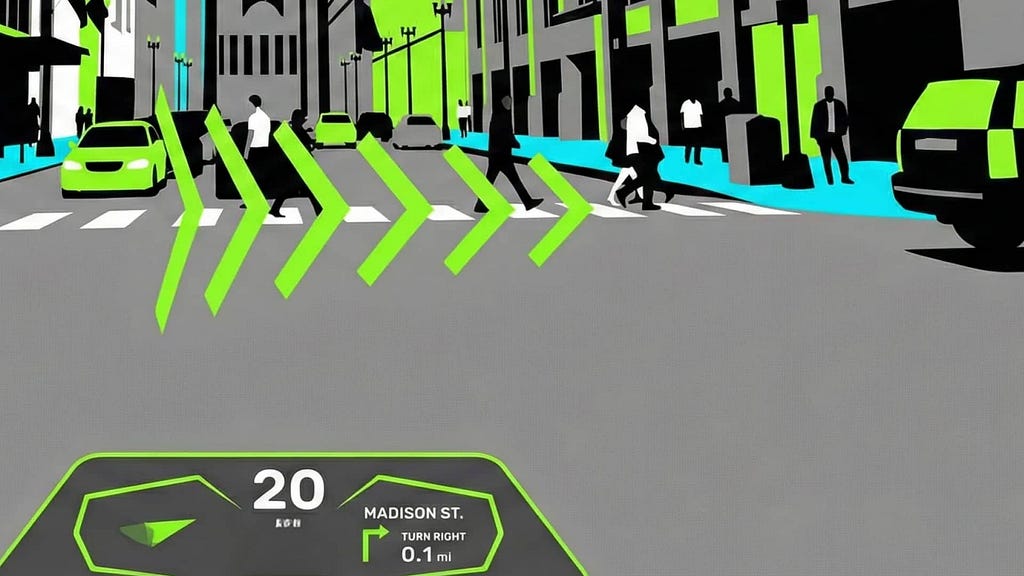
The utility of placing digital objects into the physical world is undeniable. While current iterations act as a Heads-Up Display (HUD) rather than fully immersive AR, they are the necessary bridge to the future.
Apps designed for physical interaction will thrive first:
- Exploration and Learning: This is perhaps the strongest long-term use case. You could stand in front of a historical monument and instantly see contextual history overlaid on the stone. You could look at a complex car engine and see step-by-step repair labels pointing to the exact parts you need to touch. It turns the entire world into an interactive learning manual.
- Navigation: Arrows overlaid on the street as you walk, allowing you to converse with friends without checking a phone map.
- Cooking: Hands-free recipes floating above the counter.
- Safety: The ability to livestream to emergency services instantly during dangerous situations could be a significant deterrent to crime.
- Accessibility: For users with disabilities, these glasses can provide real-time context, enhance visual contrast, or narrate the environment instantly empowering users without requiring active intervention.
As product designers we can already start exploring how to design for AR glasses in Google’s documentation for instance, in this article, David Allan Reese talks about how to design with daylight, UI components sizes, contrast, space awareness and more. You can also take a look at how Google’s AR UI kit, Jetpack Compose Glimmer, looks like. On the other hand, Meta has also released its documentation about developing and designing for Ray-Ban Meta Glasses.
5. The Renaissance of Voice

Historically, conversational interfaces have suffered from poor reputations. They were often frustrating and limited. However, the rise of Large Language Models (LLMs) has fundamentally changed this.
Conversational AI is becoming natural, instant, and context-aware very fast. When you combine competent AI with the “hands-free” nature of glasses, voice becomes a crucial input system. The social awkwardness of talking to a device will likely fade, much like how wearing wireless earbuds 24/7 went from “rude” to “normal.”
The Consequences
If this technology succeeds, we must be prepared for two major friction points, particularly from a design perspective:
1. The Privacy Paradox Privacy concerns run in two directions. First, what are manufacturers capturing about our daily lives? Second, how do we manage peer-to-peer privacy? The “always-on” camera creates uneasiness in social settings. How will society regulate recording in public? Will hacking the “recording LED” become common? These social contracts will need to be rewritten, and many users may reject the tech simply to opt out of this surveillance state.
2. Spatial Invasion and New UX Patterns If the world becomes a digital canvas, who owns the rights to that space? We risk a future of “spatial spam” ads anchored to physical storefronts, landmarks, or even sidewalks. Without strict regulation, the tranquility of the real world could be interrupted by pop-ups and notifications that we cannot swipe away.
For designers, this raises critical ethical questions. What is the “dark pattern” of spatial reality? How do we design an “opt-out” mechanism for the real world? We will likely see the rise of aggressive attention-grabbing patterns that physically block your view until acknowledged. Designers will have the heavy responsibility of defining the etiquette of this new layer. Will we design respectful interfaces that blend in, or intrusive billboards that demand attention? We may not see the regulations put in place until after the intrusion has already begun.
To wrap up
AR glasses introduce a new reality literally, bringing with them as many opportunities as there are threads of concern. For product designers, the challenge is not just to be ahead of the trend, but to deeply understand what this technology adds to or subtracts from human life.
Personally, I am fascinated by a future enhanced by this technology, a life where reality is augmented to help and delight us. However, I remain cautious. We have seen how initial excitement can turn into unforeseen consequences. Social media reminds us of how a tool for connection can evolve into a mental health crisis. By the time we realized the damage, it was already too late for some generations.
I believe in the power of individual common sense, but I also know that mass adoption shifts behavior in unpredictable ways. I hope this article has sparked your interest and encouraged you to investigate further. We are facing a fascinating technological horizon, and it is up to us, designers and users, to ensure it remains a tool for human enhancement rather than distraction.
5 Reasons why AR glasses are inevitable was originally published in UX Collective on Medium, where people are continuing the conversation by highlighting and responding to this story.