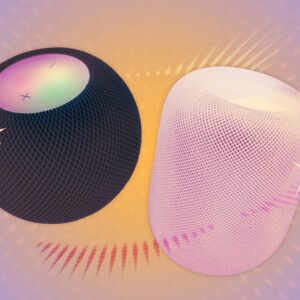
The HomePod is one of the most polarizing Apple devices I’ve ever owned. When it works, it’s awesome, but if anything goes wrong, it can be a bit of a head-scratcher to troubleshoot. That’s led to a bit of a mixed reception among Apple fans, but I’ve been buying HomePods since 2017, and know all the hacks to help make them easier or better to use. Some of these hacks are geared towards trouble-free usage, but others highlight hidden features. Let’s dive right in.
Ensure that the HomePod has a solid wifi connection
In all my experience with HomePods, I’ve observed that the product just works a lot better when it’s in a place with a strong wifi signal. For a few months, I’d kept the HomePod in a bedroom where my wifi was a bit flaky, and the speaker did not perform well at all. Since it uses either the internet or AirPlay to play sound, it needs a strong wifi signal. If your house has a single router, you may have better luck connecting your HomePod to the 2.4GHz band as opposed to the 5GHz option, which has a shorter range.
You can check which network your HomePod is connected to by going to the Home app on your iPhone, selecting your HomePod, and going to Accessory Settings. The smart speaker automatically connects to the same network that your iPhone or iPad is connected to. You can switch the wifi network on your iOS device to change the connected wifi on the HomePod.
The HomePod’s rock solid when paired with an Apple TV
Since we’re talking about increasing the reliability of your HomePod, you’ll find that pairing it with your Apple TV will make it far less flaky. This is not to say that you should go out and buy an Apple TV just to make your HomePod work better, but if you do have the streaming device, you should consider pairing it with your HomePod for the best results.
I’ve used my HomePods with my iPhone, Mac, iPad, and even my Apple Watch, and I can tell you that the experience is just not the same as when using the speaker with an Apple TV. For starters, the Apple TV can use a HomePod as a default output, which means that you don’t have to fiddle with software buttons or use Siri to operate the speaker. You just switch on your Apple TV, play anything you like, and the HomePod will just work. That may sound like a minor benefit, but it’s really not. I don’t have many good things to say about the HomePod’s software and reliability, and it’s only been 100% solid when I’ve used it with an Apple TV.
Stereo sound enhances the HomePod immensely
I don’t usually tell people to spend more money to make the most of a product, but in the case of Apple’s HomePods, two speakers are a lot better than just one. If you have the bigger HomePod, you’ll probably be fine with just one of those, but that’s not true for those of us who have opted for a HomePod mini. Using two HomePod minis in a stereo pair is a much better experience, taking what can be underwhelming audio and letting it play with the big boys. And that goes double if you followed through on that last hack. If you have an Apple TV, you’re going to be really impressed when connecting it to two HomePods in a stereo pair. It makes watching movies so much better.
Route audio from any device to your HomePod

Credit: Apple
HDMI ARC is one of the least-known features of the HomePod, but once you try it, there’s no going back. In a nutshell, it lets you use the HomePod as a speaker for your PS5, Xbox, or any other device connected to your TV. It requires a pretty specific combination of hardware to work, and even after having that in place, you may have to troubleshoot it a bit to get it working correctly. This is because there are at least four different devices made by different manufacturers involved here. Sometimes you might need to manually enable ARC, eARC, or HDMI-CEC in your TV’s settings, which usually does the trick.
This Apple Support page highlights everything you need to make this feature work, which boils down to having an Apple TV 4K (second-gen or newer), a HomePod or a HomePod mini, and a TV that supports HDMI ARC or eARC (usually, TV manufacturers label the HDMI ports to indicate support for these technologies). You’ll have to enable this feature on your Apple TV first, and once you do that, the HomePod should play sound from other devices connected to your TV. Note that you need to add the Apple TV and the HomePod to the same “room” in the Home app on your iPhone to make this feature work.
The good news is that this setup is a one-time headache, and once it’s done, it works without much trouble.
You can chain multiple HomePods together for multi-room audio
If you have more than one HomePod of the same type, you can and should try using them for multi-room audio. Three HomePods (or HomePod Minis) are good enough to cover an apartment of around 1000 sqft, and you can use them to have music playing in every room as you go about your day. If you have a Mac, you could also get the excellent SoundSource app to test how much you like multi-room audio without having to buy multiple HomePods first, too. SoundSource lets you send audio to multiple devices at once, which means that you can play the same audio file on generic Bluetooth speakers, HomePods, AirPods, and any other audio devices connected to your Mac, at the same time.
You can use this to get a feel for how multi-room audio sounds, and if you like the experience, you can use multiple HomePods to have the same experience with minimal latency.
Your HomePod is also an intercom
You can use your HomePod to send voice messages to other people in your house. For instance, you can send the following command to Siri: “Intercom, it’s time for dinner.” This will send your dinner reminder message to all HomePods in the house. Others can use Siri to reply to you as well, making it an effective alternative to sending texts.
You can access the intercom function by opening the Home app on your iPhone, holding down the HomePod icon, and selecting Accessory Settings > Intercom. It also works with Siri on your iPhone, so you can send an intercom message to a HomePod even when it’s not nearby.
The HomePod can be a smart home hub
Apple’s HomeKit smart home platform may not be as popular as its competition, but there are some good HomeKit-compatible smart home accessories out there. If you find the right products, you can use the HomePod to control your entire house. This includes lights, doors, cameras, and many other types of smart home gadgets. Of course, all of these features are heavily dependent on Siri, which means that you’ll occasionally have to repeat your commands or deal with the wrong gadget being switched on or off.
Although Siri can be frustrating to deal with, HomeKit is the best option for people who want a privacy-focused smart home platform. Apple tries its best to minimize data sent to external servers and encrypts security footage, which is different from the approach many competing platforms have chosen.
Find the right place for your HomePod

Credit: Apple
In my experience, it’s worth it to take some time to figure out the best place to put your HomePod, particularly for the best stereo output. Apple recommends placing your HomePod up to 10 inches away from a wall, but in my experience, it works best if it’s about 6-10 inches from walls. For the best stereo experience, you should place your two HomePods on either side of your TV, not more than 4 feet from each other.
If you have expensive wood furniture, be sure to check if it’s safe to place the HomePod on those surfaces. Sometimes, HomePods can leave a mark on wooden surfaces, so you can consider using a cork trivet to protect the surface.
Keep your Siri data away from Apple
If you’ve previously enabled sharing analytics data with Apple, your HomePod could be sending audio of your Siri interactions to Apple’s servers. You should review this and disable the feature if you don’t want to share this data. Open the Home app on your iPhone, hold the HomePod icon, and go to Accessory Settings. Now, go to Analytics & Improvements and disable all options on this page. On the Accessory Settings page, you can also go to Siri History and select Delete Siri History to clear out previously stored data.
Automation routines are incredibly fun to use
The HomePod also supports automation routines, and you can use these to do lots of fun things. For about a year, I’d set up my HomePod to play calming music in the mornings and some jazz at sunset. You can set these up in Apple’s Shortcuts app. Go to the Automation section, tap the + button, and select Create Home Automation. This is where you can set up your favorite automation routines. The HomePod supports executing actions when you reach or leave your home, at a specific time of the day, when accessories are connected, or when a sensor detects something (eg: motion).