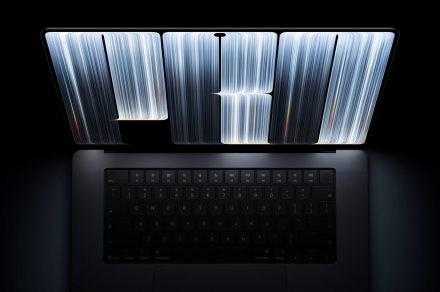
After years of rumors and anticipation, Apple finally unveiled the touchscreen MacBook Pro, or as it likes to call it, the MacBook Pro with PROLED XDR display.
There’s no new chip, so the focus is entirely on the touchscreen. Apple has used tandem OLED technology (first debuted on the iPad Pro), which rates the display at a 2,000-nit peak brightness. It also features ProMotion (adaptive refresh rate up to 120Hz) and covers both P3 and Adobe RGB gamuts. And yes, the screen also features the Dynamic Island we’ve seen on iPhones for years.
A closer look at the new MacBook Pro with a touch OLED screen pic.twitter.com/ZQ5DtfrIPH
— Digital Trends (@DigitalTrends) October 28, 2026
You can get the touchscreen MacBook Pro in two sizes
However, the main highlight is that the screen supports touch input. For the first time ever, Apple has integrated touch capability directly into the display panel. Having used several touchscreen laptops over the years, I know how transformative the experience is, and it’s finally coming to a MacBook.
Apple has also revived the iconic glowing logo on the lid; the touchscreen MacBook Pro gets one. You can buy the laptop in two screen sizes: 14.2-inch (about three pounds) and 16.3-inch (about four pounds).
Under the hood, both models use either the M5 Pro or M5 Max chipset, among Apple’s most capable silicon currently on sale (after the M5 Ultra).
The official name is MacBook Pro with PROLED XDR Display
— Digital Trends (@DigitalTrends)
Quite a mouthful pic.twitter.com/AQNvkb94Ac
The touchscreen upgrade comes at a steep cost
Pre-orders for the new MacBook Pro models start today, October 28, 2026, and general availability begins November 6, 2026.
The baseline touchscreen MacBook Pro (14-inch) starts at $2,899, while the larger 16-inch variant starts at $3,399. These models use the M5 Pro chipset. The M5 Max variants cost more ($4,499 and $4,799, respectively).
| Touchscreen MacBook Pro (14-inch) | Touchscreen MacBook Pro (16-inch) | ||||||||||||
| Display | 14.2-inch (diagonal) tandem OLED PROLED XDR | 3024 × 1986 at 254 ppi | Up to 1000 nits sustained full-screen / 2000 nits peak (HDR & outdoor SDR) | 10,000,000:1 contrast ratio | 1 nit min brightness | P3 + Adobe RGB, 1 billion colors, True Tone | ProMotion 10–120 Hz adaptive | Multi-Touch (sensor built into panel) | Dynamic Island | Antireflective + oleophobic coating; nano-texture option | 16.3-inch (diagonal) tandem OLED PROLED XDR | 3472 × 2266 at 254 ppi | Same brightness, contrast, color, refresh, Touch, Dynamic Island, and glass options |
| Chip Options | M5 Pro: 15-core CPU (5 super + 10 performance) + 16-core GPU | or 18-core CPU (6 super + 12 performance) + 20-core GPU | 307 GB/s memory bandwidth | 16-core Neural Engine + Neural Accelerators + hardware ray tracing
M5 Max: 18-core CPU (6 super + 12 performance) + 32-core or 40-core GPU |
460–614 GB/s memory bandwidth | Same Neural Engine / ray tracing features | Media Engine with hardware H.264/HEVC/ProRes/ProRes RAW + AV1 decode (Max has dual encode engines) | Same chip configurations | |||||
| Unified Memory | M5 Pro (16-core GPU): 24 or 48 GB | M5 Pro (20-core GPU): 24 / 48 / 64 GB | M5 Max (32-core GPU): 36 GB | M5 Max (40-core GPU): 48 / 64 / 128 GB | Same | ||||||||
| Storage | M5 Pro: 1 TB / 2 TB / 4 TB SSD | M5 Max: 2 TB / 4 TB / 8 TB / 16 TB SSD | Same | ||||||||||
| Battery & Power | 72.6 Wh lithium-polymer | M5 Pro: up to 22 hrs video / 14 hrs wireless web | M5 Max: up to 20 hrs video / 13 hrs wireless web | MagSafe 3 + USB-C charging; min 70 W recommended; fast charge with 96 W+ | 100 Wh lithium-polymer | M5 Pro: up to 24 hrs video / 17 hrs wireless web | M5 Max: up to 22 hrs video / 16 hrs wireless web | Min 94 W recommended; fast charge with 140 W+ | |||||
| Size & Weight | Height 0.59 in (1.50 cm) | Width 12.24 in (31.08 cm) | Depth 8.52 in (21.63 cm) | Weight: 3.0 lb (1.38 kg) M5 Pro / 3.1 lb (1.40 kg) M5 Max | Thinner/lighter design (~4 lb / ~1.8 kg overall; ~0.7 lb lighter than prior generation) | ||||||||
| Ports | 3× Thunderbolt 5 (USB-C, up to 120 Gb/s, DisplayPort, charging, Genlock) | HDMI | SDXC card slot | MagSafe 3 | 3.5 mm headphone jack | Same | |||||||
| External Displays | M5 Pro: up to 3 external (e.g., 3× 6K@60 Hz or 8K@60 Hz + secondary) | M5 Max: up to 4 external | Supports built-in display simultaneously; Thunderbolt 5 supports native DisplayPort 2.1 | Same | |||||||||
| Camera | 12MP Center Stage (Desk View support) | 1080p HD recording | Advanced ISP, computational video, video stabilization | Same | |||||||||
| Audio | 6-speaker system (force-cancelling woofers, 50% deeper bass) | Spatial Audio + Dolby Atmos | Studio-quality 3-mic array with beamforming, Voice Isolation / Wide Spectrum modes | High-impedance headphone support | Same | ||||||||
| Wireless | Apple N1 chip: Wi-Fi 7 (802.11be), Bluetooth 6, Thread | Same | |||||||||||
| Keyboard & Trackpad | Backlit Magic Keyboard (78/79 keys + 12 function keys), Touch ID, ambient light sensor | Force Touch trackpad | Same | ||||||||||
| Other Features | macOS 27 (Golden Gate) with Apple Intelligence & Siri AI | Reference modes (including DICOM medical, various HDR/P3/Adobe RGB/cinema/print) | Genlock support | Colors: Space Black, Silver | Same | ||||||||
| Pricing (US, starting) | 14″ M5 Pro: $2,899 | 14″ M5 Max: $4,499 | 16″ M5 Pro: $3,399 | 16″ M5 Max: $4,799 |
RELATED COVERAGE: